
Categories
Fußball Kamera

The 5 Best Cameras for Football Video Analysis in 2026

Contents

The 5 Best Cameras for Football Video Analysis in 2026

Choosing the right camera for football video analysis has become one of the most important strategic decisions for your club in 2026. The market is full of excellent options for match analysis, but the technology has evolved. It's no longer just about who has the highest resolution. It's the choice between a strategic club infrastructure for automated video analysis and a flexible team tool.

This guide compares the top 5 AI cameras for video analysis and helps you make the right choice for your ambitions, your infrastructure, and your philosophy. We'll start with the most comprehensive solution and work our way to the specialized alternatives.

Which system is the right fit for you?

Answer these 3 questions:

  1. Who will primarily be using the camera?
    (A) A single team, including away games? or (B) The entire club for video analysis at your home ground?
  2. What is your primary sporting goal?
    (A) Capturing key moments? or (B) In-depth tactical video analysis of the entire team?
  3. What is your biggest operational challenge?
    (A) A tight budget? or (B) The limited time of your volunteers?

If you mostly answered "A," portable cameras like Veo or XbotGo are likely a great starting point. If you leaned towards "B" on the important questions, read on to see why an infrastructure solution like zone14 is the more strategically sustainable choice for your football videoanalysis.
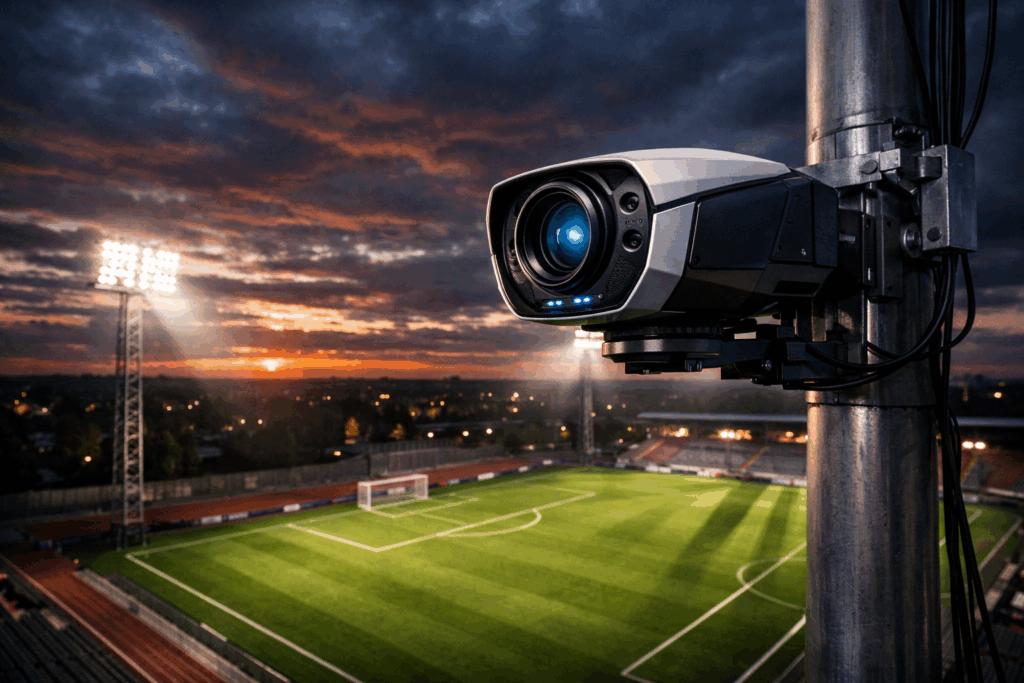
For those who prioritize automation and tactical depth over portability, these permanently installed systems are the top choice on the market.

1. zone14

The Foundation for the Entire Club

zone14 occupies a clear niche: the transformation of amateur clubs through professional, fixed infrastructure. The philosophy is based on solving the two biggest problems in grassroots football: the lack of time for volunteers and the lack of objective data for coaches.

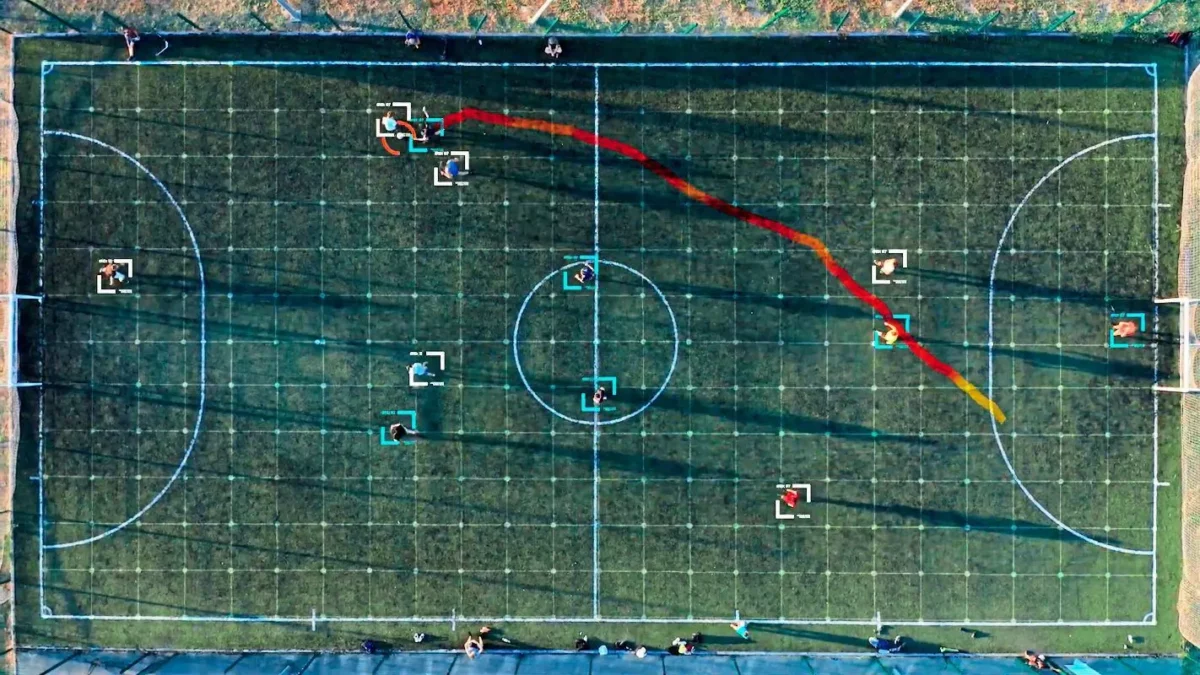
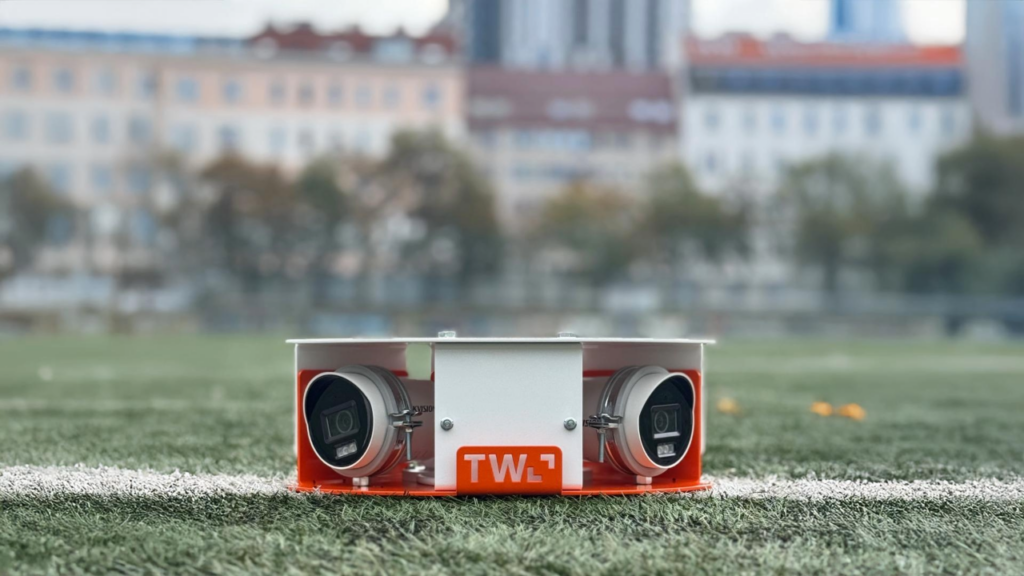
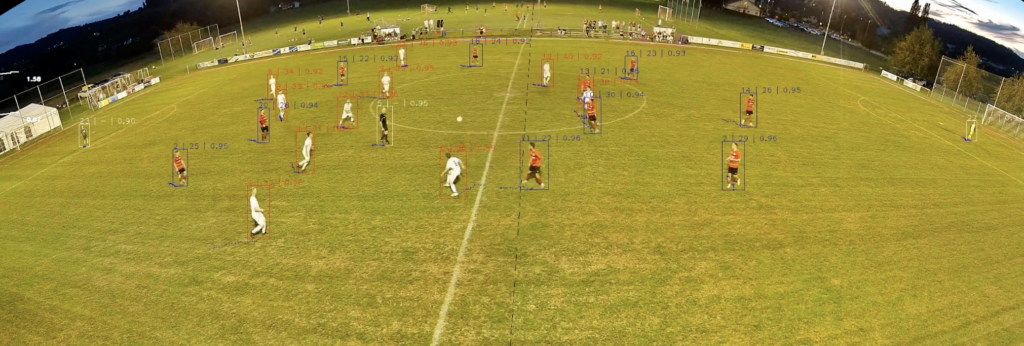
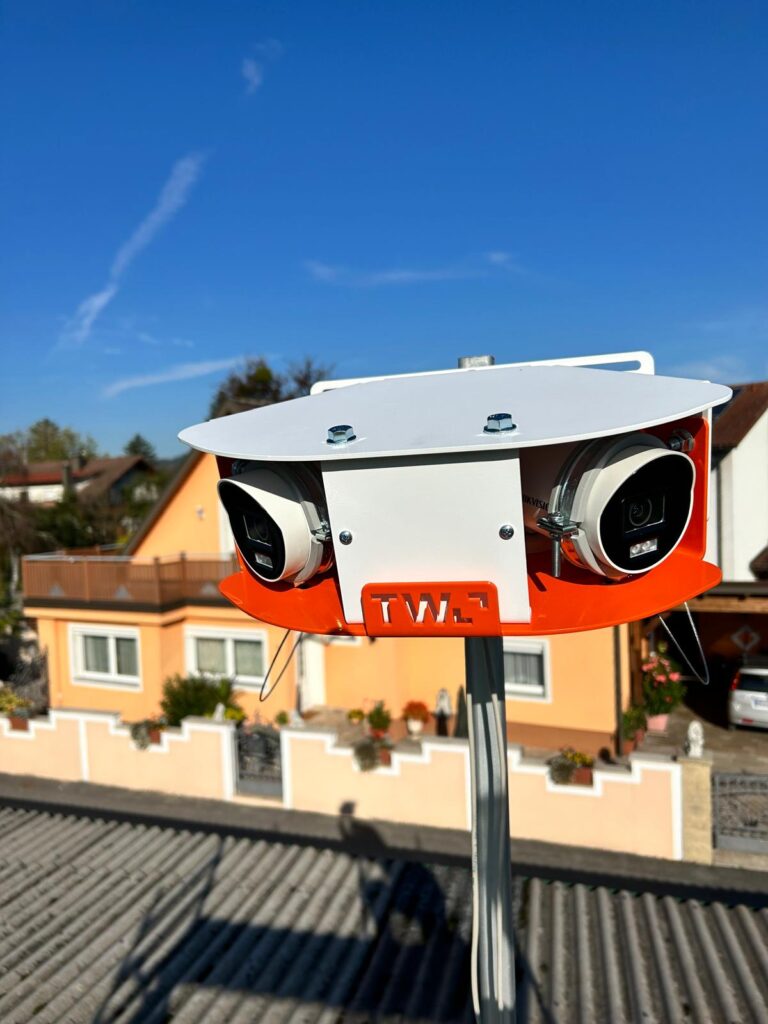
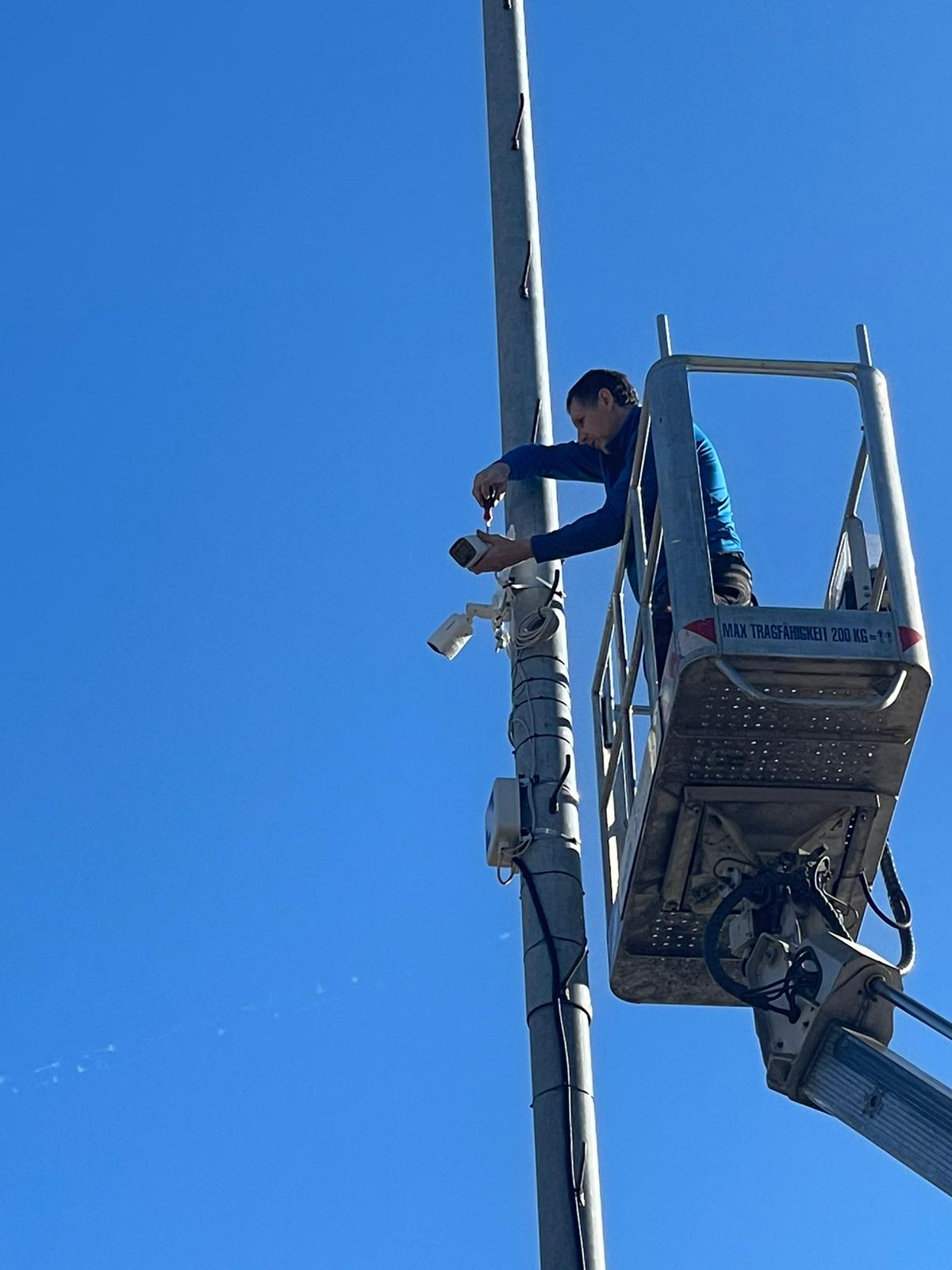
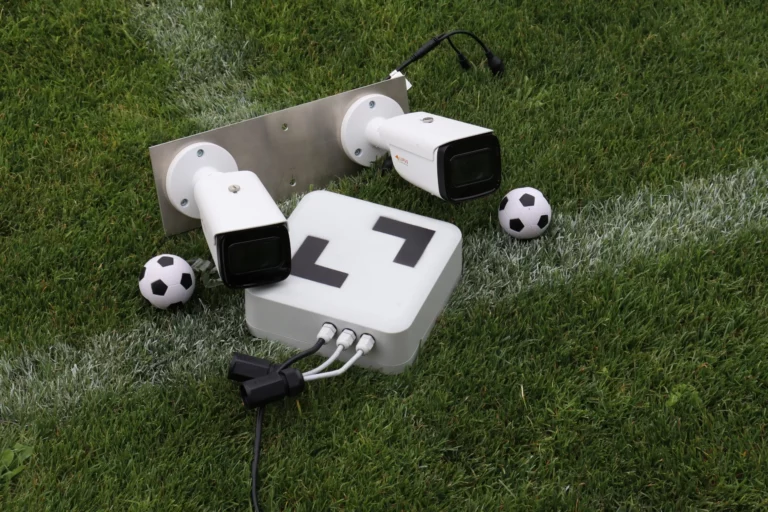
  • Camera: zone14 is less a single camera product and more a customized camera system. Typically, a weatherproof outdoor unit with multiple 4K lenses is installed high above the pitch (e.g., on a floodlight mast). These lenses create a seamless 180-degree panoramic view of the entire field. The defining feature is the "Set-and-Forget" nature of the hardware, which operates fully automatically after a one-time setup and is deeply integrated into the software ecosystem (REPLAY, STATS).

  • System Type: Fixed installation for automated Video Analysis.
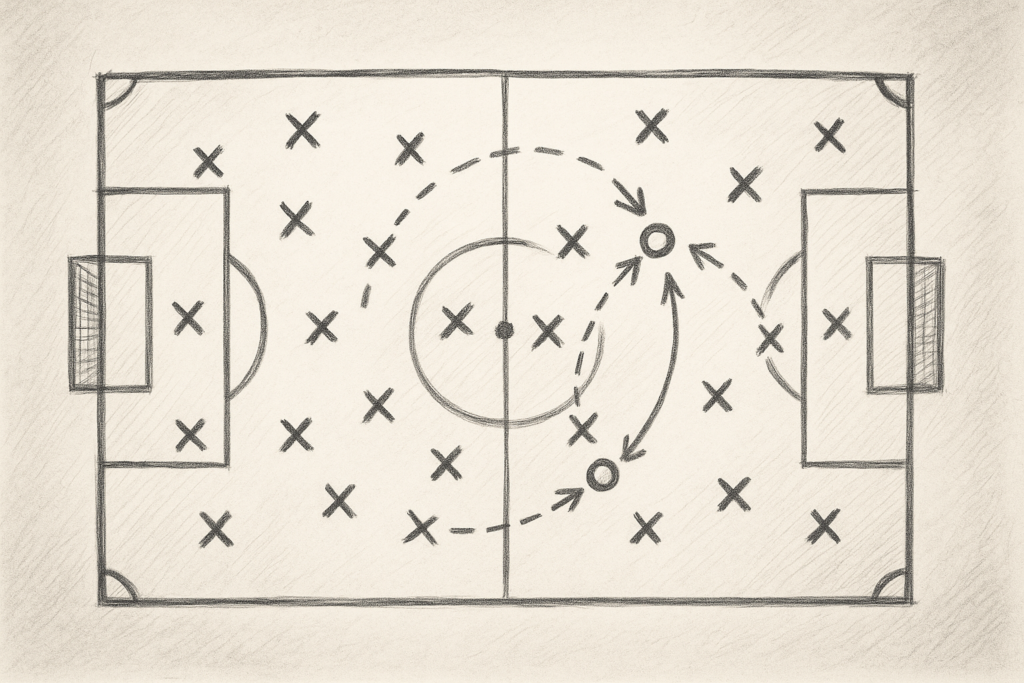
  • Analysis Perspective: High, tactical bird's-eye view (the gold standard). This perspective is the only way to see all 22 players simultaneously and objectively assess the distances between the lines, pressing behavior, and spatial organization.
  • Main Advantages:
    • Complete Automation & Relief for Volunteers: The system is installed once and then runs by itself. It's a liberation for volunteers by reducing the personnel effort on match day to zero and raising reliability to 100%.
    • Superior Tactical Perspective: The high camera position enables professional-level analysis that is impossible with ground-based systems. Coaches can finally make well-founded tactical decisions based on facts.
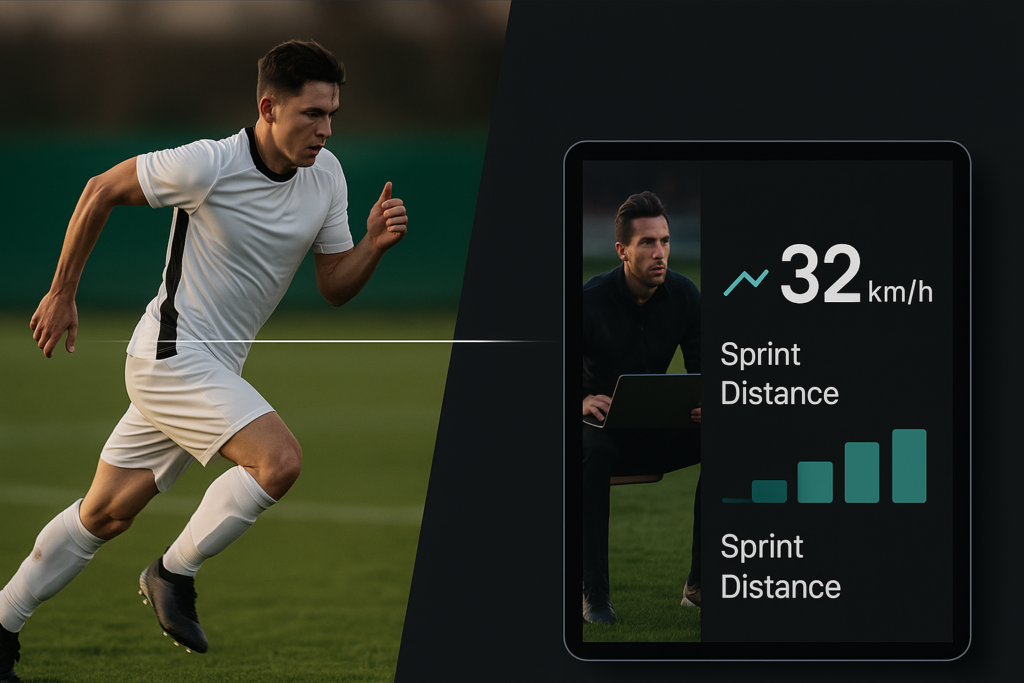
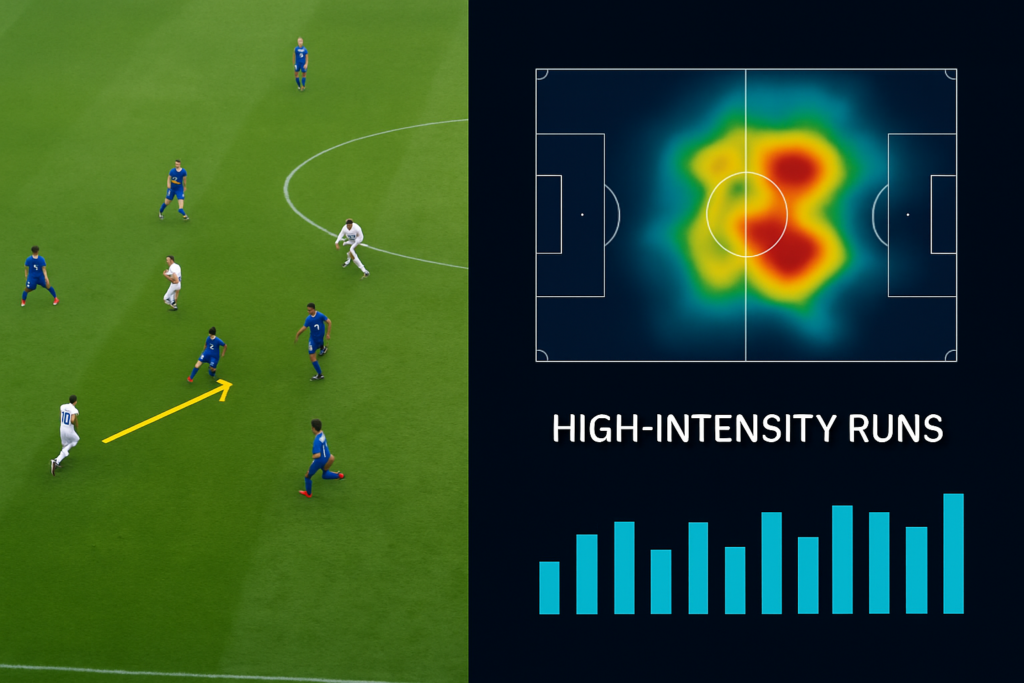
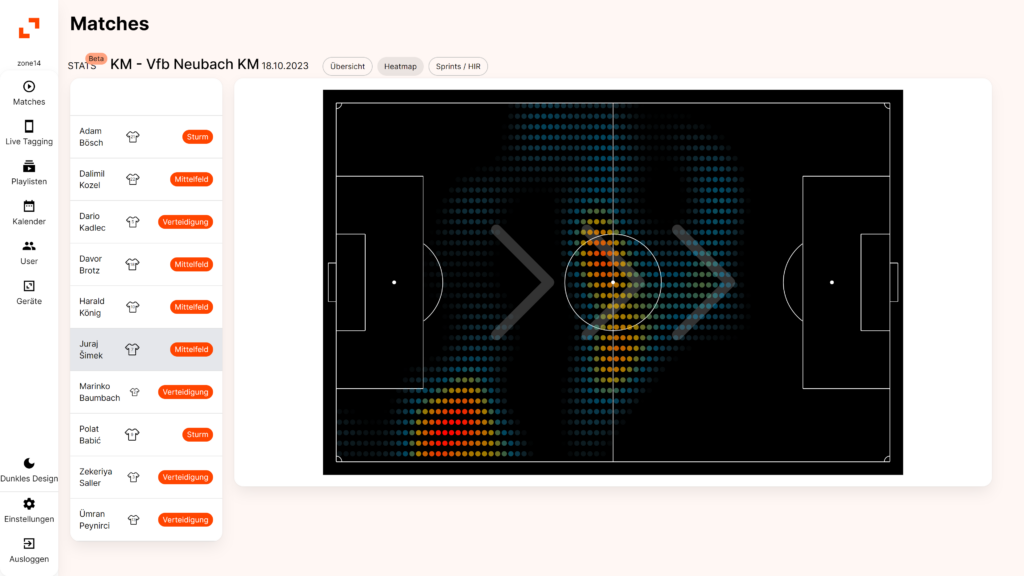
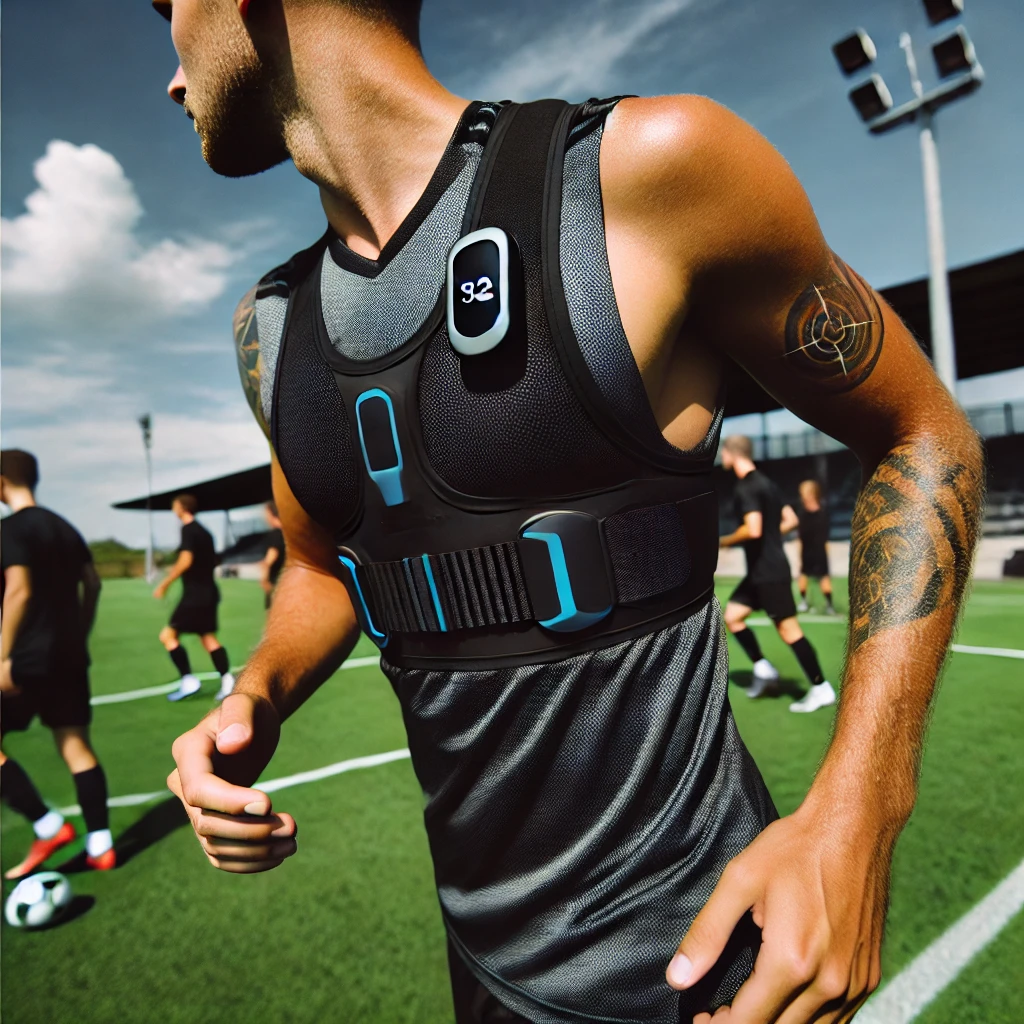
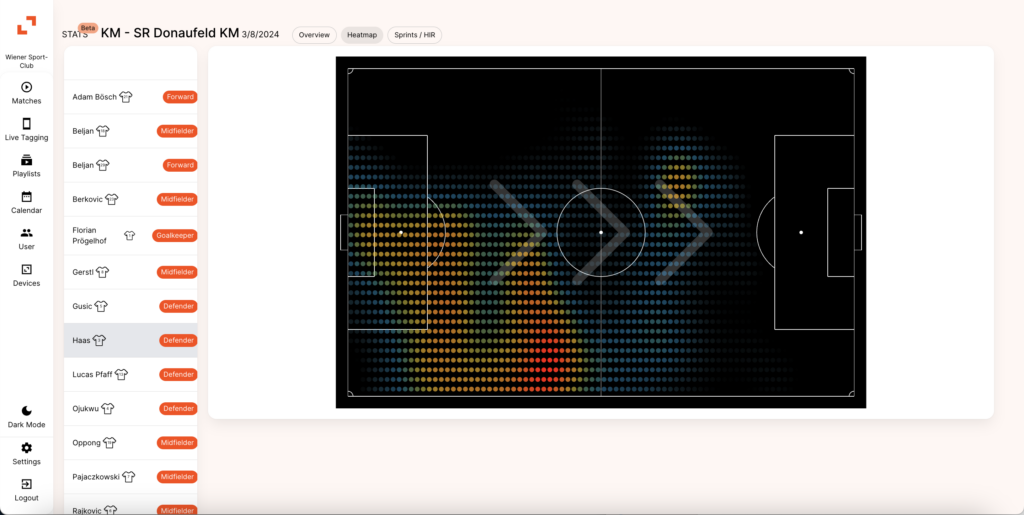
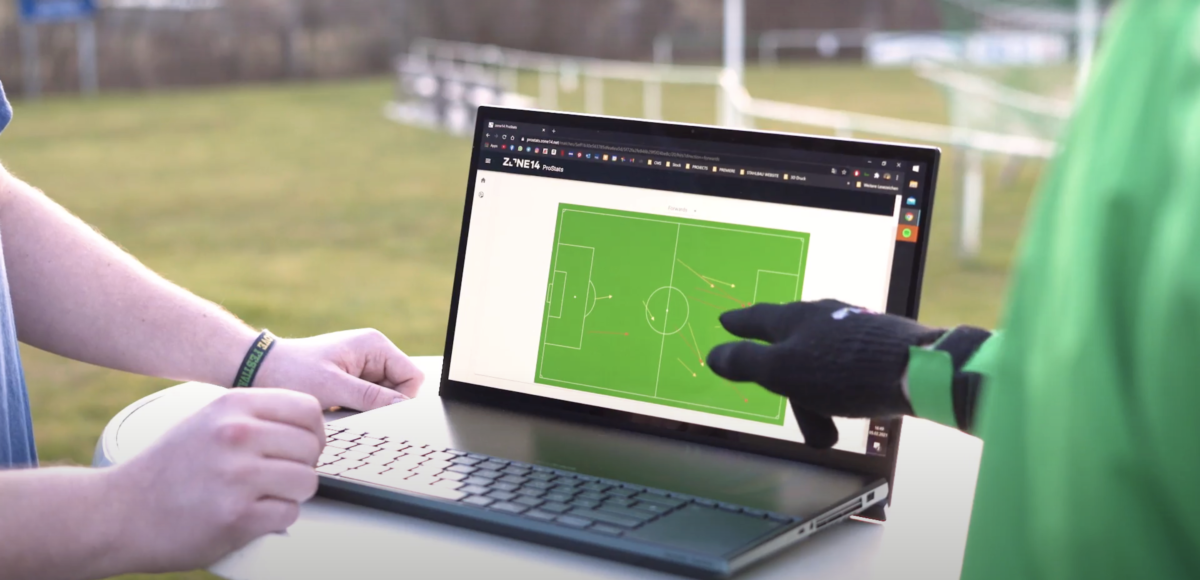
    • Objective Performance Data without the Hassle (STATS): In addition to tactical analysis, the system delivers valuable physical performance data like distance covered, sprints, and heatmaps with STATS – fully automated from the video feed. This eliminates the high costs and enormous logistical effort of GPS vests (charging, distributing, washing, assigning data) and makes objective performance data accessible to every team in the club for the first time.
    • An Integrated Ecosystem for All: The platform (REPLAY, STATS, Livestreaming) is designed to develop the entire club – from youth to senior teams – athletically while simultaneously generating new revenue through professional sponsoring in the stream.
  • The Reality at the Club: The solution is a deliberate, strategic investment in the home ground's infrastructure – comparable to purchasing a new floodlight system. It is the foundation for the club's digital future and professionalization on-site.
  • Conclusion: zone14 is the strategic choice for ambitious clubs with their own facility that want to take the next step towards professionalization. It is the solution for boards that want to develop the club sustainably and for coaches who want to get the most out of their tactical and physical analysis.

2. Hudl Focus

The Choice for Data-Driven Performance Centers

Hudl is a giant in the sports analysis space with deep roots in US college and high school sports. Their philosophy is data-centric: the camera is primarily a data capture device for a vast ecosystem focused on performance diagnostics, player development, and scouting.

  • Camera: The hardware falls under the Hudl Focus camera family, which includes models like the Focus Outdoor . The technical features are geared towards reliability and capturing footage from multiple angles, often connecting several cameras into one system. However, the crucial feature is less the camera's resolution and more the deep hardware-software integration with the extremely powerful Hudl analysis platform.
  • System Type: Mostly fixed installation (Indoor & Outdoor)
  • Analysis Perspective: High, often sideline perspective, optimized for the analysis of individual players.
  • Main Advantages:
    • Deep Ecosystem: Seamless integration into the extensive Hudl software suite, which offers extremely detailed statistics, telestration tools, and professional tools for creating highlight tapes for recruiting.
    • Focus on Performance Data - The system is designed to generate a wealth of individual performance data and track players throughout their careers.
  • The Reality at the Club: The immense range of features can quickly become overwhelming and unnecessarily complex for the average European amateur club. The focus is heavily on individual player performance and recruiting, which is less relevant for a U15 district league team than a simple, understandable analysis of team movement. Operating it often requires more intensive training.
  • Conclusion: Hudl Focus is the top choice for professional academies, performance centers, and clubs that are already deeply integrated into the Hudl ecosystem and prioritize detailed, data-driven individual player analysis and scouting.
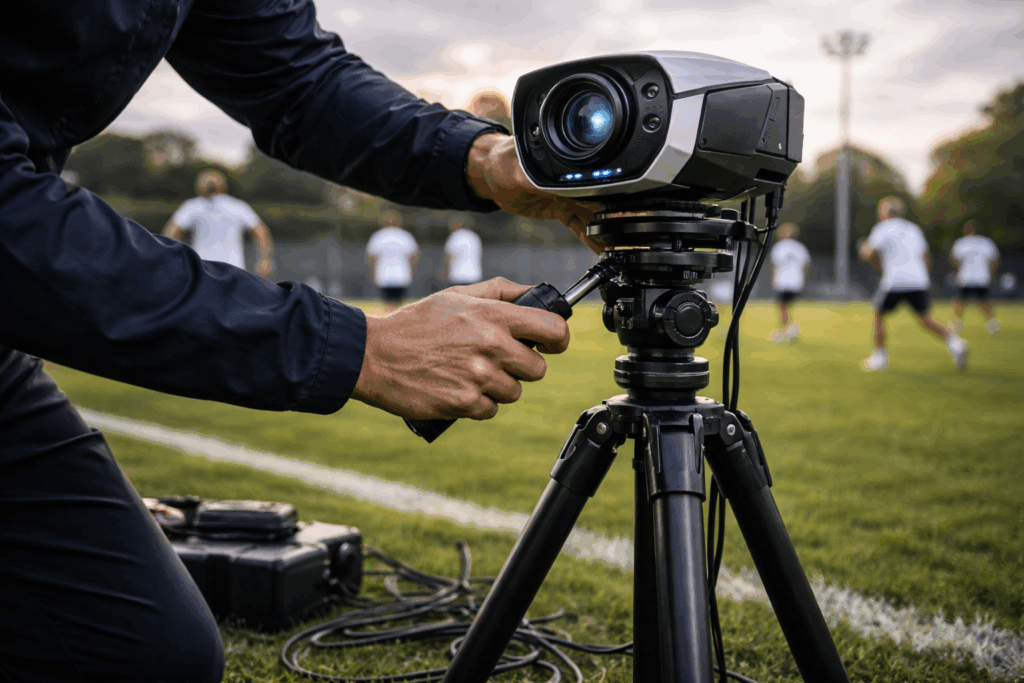
For clubs where maximum mobility is the priority, the following cameras are the best alternatives on the market.

3. Veo Cam 3

The Market Leader in Portability

Veo is undoubtedly one of the pioneers and most recognized names in mobile sports cameras. Their philosophy is to provide individual teams with a flexible tool they can take anywhere. With the Cam 3, they have further refined their technology, offering a robust and user-friendly system.

  • Camera: The centerpiece is the Veo Cam 3. It's equipped with two 4K lensesthat together capture a 180-degree field of view. Key features include an improved design for better wind stability, built-in 4G/5G connectivity for direct live streaming, and a portable housing designed for quick setup and takedown on a tripod.

  • System Type: Portable camera on a tripod
  • Analysis Perspective: Ground-level perspective (approx. 4-7 meters high). This view is well-suited for tracking individual player runs and duels, but it makes it difficult to objectively assess the tactical distances between team sections (e.g., defense and midfield).
  • Main Advantages:
    • Maximum Mobility: The camera can easily be transported to every home and away game.
    • Mature Platform: Veo offers an established and feature-rich analysis software with tools for tagging, drawing, and sharing scenes.
    • Strong Brand: A large community and numerous online resources make it easy to get started. Newer models also offer improved connectivity for live streaming.
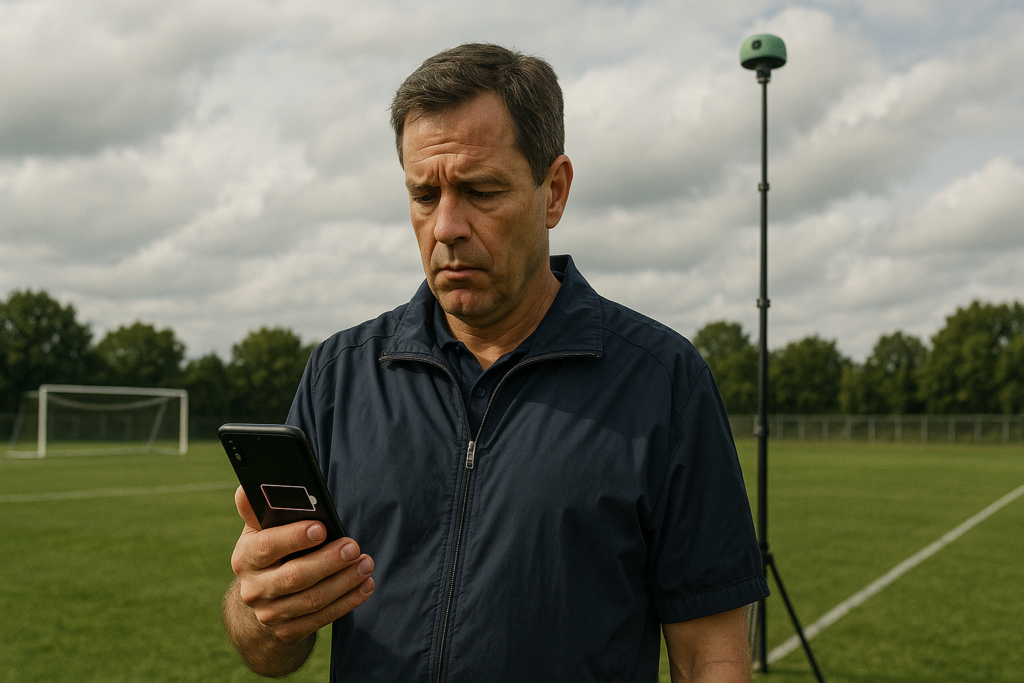
  • The Reality at the Club: Its greatest strength – flexibility – is inextricably linked to its biggest operational challenge: dependency on personnel. Imagine this: it's Saturday, 10 minutes before kickoff, it's drizzling, and an assistant coach realizes the camera's battery is at only 30% because it wasn't charged after the last away game. Every match requires a responsible person to remember to transport it, charge the battery, set it up, and start the recording. This responsibility often falls on the coach, who should actually be focusing on the team.
  • Conclusion: The Veo Cam 3 is an excellent tool for individual, self-sufficient teams or clubs without a permanent home ground who are looking for a proven, highly flexible solution and are willing to accept the recurring manual effort on match day.

4. XbotGo X1

The Innovative Challenger

XbotGo has shaken up the market as an agile tech company with a strong focus on AI algorithms and an attractive price model. Their positioning clearly aims to be a smart and accessible alternative to established providers.

  • Camera: The main product is the XbotGo X1. Unlike some competitors, it uses a single 4K camera with an advanced gimbal system. The most important feature here is the advanced AI tracking software, which can follow not just the ball but also the movements of specific players. The housing is especially lightweight and designed for maximum mobility.

  • System Type: Portable camera on a tripod
  • Analysis Perspective: Ground-level perspective (approx. 4-7 meters high), with similar tactical limitations as other mobile systems.
  • Main Advantages:
    • Attractive Price: Often more affordable to purchase than its direct competitors.
    • Smart AI: The AI is trained not only to follow the ball but also to proactively anticipate player actions, resulting in dynamic, broadcast-style footage.
    • Simple Operation: Control and streaming via the smartphone app are very intuitive.
  • The Reality at the Club: The setup is quick, but it still has to be done. This means the coach's or a volunteer's pre-game focus shifts from the team talk to the technical setup. As with all portable systems, the reliance on a tripod, battery, and a responsible person remains a potential point of failure during the often hectic reality of a match day.
  • Conclusion: The XbotGo X1 is ideal for price-conscious clubs and individual teams looking to enter the world of AI recording and needing a maximally flexible solution for constantly changing venues.

5. Pixellot Air / Show – The Automation Solution for Leagues & Federations

Pixellot has specialized in automating the video production process at a massive scale. Their philosophy is aimed less at the individual coach and more at leagues, federations, and large clubs that need a reliable solution for capturing and broadcasting a huge volume of games.

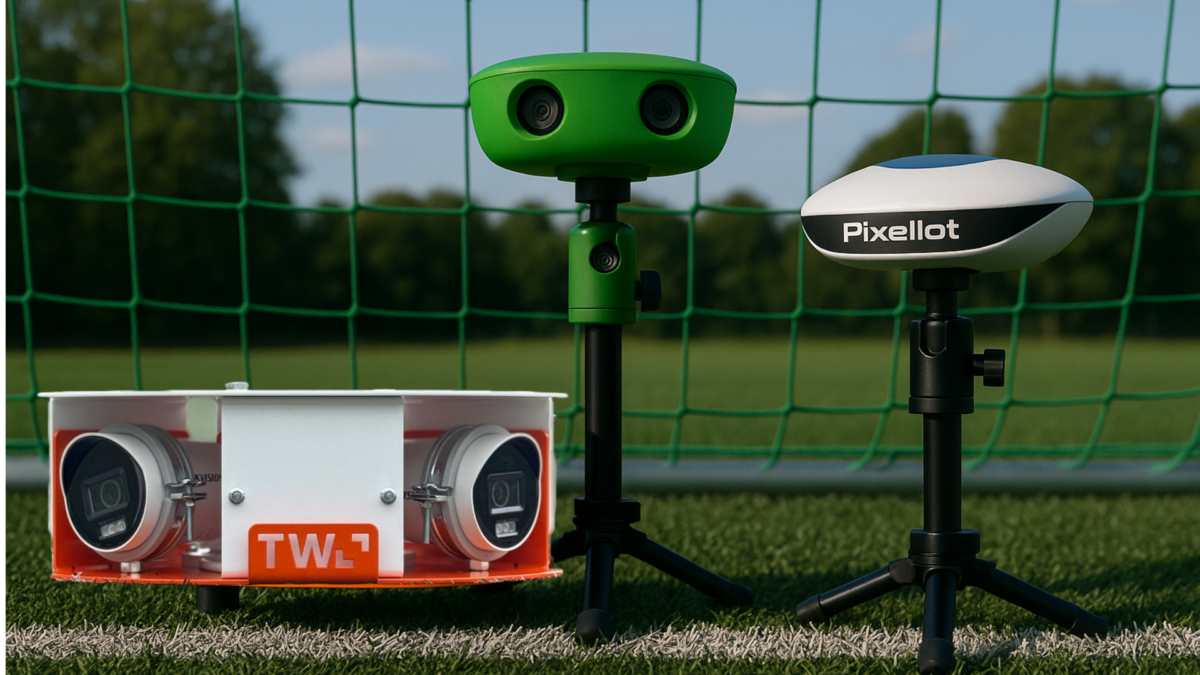
  • Camera: Pixellot offers various models, including the fixed installation Pixellot Show and the mobile Pixellot Air. Their unique technological feature is a multi-camera array, consisting of several lenses whose images are stitched together by software to create a single, ultra-wide panoramic view. This enables automated, TV-like video production that follows the action.

  • System Type: Fixed installation or mobile (Air)
  • Analysis Perspective: High, wide "broadcast" perspective, optimized for televising the game for a spectator.
  • Main Advantages:
    • Scalability: A leader in fully automated production. Once set up, entire match days across multiple fields can be covered without any personnel.
    • Partnerships: Often integrated directly into the platforms of federations, which simplifies content distribution.
  • The Reality at the Club: Pixellot thinks from the perspective of a broadcaster, not a coach. While the recording automation is top-notch, the analysis software is often less intuitive and not as deeply tailored to the individual coach's needs as more specialized providers. You often get "just" the raw footage; the detailed work of creating coaching scenes remains with the coach.
  • Conclusion: Pixellot is the dominant solution for federations, leagues, and large clubs whose primary goal is the automated broadcast and recording of a maximum number of games, rather than deep and efficient coaching analysis.

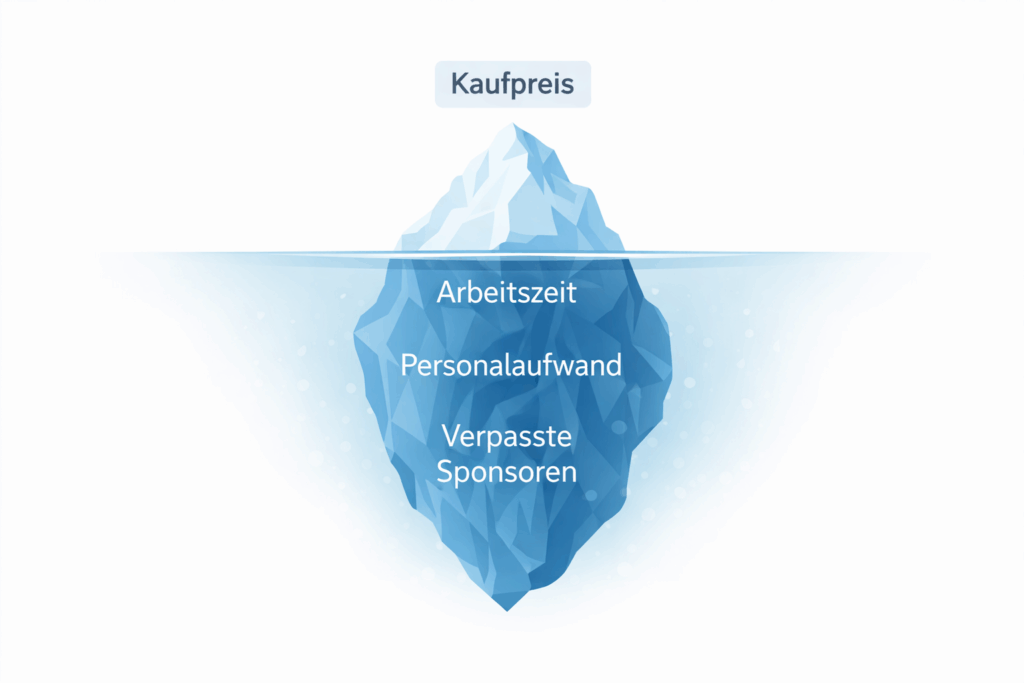
More Than Just the Purchase Price: Hidden Costs and the True ROI

A camera is an investment. But the true costs often only reveal themselves during operation.

  • With portable systems: Consider the "invisible" costs – the man-hours for setup and takedown, charged batteries, potential defects of tripods, or the need for expensive 5G data plans for stable streaming.
  • With infrastructure systems: The greatest ROI lies in time savings. Do the math: if you eliminate just 1 hour of effort per game over 20 home match days in a season, you save 20 hours of valuable volunteer time. Added to this is the predictable revenue from professional sponsoring in the livestream, which is only made possible by a reliable, automated solution.
Comprehensive Conclusion: Your Strategic Decision for 2026

Choosing the right camera system is a decision that sets a direction. The core question is: Are we investing in a mobile tool for individual games, or in a strategic asset that enhances the club as a whole?

Portable systems are the sprinters on the market – fast, agile, and perfect for the moment. Infrastructure systems are the marathon runners – reliable, durable, and designed to elevate the entire club to a new level for years to come.

Your decision should be based on three key questions:

  1. Effort vs. Relief: Are you looking for a solution that requires manual work before every game, or one that automatically provides relief for the entire club?
  2. Perspective & Ambition: Is a good view of individual actions enough, or do you need a professional, tactical perspective to analyze complex team movements?
  3. Vision & Sustainability: Do you want a recording solution, or a platform for athletic development AND new revenue streams?

The best camera is the one that best supports your vision for your club. If your vision is a professional, hassle-free, and future-proof infrastructure for your sporting home, then the choice is clear.


Share on Facebook
Share on Twitter
Share on Linkedin
More related content from zone14
Categories
Video Analysis

The Analyst's Dilemma: Hudl Sportscode vs. ONCE vs. zone14 – Which Software is Right for You?

Contents

The Analyst's Dilemma: Hudl Sportscode vs. ONCE vs. zone14 – Which Software is Right for You?

An honest look at the tools of the pros and why the best solution for your club might be one you haven't considered yet.

It's Monday morning. On your laptop, you have 90 minutes of video footage from the weekend. Somewhere in this digital maze of passes, tackles, and runs lie the answers to the questions that have been haunting you since the final whistle: Why didn't our press work? Where exactly was the gap before we conceded the goal? And how can we replicate that one brilliant play?

The search for the right video analysis software to find these answers often feels just like that: an impenetrable jungle. The choice of platform is one of the most important strategic decisions for the professionalization of any club. In this comprehensive comparison, we take an honest look at three of the most prominent names on the market: Hudl Sportscode, the undisputed industry standard; ONCE, the modern challenger for live analysts; and zone14, the architect of a holistic club ecosystem.

The Two Worlds of Football Data The "What" and the "How Much"

Before we compare the tools, we need to understand the two fundamental types of data in football, which often exist in separate worlds:

  1. Tactical Event Data (The "What?"): This data describes what happened in the game. A pass from A to B, a shot on goal, a tackle. It is the heart of tactical analysis and is traditionally captured manually by an analyst.
  2. Physical Performance Data (The "How Much?"): This data describes how much a player has physically invested. Running distance, number of sprints, top speed. It is the core of athletic analysis and is traditionally collected via expensive GPS vests.

The crucial question is: How well does a software solution represent these worlds and – more importantly – connect them?

The Providers: A Character Check – Three Philosophies, Three Worlds

Hudl Sportscode: The Architect
  • The Philosophy: Hudl Sportscode is the "Photoshop" of video analysis – infinitely powerful, endlessly customizable, and the standard in almost every professional club in the world. It is a software designed for the full-time professional analyst who is willing to endure a steep learning curve to create their own perfect, customized analysis universe.
  • A Day in the Life with Sportscode: The analyst spends hours programming complex tagging windows (Code Windows) with hundreds of buttons. In the meticulous post-match analysis, they click through the game, tagging every conceivable tactical event. The result is a massive amount of data and statistical dashboards. The strength lies in the incredible depth of data capture. The weakness? It's a pure tool for capturing event data and solves neither the problem of video recording nor that of physical performance data.
ONCE: The Live Reporter
  • The Philosophy: ONCE recognized the complexity of Sportscode and specialized in one thing: efficiency and live analysis. It is the tool for the modern, agile analyst who doesn't want to waste time.
  • A Day in the Life with ONCE: The analyst sits in the stands with their laptop during the game. They use ONCE's intuitive interface to tag the most important scenes live as they happen. A goal? One click. A key tactical change? One click. At halftime, they can already show the coach a finished playlist with the decisive moments on a tablet. The post-match work the next day is done in a fraction of the time.
  • The Limitations: ONCE is an excellent tool that solves one problem: the speed of event capture. However, it remains a highly specialized tool for the analyst. The question of video recording remains unanswered, and the world of physical performance data remains locked away, unless you invest in a separate GPS system.
zone14: The Integrated Brain of the Club
  • The Philosophy: zone14 asks a different question: Why should you have to choose between different tools, systems, and data worlds? Here, the software is not the sole product but the heart of a holistic ecosystem for the entire club. The target audience is the modern club looking for a simple yet powerful all-in-one solution.
  • A Day in the Life with zone14: The crucial difference begins even before the analysis: The zone14 TWO AI camera has automatically recorded the game. The coach opens the REPLAY App on their phone on the way home, reviewing the key moments suggested by the AI. The next day, with two clicks, they filter all scenes related to "turnovers in build-up." They notice that one player seemed unfocused after the 70th minute. A click on zone14 STATS reveals the truth: the number of his high-intensity runs dropped by 50% in the final phase. The coach now has the complete picture: the tactical decision (the "What?") AND the physical condition (the "How Much?") in a single, inseparable context.
  • Already have your own video footage, or want to test the waters with a software-only solution? zone14 COACH is your perfect entry point. It unleashes the full power of our REPLAY analysis platform as a standalone tool. Upload footage from any source—be it a tripod, phone, or drone—and you'll immediately access the same intuitive analysis tools trusted by users of our integrated system. It's the ideal way to elevate your analysis with the quality of zone14's software, before taking the next step to automate your entire workflow with our camera.
  • The Strength: zone14 is the only solution in this comparison that fuses the two data worlds without additional hardware like GPS vests.

The Comparison in Detail: Workflow, Data Philosophy, and Ecosystem

When it comes to the workflow, Hudl Sportscode's manual, extremely detailed post-match process stands in contrast to ONCE's fast, live-tagging-optimized workflow. zone14 goes a step further by automating the very first, often most tedious step – the recording.

In terms of data philosophy, the difference is greatest. Sportscode and ONCE are masters of tactical event capture: they measure what the analyst manually inputs. zone14 follows a hybrid approach: it not only captures tactical events but also enriches them with automatically extracted physical performance data (STATS) . This creates a complete, contextualized picture of player performance.

The decisive difference, however, lies in the ecosystem. ONCE is primarily an excellent software solution. Hudl offers a broad product range. zone14 is the only system in this comparison designed from the ground up as a fully integrated ecosystem: the automatic camera, the analysis platform, the mobile apps, the performance data (STATS), and the livestreaming work together seamlessly. It is a strategic platform for the development of the entire club, not just a tool for a single analyst.

Conclusion: Which Software DNA Fits Your Club? A Quick Self-Test

  • Are you a full-time professional analyst who loves to configure every detail yourself and dive into the deepest statistical evaluations? Then Hudl Sportscode is your powerful but demanding tool.
  • Are you an analyst or assistant coach whose main focus is on live analysis on matchday and maximum efficiency in tactical evaluation? Then ONCE is the perfect, modern solution for you.
  • Are you a head coach, sporting director, or club official looking for a holistic, easy-to-use, and integrated solution that eliminates the effort of recording and provides the complete picture of tactics AND performance data? Then the ecosystem approach of zone14 is second to none.

If your goal is a hassle-free, reliable, and qualitatively superior video analysis that provides a complete picture of your team and serves as the foundation for sporting success and new revenue streams, there is hardly any way around an integrated, intelligent solution like that from zone14.

Share on Facebook
Share on Twitter
Share on Linkedin
More related content from zone14
Categories
Fußball Kamera

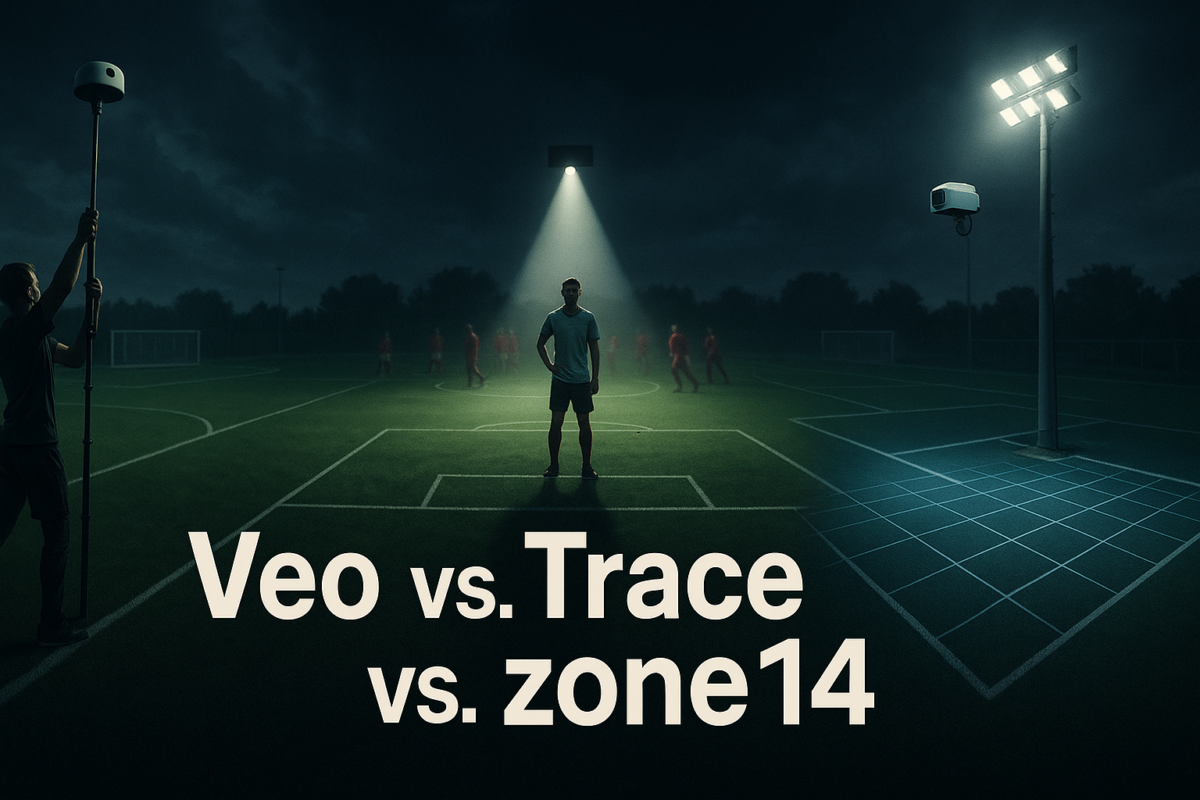
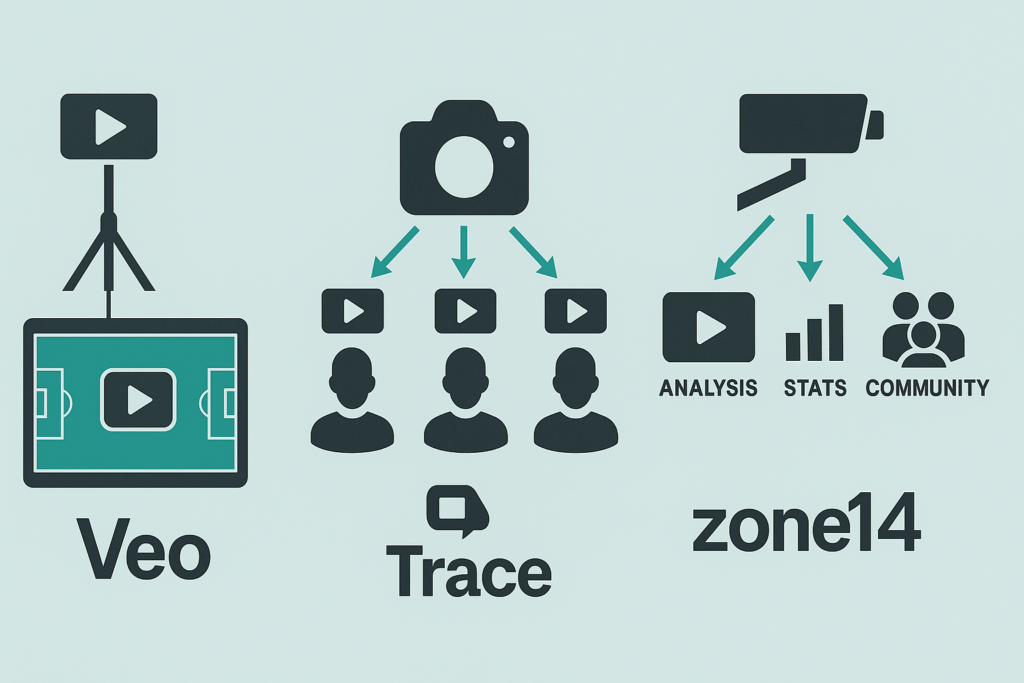
Video Analysis in Football: A Comparison of Camera Systems from Veo, Trace, and zone14

Contents

Video Analysis in Football: A Comparison of Camera Systems from Veo, Trace, and zone14

Which Philosophy Fits Your Club? A Decision-Making Guide Between Mobile Flexibility, Individual Highlight Focus, and Integrated Club Intelligence.

Video analysis has definitively conquered amateur and youth football. The question is no longer if, but how to use it. For clubs wanting to take the next step in their development, choosing the right automatic AI camera system is one of the most important strategic decisions of recent years. The market is full of promises, but the philosophies behind the providers could not be more different.

In this comprehensive comparison, we shed light on three of the most prominent names: Veo, the pioneer of mobile sports cameras; Trace, the specialist in player-centric highlights; and zone14, the architect of a holistic club ecosystem. We dive deep into the DNA of each system to help you find the solution that truly fits the goals, resources, and culture of your club.

The Crucial Questions Every Club Must Ask Itself

Before we compare the providers, we should sharpen the criteria that really matter in the often-hectic daily life of a club:

  1. The Human Factor & Effort: How much does the system tie up the scarce time resources of our volunteers on matchday?
  2. The Analytical Perspective: Does the camera provide a high-quality, tactical analysis of the entire game or just individual actions?
  3. The Data Capture Philosophy: Is the team, the individual player, or the entire game the focus of the technology?
  4. The Digital Ecosystem: Are we just getting a camera, or an integrated platform for analysis, communication, and even club development?

The Providers in Detail: Three Philosophies, Three Solutions

Veo: The Freedom of Mobility

Veo has established itself as a major player in the field of mobile sports recording. Their solution is well-known and used by many clubs.

  • Core Philosophy: Veo's DNA is flexibility. The system, consisting of a camera and a high telescopic mast tripod, is designed to be taken everywhere – to home games, away games, and training camps.
  • Practical Implementation & Consequences: The strength of mobility is simultaneously its greatest operational challenge. Every single matchday requires a dedicated volunteer who is responsible for transport, the time-consuming setup and teardown (often 15-20 minutes), and operation. The dependence on this one person is a constant risk in the analysis process. The good tactical perspective gained from the high mast is a clear advantage over ground-level recordings but can be compromised by wind and an uneven setup. Veo's analysis platform offers solid tools for coaches to edit the recorded game.
  • Ideal for: Clubs for whom recording away games is the highest priority and who have reliable personnel resources to handle the recurring effort on every matchday.
Trace: The Specialist for Individual Player Highlights

Trace pursues a different, very player-centric approach that is particularly popular in US youth and college sports. Here, the focus is not on the coach's tactical analysis, but on the experience and development of the individual player.

  • Core Philosophy: The focus of Trace is to automatically provide each player with their personal moments from a game. The system uses, similar to Veo, a mobile AI camera on a tripod that follows the action. The crucial difference lies in the software: after the game, an intelligent AI identifies the actions of each individual player on the field and automatically edits personal highlight clips for each player.
  • Practical Implementation & Consequences: The unbeatable strength of Trace is its automated and personalized content creation. After the game, every player receives their individual scenes (goals, ball touches, important actions) directly on their smartphone – without any further action from the coach. For young players who want to share their best moments on social media or compile them for applications to scouts and colleges, this system is a dream. It promotes self-motivation and makes one's own performance immediately visible.
    The downside of this strong player-centricity is that the overall tactical analysis for the coach often plays a secondary role. The camera perspective and the software are primarily optimized to capture individual actions well, which does not always provide the best total overview for assessing team tactical behavior. So, if the club's primary goal is an in-depth, coach-led analysis of the entire team, other systems might be more suitable. As with any mobile tripod solution, the recurring effort for setup and teardown on matchday remains.
  • Ideal for: Clubs and academies (especially in the youth sector) whose absolute focus is on the automatic creation of individual player clips for social media, scouting, or personal development.
zone14: The Integrated Brain of the Club

zone14 was developed with a clear focus on the reality and strategic needs of European club football at all levels.

  • Core Philosophy: zone14 focuses on maximum reliability, zero effort on home matchdays, and the creation of a holistic, digital ecosystem for the entire club. The motto is "Set-and-Forget."
  • Practical Implementation & Consequences: The zone14 TWO AI camera is permanently installed once and from that moment on is a fixed, always-available part of the club's infrastructure. The effort on matchday is reduced to zero, which completely relieves the volunteers and guarantees a seamless recording of all home games and training sessions. The always-identical, optimal tactical perspective from above is the basis for professional analysis in the panoramic view of zone14 REPLAY.
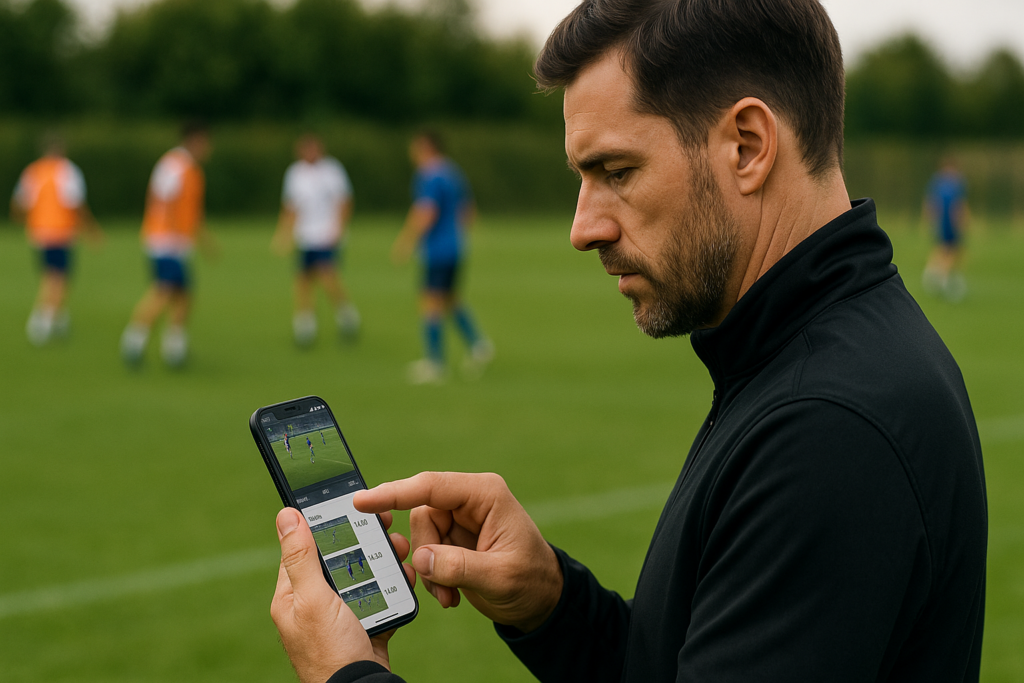
    However, the true strength lies in the integration: zone14 is not just a camera but a strategic platform. With zone14 STATS, performance data like running distances are extracted directly from the video without sensors, inseparably linking data and tactics. The REPLAY iPhone App also makes the analysis flexible and mobile. Furthermore, the system introduces a live dimension that elevates the matchday itself: All home games can be streamed effortlessly and without a paywall, enabling clubs to reach their fans and create new, attractive sponsorship opportunities. At the same time, coaches can use the REPLAY App to tag live from the sidelines, preparing their halftime analysis in minutes and allowing them to react immediately to the on-field action.
  • Ideal for: Clubs that see their home ground as their fortress and want to rely on uncompromising, professional, and reliable analysis conditions there. It is the solution for clubs that want to relieve their volunteers, professionalize their entire sporting and administrative operations, and grow sustainably through an integrated system of analysis, data, livestreaming, and sponsorship opportunities.
Start your video analysis.

Sign up now for a completely free demo account.

The Philosophies in Direct Comparison

Let's summarize: When we compare the systems directly, it becomes clear that it's about more than just technical data. It's about fundamentally different approaches.

Veo offers you the freedom to record anywhere but demands the price of constant manual effort. Trace gives every player their personal spotlight but puts team analysis on the back burner. zone14 offers you absolute peace of mind and professionalism at home, with a deeply integrated ecosystem that goes far beyond mere recording. The decision is therefore not a question of "better" or "worse," but a question of priorities.

Conclusion: Which DNA Fits Your Club? A Clear Decision-Making Guide

Choosing the right camera system is a strategic turning point.

  • Profile A: "The Nomad" – Mobility is Everything.
    If your top priority is recording away games and you have reliable and dedicated volunteers to handle the weekly setup and teardown, then Veo is an established choice that gives you the necessary flexibility.
  • Profile B: "The Talent Developer" – The Player is the Focus.
    If your main goal is the automatic creation of individual highlight clips for your youth talents to promote their development and visibility, and tactical team analysis is a lower priority, then Trace could be the right solution for you.
  • Profile C: "The Strategist" – Reliability, Professionalism, and Club Development.
    If, however, your goal is to turn your home ground into a fortress of analysis, to maximally relieve your volunteers, and to implement a holistic system for sporting success, fan engagement, and financial development, then the integrated approach of zone14, designed for reliability and professionalism, is an advanced and sustainable solution.

If your goal is a hassle-free, reliable, and qualitatively superior video analysis that serves as the foundation for sporting success and new revenue streams, there is hardly any way around a permanently installed, intelligent solution.

Share on Facebook
Share on Twitter
Share on Linkedin
More related content from zone14
Categories
Fußball Kamera

The Tripod Dilemma in Amateur Football & How to Solve It

Contents

The Tripod Dilemma in Amateur Football & How to Solve It

Which Camera Solution Truly Fits Your Club's Goals? A Detailed Comparison of Perspective, Effort, and the Potential of a Complete League Solution.

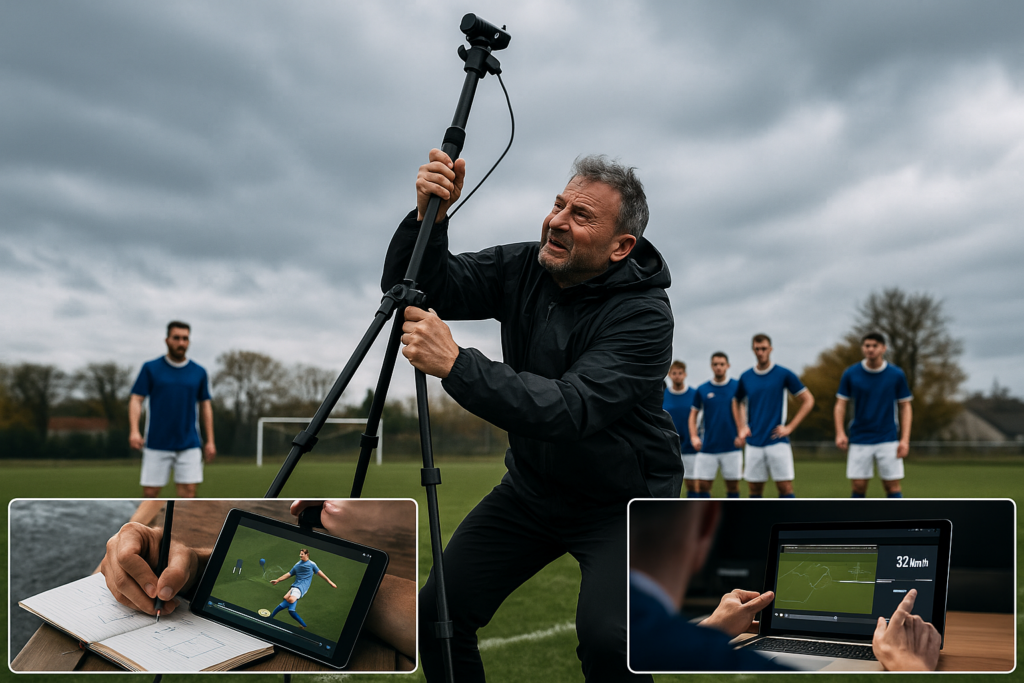
Every dedicated coach and club official in amateur football knows the challenge: to keep up in the modern game, video recordings for game analysis are essential. However, the implementation is often a compromise. Usually, a brave soul—a "cameraman"—is found to stand on the sidelines for 90 minutes. The tripod is a constant companion, and the result is often footage that is valuable for memories but only partially suitable for in-depth tactical football analysis.

But what are the alternatives? Is the classic tripod the only option? What do modern high tripods (masts) really offer? And what revolutionary potential lies in permanently installed, automatic AI cameras, especially when considered not just for a single club, but as a networked solution for an entire league?

This comprehensive guide illuminates the various options for game recording in football. We analyze the pros and cons of each method and provide you with a clear basis for deciding which solution is right for your club.

1. The Classic: The Standard Tripod on the Sideline – Maximum Flexibility with Analytical Compromises

The simple three-legged tripod is the undisputed standard in amateur football. It is the most obvious and, at first glance, the cheapest solution.

  • The Advantages: Low initial cost and high mobility, as it can be taken to every away game.
  • The Reality in Practice: The recording depends on the reliability of a volunteer, which poses a high risk. Far more crucial, however, is the inadequate perspective for serious tactical analysis. From the sideline, formations and distances are nearly impossible to assess. Added to this are inconsistent video quality and a high, recurring effort on matchday.

2. The Evolution: The High Tripod (Telescopic Mast) – An Important Step Up

To solve the perspective problem, high tripods for sports recording have become increasingly popular.

  • The Approach: An extendable telescopic mast raises the camera to an elevated position, significantly improving the overview.
  • The Advantages: A significantly better tactical perspective makes the analysis of formations meaningful for the first time. The system also remains portable.
  • The Remaining Challenges: The high personnel effort for transport, setup, and teardown persists and is often even greater. Additionally, the masts are often susceptible to wind, and battery life remains a critical issue.

3. The Advanced Option: The Permanently Installed, Automatic AI Camera

What if the camera were simply always there? Perfectly positioned, always ready, completely automatic. This is precisely the philosophy behind the permanently installed camera for football pitches. This is precisely the approach that zone14 pursues.

  • The Concept: "Set-and-Forget" – Install and Benefit:
    An intelligent AI camera is installed once in an optimal, elevated, and central position—typically on a floodlight mast. It stays there, permanently connected to power and the network.
  • The Clear Advantages of This Option:
    • Maximum Reliability & Relief for Volunteers: The camera automatically records every scheduled home game. The dependency on personnel on matchday is completely eliminated.
    • The Perfect Perspective for Pro-Level Analysis: The high, central position is the "holy grail" for any top-down game analysis. A panoramic view provides an invaluable tactical overview.
    • Professional & Consistent Video Quality: Modern AI camera systems for football intelligently follow the action and deliver a stable, broadcast-quality feed.
    • Zero Effort on Matchday: No setup, no teardown, no battery charging. Coaches and officials can fully concentrate on the essentials.
Start your video analysis.

Sign up now for a completely free demo account.

4. The Future, Today: The Networked League Solution – A Game-Changer for Everyone

So far, we have looked at camera systems from the perspective of a single club. But what happens when you expand the potential of permanently installed cameras to an entire league? This creates a revolutionary added value that mobile solutions can never offer.

  • The League Solution Concept:
    Imagine every club in your league equips its main pitch with a permanently installed AI camera from providers like zone14. All cameras are part of a networked system.
  • The Groundbreaking Advantages:
    • EVERY Game is Recorded – Home & Away: The problem of missing footage from away games is completely solved. No matter where you play, a recording in the usual high, professional quality is guaranteed.
    • Seamless Video Exchange for Opponent Analysis: Gone are the days of hoping to somehow get a video of the next opponent. The recordings can be easily and fairly shared between clubs via the platform. Opponent analysis in amateur football is thereby raised to a completely new, professional level.
    • Increased Attractiveness for League Sponsors: An entire league that can livestream every game and produce professional highlights becomes an extremely attractive advertising partner. League-wide sponsorship packages can be created, from which every single club benefits.
    • Fairness and Transparency: The complete documentation of all games can also provide valuable, objective insights into controversial scenes or for the work of the referees.

Such a league solution is the logical next step in the professionalization of amateur football. It creates a win-win-win situation for players, coaches, and the league as a whole.

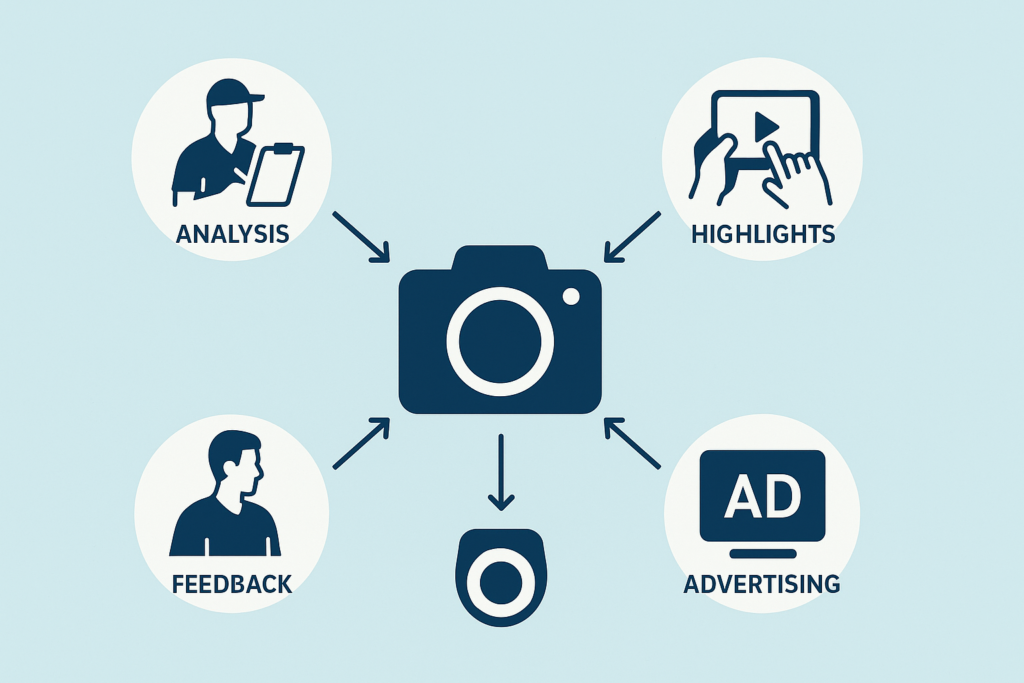
5. One Recording, Countless Possibilities: The Smart Content Cycle for Your Club

  • For Coaches/Analysts: The raw material for detailed tactical analysis in REPLAY.
  • For Players: Short, individual feedback clips and motivational highlights.
  • For Fans/Community: Spectacular highlight videos for social media and the club website.
  • For Sponsors: Professional livestreams with ad integration and branded highlight clips as a measurable ROI.
  • For the Press/Media: Easy provision of high-quality footage for local newspapers or online portals.

6. More Than Just a Camera: An Honest Cost-Benefit Analysis (ROI)

For club officials, the financial side is crucial. The Return on Investment (ROI) of a video analysis solution must be clear.

  • The Hidden Costs of Mobile Solutions: If one considers the "implicit personnel costs" (what is the time of a volunteer worth?), the wear and tear of equipment, and the opportunity costs (lost sponsorship revenue), the seemingly low price of tripods is quickly put into perspective.
  • The ROI of a Permanent Installation (especially as a League Solution): A permanently installed camera is a strategic investment. The reliability and high quality of the recordings create the foundation for new revenue streams through professional highlight clips and livestreams with sponsor integration. In a league solution, this effect is potentiated. The time saved for volunteers frees up resources. It is an investment in the athletic and financial health of the club.

Conclusion: It's Not About the Tripod – It's About the Right Strategy for Your Club and Your League

The choice of recording method is a strategic decision.

  • The classic tripod remains a flexible entry-level solution with clear compromises in quality and reliability.
  • The high tripod improves the perspective but does not solve the problem of recurring effort.
  • The permanently installed, automatic AI camera is the most advanced option for clubs that value maximum reliability, unsurpassed analysis quality, and relieving their volunteers.

However, the revolutionary potential only unfolds when thinking about a networked league solution. It not only professionalizes the individual club but also elevates the entire league to a new level in terms of analysis, marketing, and sporting fairness. If the goal is continuous, high-quality, and low-effort video analysis in amateur football, there is hardly any way around a permanently installed, intelligent, and networked solution.

Share on Facebook
Share on Twitter
Share on Linkedin
More related content from zone14
Categories
Video Analysis

Football match analysis: Your ultimate guide – From the basics to professional analysis with zone14 REPLAY

Contents

Football match analysis: Your ultimate guide – From the basics to professional analysis with zone14 REPLAY

The final whistle blows. Emotions are running high – the joy of victory, the frustration of defeat. But for dedicated coaches, analysts, and forward-thinking club officials, a crucial part of the work is just beginning: the analysis. It is the key to learning from past performances, identifying tactical patterns, developing players in a targeted way, and preparing optimally for the next opponent. But where do you start? How do you transform 90 minutes of pure chaos into clear, actionable insights?

Many rely on their gut feeling and notes. But a structured, in-depth analysis can make the difference between stagnation and sustainable success. This comprehensive guide takes you step-by-step through the process of a professional game analysis – from basic preparation and the psychological aspects of communication to the use of modern tools like zone14 REPLAY, which make this process easier, faster, and more effective than ever before.

1. Preparation: The First Step to Successful Game Analysis (Before the Game)

Good analysis doesn't start after the final whistle, but before it. A clear set of expectations and targeted questions will help you watch the game with an analytical eye.

  • Define Your Game Idea: What did you want to implement as a team today? What were the tactical instructions? (e.g., high press, fast transitions, a compact defensive unit). Your analysis will always be benchmarked against your own game philosophy.
  • Ask the Right Guiding Questions: Formulate 2-3 central questions you want to observe during the game.
    • Offensively: How well does our build-up play work against the opponent's press? Are we creating scoring chances from the wings?
    • Defensively: How stable is our central defense against long balls? How do we react to fast counter-attacks?
  • Consider the Opponent Analysis: What do you know about the opponent? Do you know their strengths, weaknesses, and key players? This helps you to better contextualize certain situations in the game.

2. Observation: How to Watch a Game with the Eyes of an Analyst (During the Game)

During the game, you are often emotionally involved. Nevertheless, try to maintain an analytical distance and observe systematically.

  • Forget the Ball (Sometimes): Don't just follow the ball; observe the behavior of players without the ball. How do the team units move? Where do open spaces appear? What is the formation like when possession is lost?
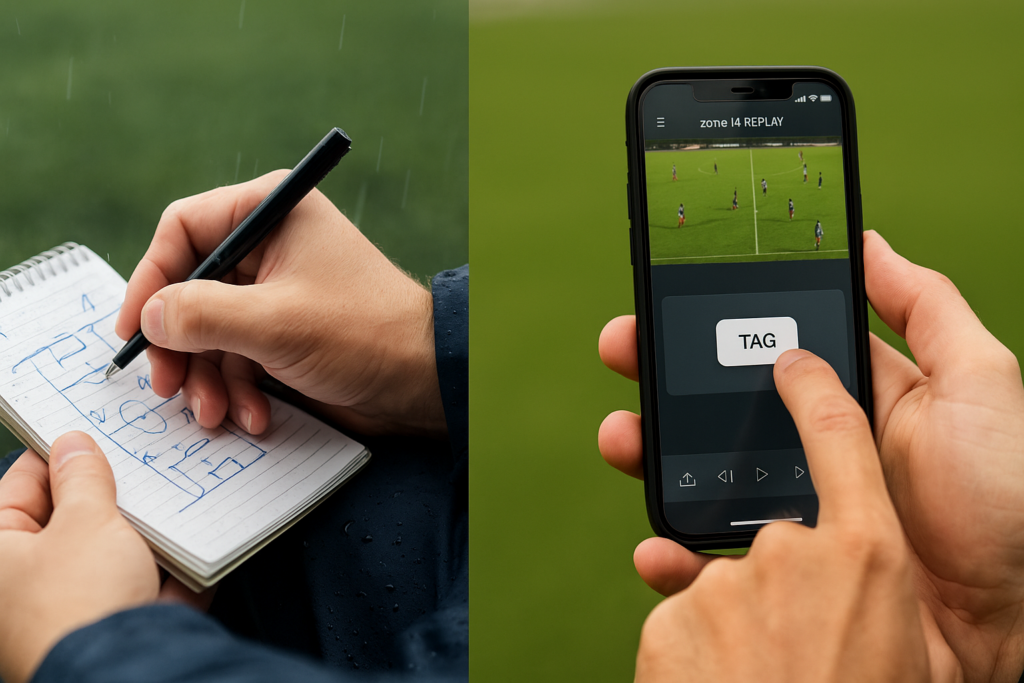
  • Take notes manually – the traditional way: Have a notepad or laptop ready. Write down the minute of play and a short keyword for notable scenes (e.g., “12th minute – counterattack opportunity missed,” “28' – poor spacing in midfield,” “55' – good pressing scene RV”). These notes will be invaluable later on for finding the scenes in the video.
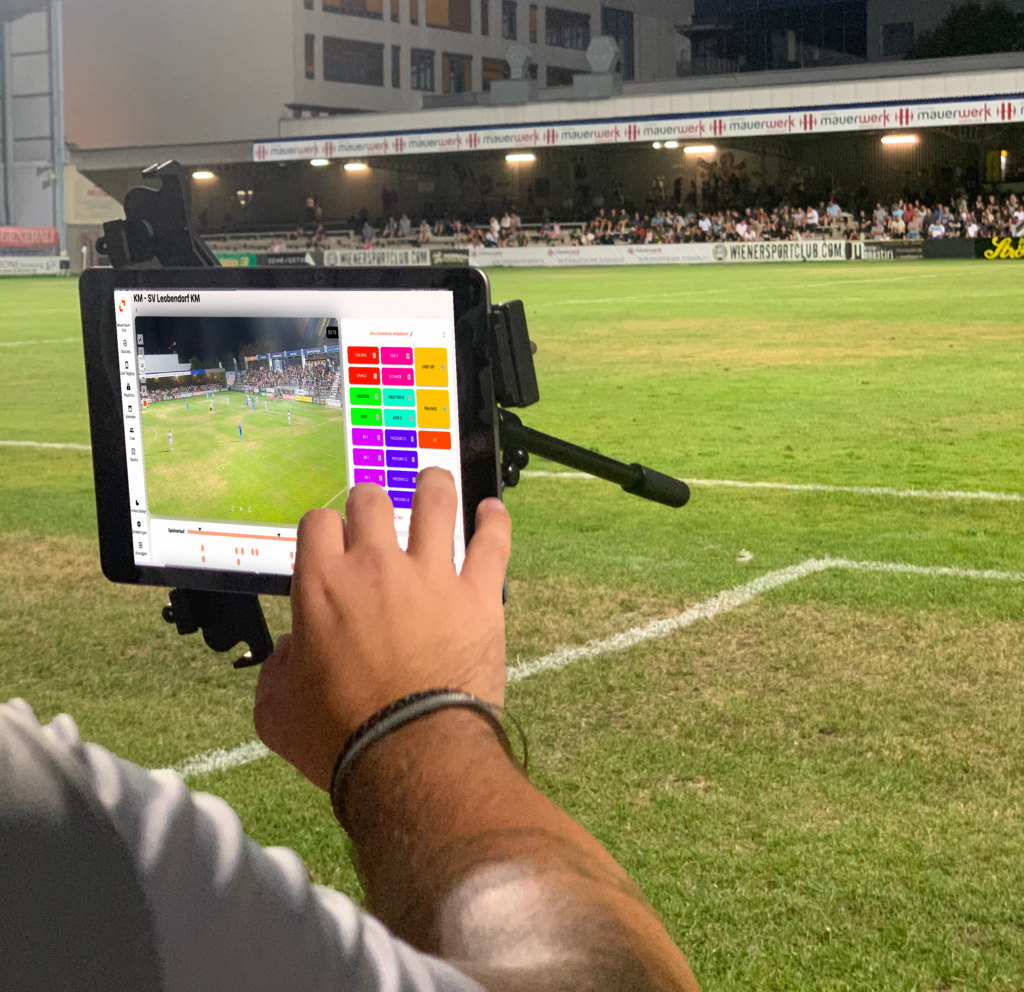
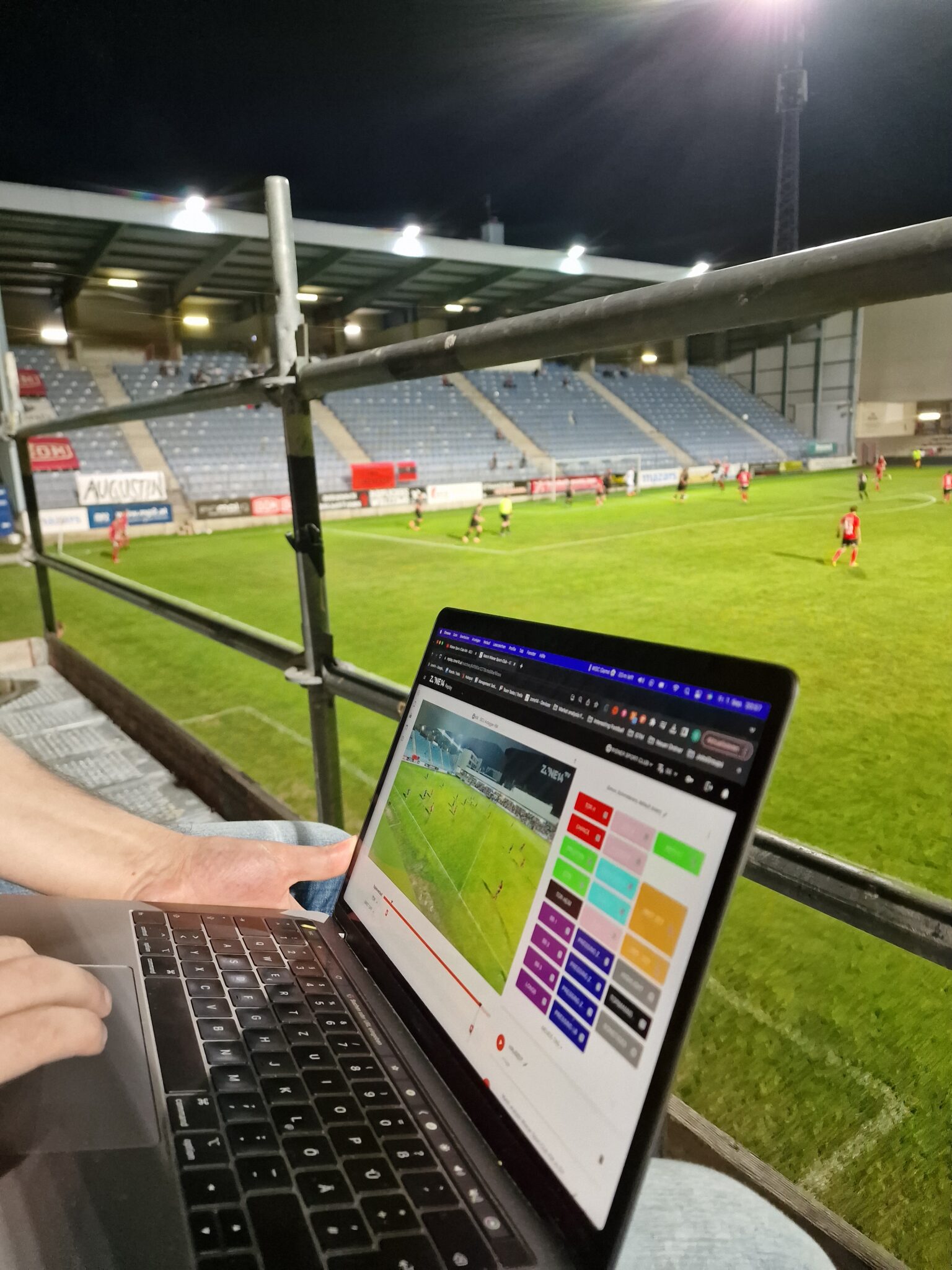
  • Live tagging with zone14 – The modern, faster alternative: Instead of using pen and paper, you can revolutionize this process with modern systems such as zone14. With your laptop, tablet, or simply on your smartphone with the REPLAY App, you can mark important moments during the game with predefined or custom tags. Just click on “Goal opportunity,” “Bad pass,” or “Good defensive action,” and the scene will be automatically with the exact time stamp for later analysis. This not only saves time, but is also much more accurate than any manual note.
  • The limits of live observation: Be aware that it is impossible to capture everything live. You are stressed, distracted, and cannot rewind a scene. The real, in-depth analysis always takes place after the game.

3. The Post-Match Debrief: Conducting the Actual Game Analysis (After the Game)

Now the real work begins. With the video footage in front of you, you can analyze the game objectively and at your own pace.

  • Step 1: The "Cool-Down" & First Viewing
    Never analyze right after the game when emotions are still high. Watch the entire game video once without interruption to get a feel for the overall flow.
  • Step 2: Structuring the Game (Tagging & Clipping)
    Now you begin to break the game down into relevant scenes. This process is called tagging or clipping. Watch your video a second time and create short clips of all the moments you noted earlier or that stand out to you now. Categorize these scenes to maintain an overview. Typical categories are:
    • Own Offense: Build-up play, scoring chances, counter-attacks, wing play
    • Own Defense: Pressing behavior, defending against counters, tackling behavior
    • Transition Moments: From defense to offense and vice versa
    • Set Pieces: Own and opponent's corners, free kicks, throw-ins
    • Individual Actions: Special performances or mistakes by individual players
  • Step 3: The "Deep Dive" – Detailed Analysis of the Scenes
    Now, go through your created clips and analyze them in detail. For each scene, ask the "What-Why-How" questions:
    • What happened? (e.g., We conceded a goal from a corner.)
    • Why did it happen? (e.g., The marking in the penalty area was off, player X lost sight of his opponent.)
    • How can we do better in the future? (e.g., Practice clear assignments, improve communication on set pieces.)
  • Step 4: Drawing Conclusions and Deriving Actionable Recommendations
    At the end of your analysis, you shouldn't have 50 different findings, but 2-3 clear key points that are most important for your team's development. These could be, for example: "We need to improve our transition play after winning the ball" or "Our compactness in central midfield is a weakness."

4. The Game-Changer: How zone14 REPLAY Revolutionizes Your Analysis Workflow

The process described above is effective, but when done manually, it is extremely time-consuming. This is exactly where modern tools like zone14 REPLAY come in, taking your football tactical analysis to a new level.

  • Automatic Recording & Immediate Availability: The biggest hurdle – getting the video footage – is eliminated. The zone14 TWO camera automatically records your games in high quality. Shortly after the game, the material is available to you on the zone14 REPLAY platform.
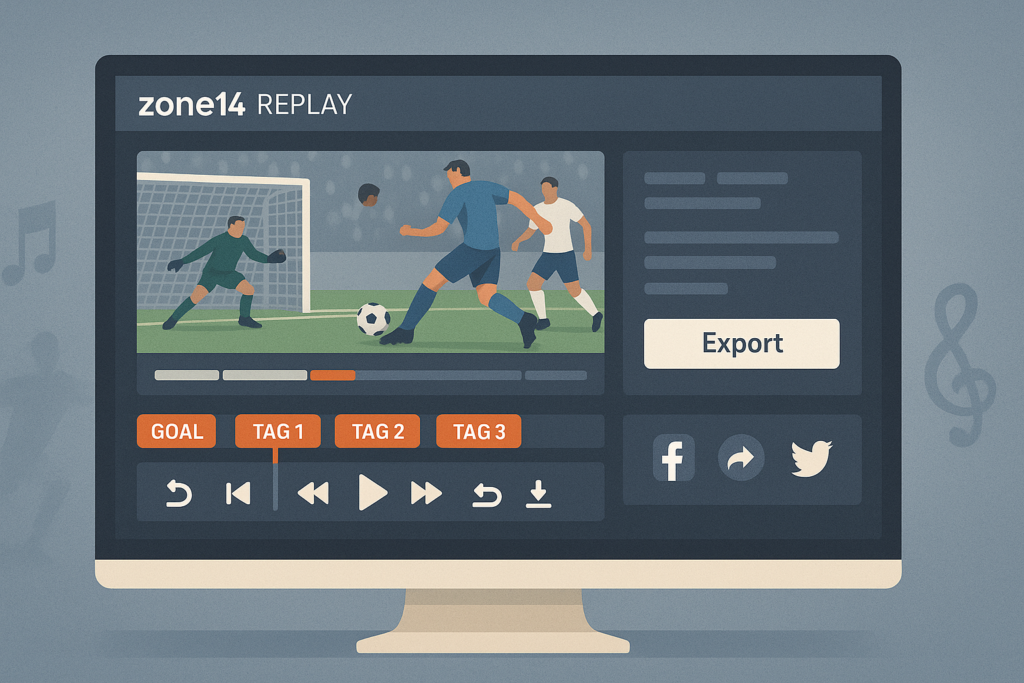
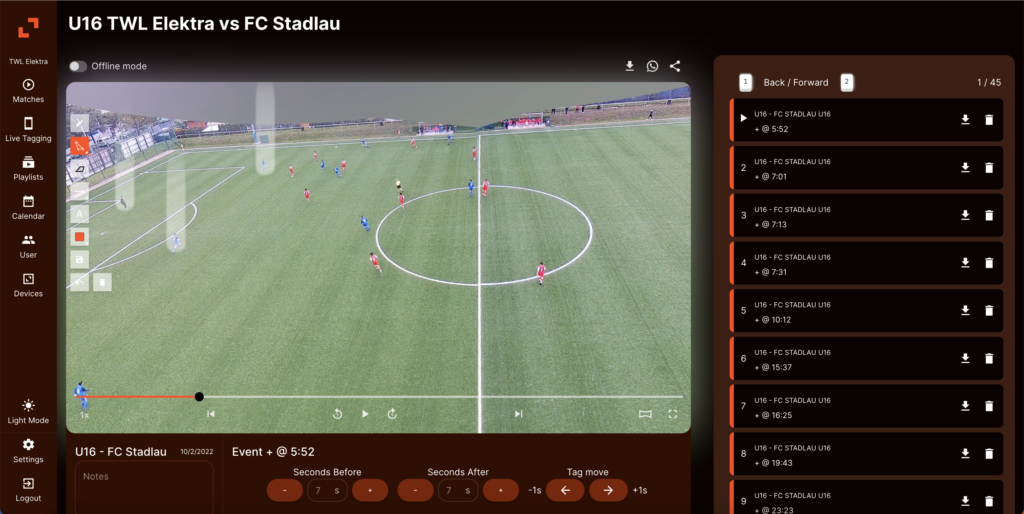
  • Efficient Tagging & Clipping: Instead of tediously writing down timestamps, you can mark, cut, and organize scenes into playlists in REPLAY with just a few clicks. 
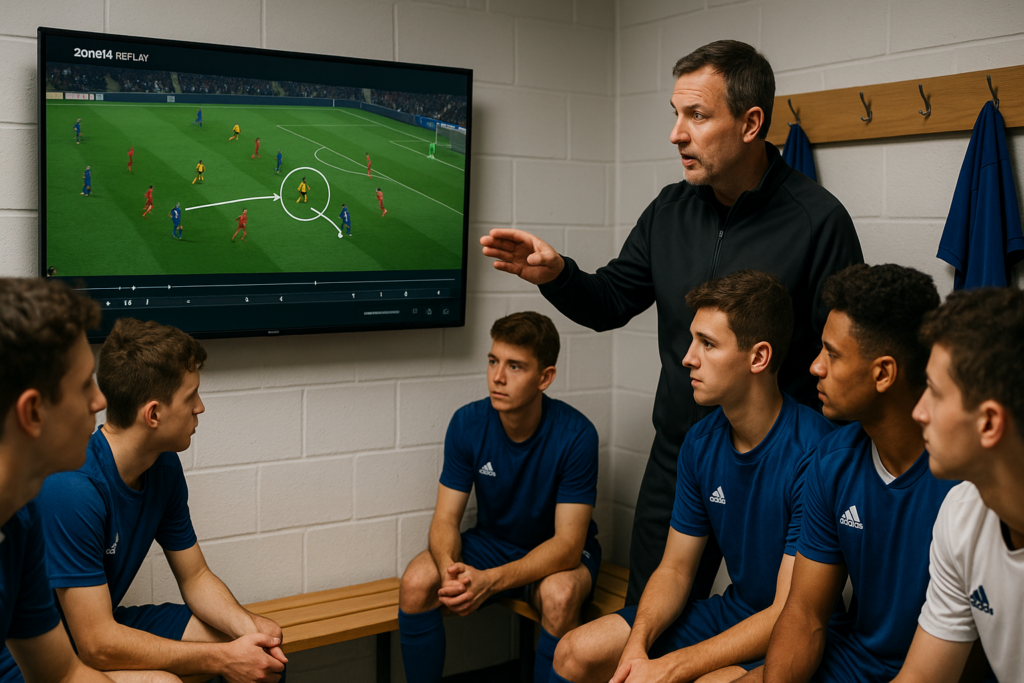
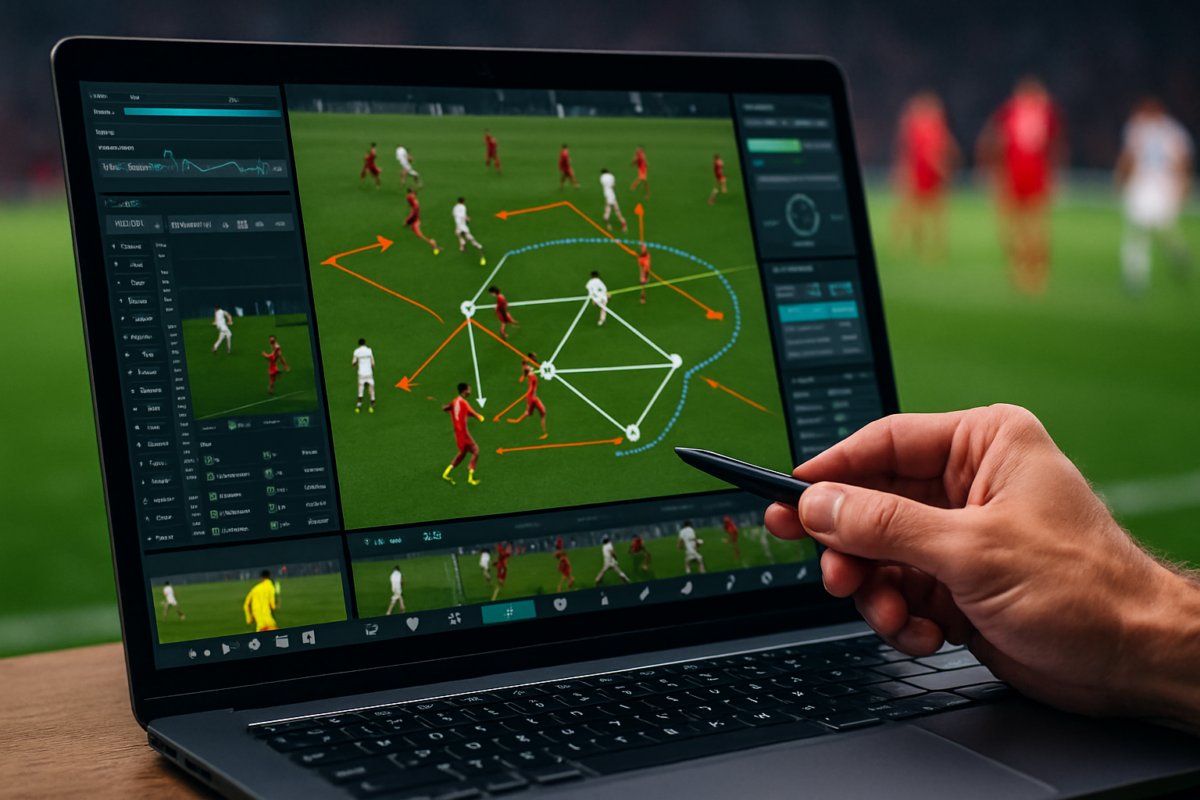
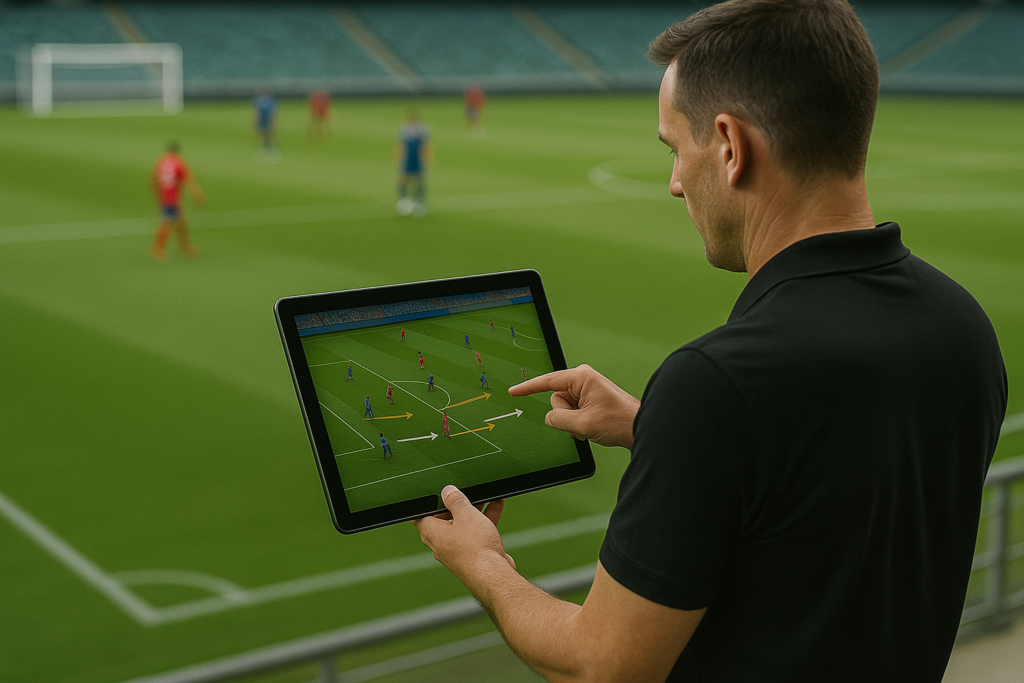
  • Professional Drawing Tools: You don't have to be a graphic designer. With the intuitive drawing tools in REPLAY, you can visualize running paths with arrows, mark players with circles, or highlight open spaces with zone tools. This makes your instructions immediately understandable for every player.
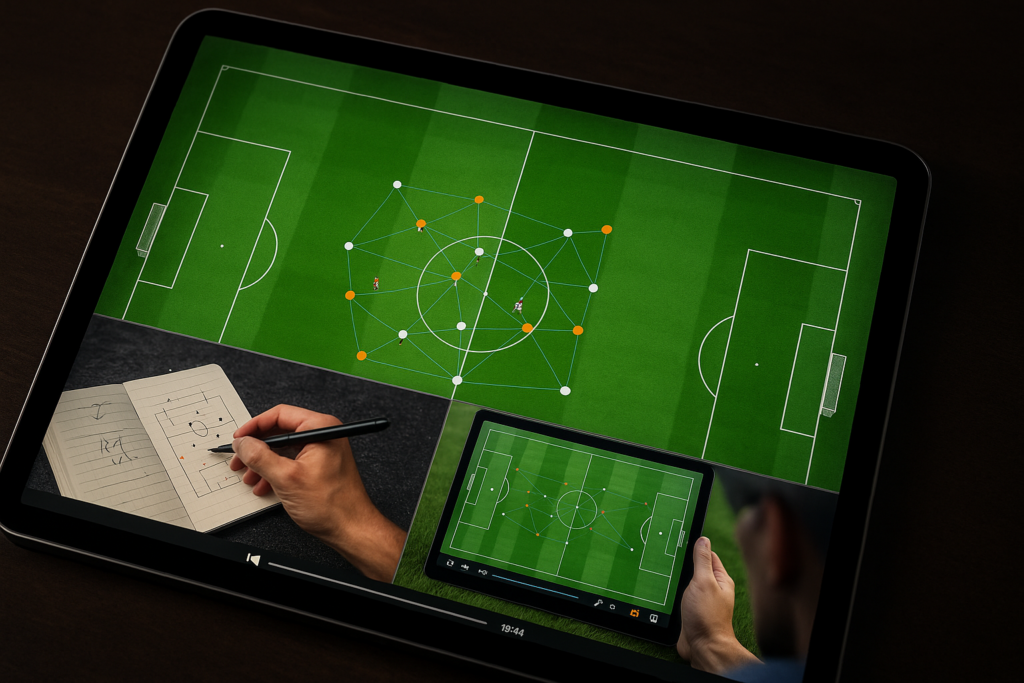
  • The Panoramic View for a Tactical Overview: One of the most powerful features! Switch from the tracking camera view to the full panoramic view of the entire pitch. This allows you to see the movements and distances of all players and analyze tactical formations and shifts like never before.
  • The Fusion of Tactics and Physics with zone14 STATS: Imagine not only seeing your full-back's wrong run but also that he ran 2 km less in this game than usual. With zone14 STATS , you get these physical performance data (running distance, sprints, heatmaps) directly from the video, without GPS vests. This combination of tactical observation and objective data gives you a complete picture of player performance.
  • Easy Sharing & Collaboration: Share your finished analyses, playlists, or individual clips with comments directly with your coaching team or individual players. Everyone is on the same page, and the feedback gets exactly where it needs to go.

So, zone14 REPLAY doesn't do the thinking for you, but it automates the time-consuming processes and gives you powerful tools so you can focus on what matters most: the substantive analysis and the improvement of your team. Here you can find out, how to get started with video analysis in your club.

5. More Than Just the Team: The Analysis of the Individual Player

Video analysis is a powerful tool for individual player development. Use its capabilities to focus specifically on individual players:

  • Create Individual Playlists: Compile a short "highlight reel" for each player with their best actions to boost their confidence. At the same time, you can create a "learning reel" with 2-3 scenes worthy of improvement.
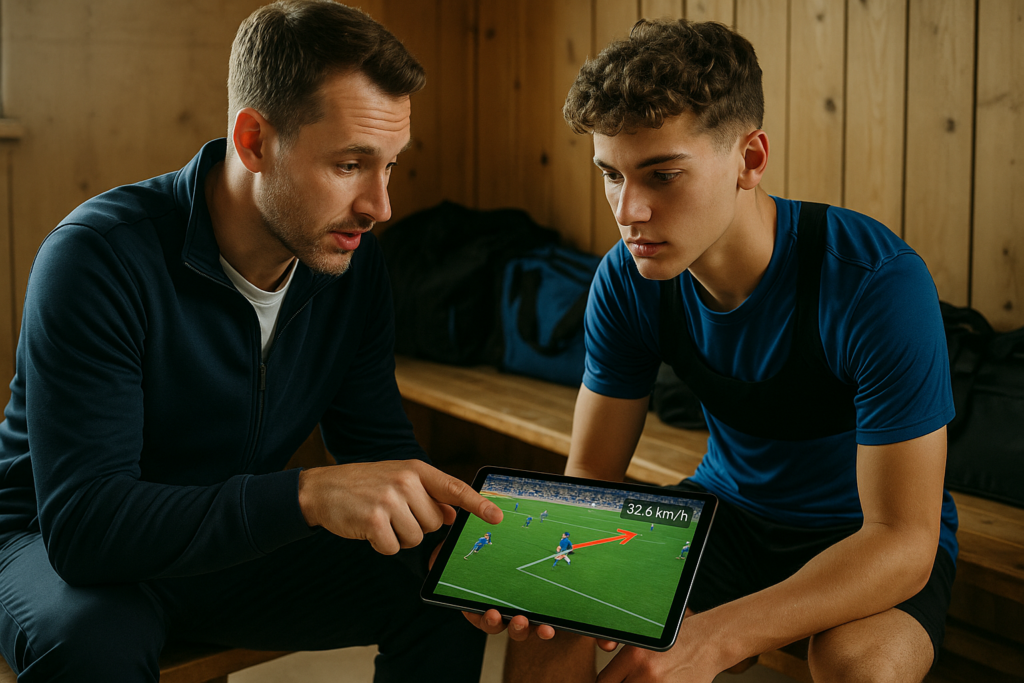
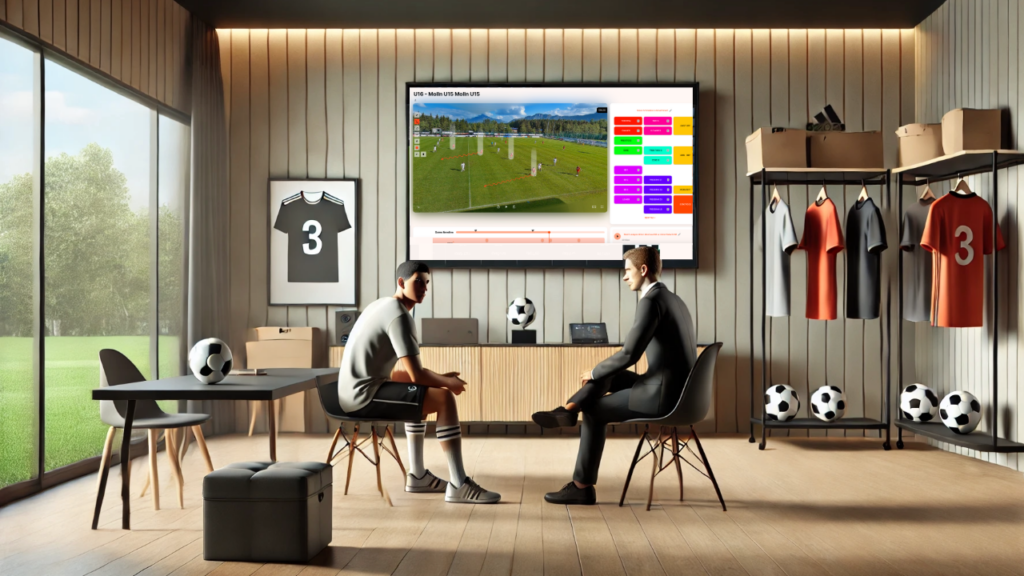
  • Conduct Constructive Development Talks: These individual clips are the perfect basis for a one-on-one conversation. The player sees objectively what is meant and can understand the instructions much better. With zone14 REPLAY, you can filter and compile such playlists with just a few clicks.

6. Between Motivation and Criticism: The Right Tone in the Video Debrief

A good analysis is one thing, communicating it correctly is another. A poorly conducted video session can do more harm than good. Consider the following psychological aspects:

  • Create a Positive Learning Atmosphere: Make it clear that it's about collective improvement, not about calling out mistakes.
  • Use the "Sandwich Method": Start with a positive scene (praise), then show a learning-intensive scene (constructive criticism), and conclude with something positive again.
  • Avoid Public Shaming: Discuss general tactical errors with the group. Very individual or repeated mistakes of a single player should rather be discussed in a one-on-one conversation. The sharing functions of modern tools allow for discreet communication here.
  • Ask Questions Instead of Just Lecturing: Actively involve the players. "What could you have done differently in this situation?" "What options do you see here?" This promotes game understanding and personal responsibility.

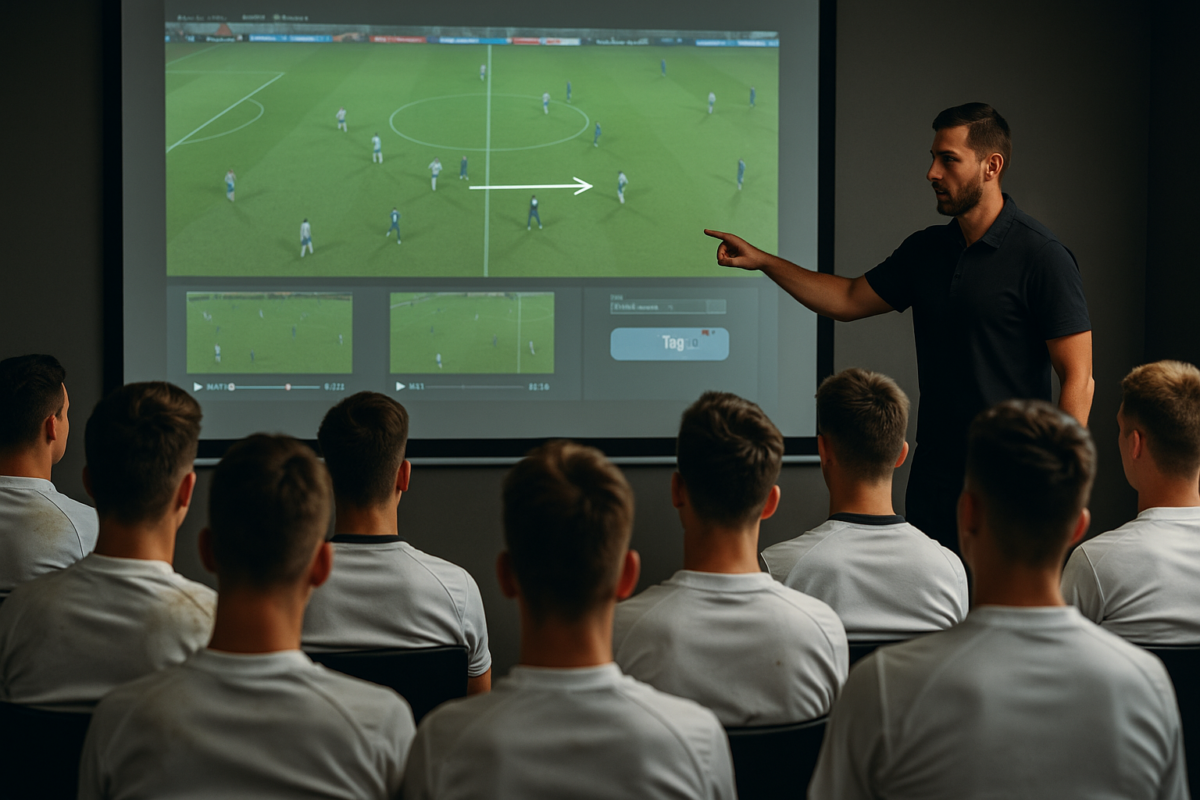
7. The Perfect Video Session: 7 Tips for an Effective Presentation

Start your video analysis.

Sign up now for a completely free demo account.

  1. Keep it short: A video session should never last longer than 15-20 minutes. The players' attention span is limited.
  2. Focus on 2-3 topics: Choose the most important findings from your analysis. Don't try to address everything.
  3. Positive scenes first: Start with a successful action to get the team in a positive mood and capture their attention.
  4. Show solutions: Don't just show the mistake; also present a scene (perhaps from the same game) where the situation was solved correctly.
  5. Be prepared: Make sure the technology (projector, laptop, screen) is working properly and your clips run smoothly.
  6. Conclude with a clear message: At the end, summarize the main take-away message that the team should take into the next training session or game.

8. Why an Investment in Video Analysis Also Pays Off Financially

Implementing a professional video analysis system like zone14 is not only a sporting decision but also a strategic one for the entire club. The Return on Investment (ROI) is evident on multiple levels:

  • Better Player Development: Players who can develop optimally within their own club reduce the need to sign expensive external newcomers.
  • Increased Attractiveness for Sponsors: Professionally created highlight clips and the possibility of livestreaming are highly attractive advertising spaces. They allow you to offer your sponsors modern and measurable benefits, which strengthens your negotiating position.
  • Retention and Motivation of Volunteers: When you provide your dedicated, often volunteer, coaches with modern tools that make their work easier and better, it increases their satisfaction and long-term commitment to the club.

Conclusion: Game Analysis is the Cycle of Success

Structured game analysis is not rocket science, but rather the crucial process that transforms gut feelings into knowledge and assumptions into facts. It is the key to learning from every performance and laying the foundation for the continuous development of your team.

In the past, this process was often time-consuming and complex. Today, modern solutions such as zone14 REPLAY make a professional analysis workflow accessible to every club. They automate the tedious steps and provide you with powerful tools to efficiently break down games, clearly visualize insights, and easily share them with your team.

By systematically preparing and conducting your analyses and transferring the results into training, you close the cycle of success. Use these opportunities to give your team, your players, and yourself the decisive advantage.

Share on Facebook
Share on Twitter
Share on Linkedin
More related content from zone14
Categories
Spieldaten

A comparison of statistics tools in soccer: Catapult, zone14, and others put to the test

Contents

A comparison of statistics tools in soccer: Catapult, zone14, and others put to the test

“We just weren’t aggressive enough today.”
“We lacked the willingness to run.”
“The decisive pass didn’t come.”

If you're involved in soccer—whether as a coach, player, analyst, or club official—you’ve probably heard these phrases countless times. For years, this was the foundation of match analysis: a coach’s intuition, a trained eye, and gut feeling.

And while that instinct will always play a role, modern football has evolved. Massively.

Today, performance data and match statistics are not a luxury—they’re essential for training management, tactical planning, and long-term player development. They turn assumptions into facts and help coaches make more objective decisions—whether it's selecting a starting eleven, planning recovery, or preparing for match day.

How do clubs access performance data?

In professional leagues like the Bundesliga, GPS vests and performance science teams have long been standard. But for most amateur clubs, these tools seemed far out of reach—until recently. Thanks to recent technological advances, the game is changing even at the grassroots level.

What do GPS trackers actually measure?

What looks like a tight-fitting vest is actually a powerful device. Inside is a GPS tracker that collects a wide range of physical performance data in real time.

Examples?

  • How far has a player run? And not just in total, but also broken down: how many meters in sprints, how many in jogging or walking?
  • How fast was it? What was its top speed?
  • How often did he accelerate explosively or brake abruptly?
  • Where exactly did he move on the pitch? So-called Heatmaps show in which zones a player was active.
  • How high was the total load? A special value such as “player load” summarizes load, intensity, and movement effort in a single number.

All this is provided by GPS trackers from suppliers such as Catapult, the market leader in professional sports. And yes: for fitness trainers and performance diagnosticians at the highest level, this data is pure gold.

They help to precisely control the load on each player, prevent injuries, adjust training intensity individually, and ensure that everyone is at 100% on game day.

Why are such systems rarely seen in amateur football?

As exciting as this technology is, it has two major drawbacks for us in the amateur and semi-professional sector.

Firstly: the price.
The cost of equipping an entire team with GPS trackers and the corresponding vests is enormous. And that's just the beginning: there are also regular license fees for the software, server access, updates—in most cases, this exceeds the budget of any club.

Secondly: the effort involved.
Before each training session, vests must be handed out, trackers assigned and charged. Then everything has to be collected again, data read out, assigned to players and evaluated. Anyone who has ever done this knows that it's not something you can do quickly on the side – especially not as a volunteer.

But from a trainer's perspective, the biggest disadvantage is something else entirely – namely, a conceptual one:

GPS tracking does not provide answers to tactical questions.

A tracker shows you that your full-back has run 11 kilometers. But it doesn't tell you why.

Was his movement tactically smart in order to create space? Or did he run back and forth aimlessly because he was in the wrong position beforehand?

He did 36 sprints – okay. But:
Was that because he anticipated correctly? Or because he constantly had to iron out mistakes?

These questions remain unanswered. The bare figures do not help us here.

The modern alternative: AI-based video analysis – When the camera thinks for itself

This is precisely where the real revolution begins—and it affects not only the professionals, but above all of us amateurs.

Instead of relying on expensive devices worn on the body, modern systems use artificial intelligence (AI) to extract performance data directly from video footage. One or more cameras film the game, and smart software automatically analyzes what is happening on the field.

This has two huge advantages:

  1. The logistical effort is reduced to a minimum. No vests. No trackers. No reading out.
  2. The performance data is directly linked to the game. You don't just see that a player has run 10.5 km – you see where, when, and why.

Whether the run was tactically sound or completely pointless—you can check that out directly in the video. And that's exactly what makes the difference.

A look inside the toolbox: zone14 and other alternatives at a glance

The market for analysis tools is changing. Today, there are various systems that rely on video data and/or performance data—but with very different approaches and philosophies. To find the right solution for your club, it's worth taking a look at the toolbox:

Catapult – The specialist for pure performance data

If you are a professional team that wants to control the physical strain on your players down to the smallest detail, then Catapult is the tool for you. Data is collected via GPS vests, and the performance data is extremely accurate—but the tactical context is completely missing. What's more, the price is high and the effort involved is considerable.

Hudl – The digital tactics board

Hudl is ideal if you want to share, comment on, and analyze tactical scenes. You can upload your video footage, edit scenes, add drawings, and share them directly with your players. Hudl is strong in communication and visual feedback—but does not provide automatically captured performance data.

Wyscout – The spy in the scouting sector

Wyscout is not a platform for your own games, but a tool for analyzing opponents and scouting. You get access to a huge video database with countless teams and players worldwide—including statistics. Perfect if you are looking for new players or want to prepare specifically for opponents.

zone14 – The all-in-one solution for ambitious clubs

And then there is zone14 – the system that integrates tactical video analysis and performance data in one. No GPS, no extra effort. With an automated camera, AI-supported game analysis, and a clear focus on the reality of amateur and semi-professional clubs.

zone14 in detail: The best of both worlds – without any extra effort

At zone14, we asked ourselves:
Why do you actually have to choose between performance data on the one hand and tactical context on the other?

Why can't both work simultaneously and fully automatically?

That was precisely the starting point for our system: a complete, integrated solution specially developed for the needs of amateur and semi-professional soccer clubs.

The eye: The zone14 TWO AI camera

The fully automatic camera is mounted once on the floodlight mast or grandstand and records all games and training sessions in crystal-clear 4K quality. No cameraman needed, no operation, no effort.

The Platform: REPLAY + STATS

All footage is automatically uploaded to zone14 REPLAY where coaches can edit clips, add drawings, and analyze tactics.
The key, however, is zone14 STATS:
It extracts performance data directly from the footage:

  • Running track
  • Sprint speed
  • Heatmaps
  • Player workload metrics

And every data point is directly linked to the game context.

Start your video analysis.

Sign up now for a completely free demo account.

How does that look?

For example, you click on “10.5 km running distance” for your central midfielder and see every single run in the video.
You will immediately notice:

  • Was the run clever?
  • Did he create spaces?
  • War er taktisch sinnvoll oder hat eher nur Energie verbraucht?

So könnt ihr Training und Spielanalyse nicht nur auf Daten, sondern immer auch auf dem „Warum dahinter“ aufbauen. Genau das macht moderne Fußballanalyse aus.

Conclusion: The data-driven future for your club is here—and it's easier than you think.

The question is no longer whether performance data and video material should be used in soccer. The question is: How can this be done in the smartest way possible—and in a way that fits in with everyday club life?

Catapult remains an exciting tool for pure performance diagnostics in the professional arena.

For coaches who want to share tactical feedback and video clips with their team, Hudl is a strong choice.

And when it comes to scouting and opponent analysis, there's hardly any way around Wyscout.

But:  If you are looking for a comprehensive, affordable, and easy-to-use system that will help you advance on all levels—physically, tactically, and organizationally—then zone14 is exactly the right tool for you.

It is the only system that automatically records and extracts performance data and links it to tactical gameplay. No frills, no additional hardware, no half-baked solutions—just modern game analysis tailored to everyday life in amateur and semi-professional soccer.

Share on Facebook
Share on Twitter
Share on Linkedin
More related content from zone14
Categories
Livestreaming

Boosting Revenue for Amateur Football Clubs: With Video Analysis & Modern Sponsorship Strategies

Contents

Boosting Revenue for Amateur Football Clubs: With Video Analysis & Modern Sponsorship Strategies

Let’s be honest – who in amateur football doesn’t know this feeling? The passion for your local club knows no bounds. You give up evenings and weekends, stand by the pitch in wind and rain, wash kits, organize away trips, and cheer every goal as if it were the World Cup final. This passion is the invaluable engine that keeps our clubs alive. But while the love for the game is burning, the cold reality of the club’s bank account often hurts. The costs of pitch maintenance, equipment, association fees, and referees keep rising, while income, at best, remains flat. You go from season to season and ask yourself: How can we increase the income of our amateur football club – not just to survive, but to grow?

This blog is your answer. We’ll take you on a journey that goes far beyond the pitch. We’ll show you how to build a new, stable foundation for your club’s finances. With the zone14 all-in-one system, you won’t just improve your on-field performance – you’ll unlock powerful new revenue streams, because our system is built specifically for the realities and challenges of amateur football.

Revenue Sources for Amateur Clubs: The Eternal Challenge and the First Step Toward Change

Before we dive into modern solutions, let’s take an honest look at the current situation. Traditional revenue sources are often like an old tactics book – tried and true, but outdated and inefficient:

  • Membership fees: They’re the foundation, but usually only cover the most basic fixed costs. Raising them is often met with resistance.
  • Matchday kiosk sales: Important but highly dependent on weather, crowd size, and the limited time of volunteers.
  • Sponsorship: Competing for local sponsors is tough. Often, it ends with a pitch-side banner offering little measurable value. The result? Tough negotiations and uncertain renewals.
  • Digital strategies: Everyone talks about them, but volunteer-led clubs often lack the time, know-how, or user-friendly tools to implement them.

This is exactly where zone14’s philosophy comes in. We don’t just offer a smart camera – we provide a complete, integrated ecosystem that strengthens your club at every level, including financially.

zone14 as a Revenue Engine: How Video Analysis Can Increase Your Return on Investment

Many of you may see investing in a professional video system as a pure expense. At zone14, it's the opposite: Our system is a strategic investment that delivers measurable ROI and enables predictable new revenue streams previously unthinkable.

1. Revolutionize Your Sponsorship Strategy with Professional, Measurable Video Content

This is the fastest, most effective way to bring more money into your club’s budget. With automatic match recording via the zone14 TWO AI camera, you suddenly have an entirely new arsenal of compelling arguments for sponsors.

  • Professional highlight clips as a high-impact ad platform: Instead of shaky phone footage, you can deliver sharp, cinematic-quality 4K highlights created easily with zone14 REPLAY . These emotional clips are gold for social media and your website. You're not just offering static ad space – you're selling measurable digital reach, emotional storytelling, and a modern brand image. Show your sponsors the view counts – these are hard facts that convince.
  • Livestreaming: The ultimate sponsorship goldmine: Broadcast your matches live in high quality – and most importantly, without a paywall. This instantly makes your club more attractive to a broader, more modern range of sponsors. Suddenly, your sponsorship packages can include:
  • Sponsor logos as overlays in the live stream – just like the pros.

Short video ads before, during halftime, or after the match.

  • Sponsored match segments: “Goal of the Game – presented by Metzgerei Huber” or “Starting XI – brought to you by Autohaus Schmidt”.
  • Even minor details like the scoreboard or substitutions can be monetized.

Data-driven, exclusive sponsorship with zone14 STATS: Use zone14 STATS to extract running distances or sprint speeds from the video – no expensive GPS vests needed. Offer sponsors exclusive, innovative packages: “Fastest player – sponsored by [Local Gym]” or “Top runner – brought to you by [Energy Company]”.

2. On-Field Success = Off-Field Revenue: The Power of Analysis in Amateur Football

Beyond sponsorship income, video analysis unlocks the most fundamental driver of growth: on-field performance.


  • Better players, better team – thanks to REPLAY: With zone14 REPLAY, coaches can break down tactics with real footage, not just drawings. Players receive visual feedback they understand immediately. Better insights = better players. And better players = more wins, more fans, and more opportunities.
  • Success attracts people – and income: A successful team playing exciting football brings in more fans on matchdays, which directly boosts revenue. A strong reputation and rising membership numbers also attract higher-caliber sponsors eager to associate with success.
  • Nurture talent and keep them at the club: Ambitious players want to improve. When they see that your club uses pro-level analysis tools, they’ll want to join – and stay. That means less spending on replacements and more long-term performance stability.

3. Efficiency in Volunteering: Saving Time with Smart Tech

  • Free up volunteers and unlock potential: The zone14 TWO Cam automatically films your matches. No more freezing volunteers chasing the ball for 90 minutes – now they can run the kiosk, announce the game, sell raffle tickets, or support sponsors. All these tasks either generate income or boost matchday quality.
  • Smart scouting without all the travel: Analyze opponents or new signings remotely through the zone14 platform. Save countless hours on the road and avoid costly transfers that don’t fit your team.
By coaches for coaches.

Learn more about the entire zone14 system for your club!

Your Action Plan for a Stronger, Wealthier Club – with zone14 as Your Strategic Partner

Audit your current revenue streams: Where are you right now? Take a hard look at your finances and identify gaps and opportunities.

  1. Rethink and upgrade your sponsorship strategy: Use digital tools from zone14 (highlight clips, live streams, data-driven packages) to pitch bold new ideas to local businesses.
  2. Invest strategically in your club’s future: Think of zone14 not as a cost, but as one of the smartest
  3. investments you can make for your club’s future – financially and athletically.

Conclusion: Time to Stop Struggling

It's time to professionalize and monetize your amateur club!

Running an amateur club will always require passion and hard work. But it doesn’t have to be a constant financial balancing act. zone14 was built from the ground up to overcome the bottlenecks of amateur football. We give you a complete, integrated system that takes your sporting level up a notch while providing practical tools to boost your income, relieve your volunteers, and ensure your club is future-ready – financially, socially, and athletically.

It’s time to think beyond the pitch and unlock your club’s full potential.

REPLAY on the go!

The new zone14 REPLAY app: Analyze on the go like the pros!

Share on Facebook
Share on Twitter
Share on Linkedin
More related content from zone14
Categories
Video Analysis

The Ultimate Guide: The Best Football Video Analysis Apps of 2025 in Detail

Contents

The Ultimate Guide: The Best Football Video Analysis Apps of 2025 in Detail

Let's be honest, who among us hasn't stood on the sidelines after the final whistle or sat in the changing room later, mulling over the decisive scenes? That one pass that didn't connect, the gap in defense that led to the opponent's goal, or that brilliant play that brought us victory. Analysis is as much a part of football as the ball is to the goal. In the past, this often meant a notepad, vague memories, and perhaps, with a lot of effort, a shaky video from the stands. But the times when complex video analyses were reserved for professional clubs with their huge team of support staff are definitely over. Today, the revolution is right in our pockets – in the form of powerful apps on our smartphones.

These small digital helpers provide us with detailed insights and quick evaluations that can fundamentally change our work as coaches, analysts, and yes, even as forward-thinking club officials. The market for mobile video analysis apps is now huge and sometimes a bit overwhelming. From simple editing tools to complex, cloud-based analysis platforms, everything is out there. But which app really delivers on its promises and suits our needs in the often hectic everyday life of football? This guide aims to shed some light. We'll take a detailed look at some of the best and most well-known apps, examine their strengths, and compare what they can do for us in football. We'll pay special attention to an exciting new development: the zone14 REPLAY app for iPhone, which promises to take professional analysis power to a new mobile level. So, grab a coffee, sit back – it's going to get technical, but above all, practical!

What does a top-notch football video analysis app really need to have?

Before we dive into app presentations, let's briefly consider: What do we actually expect from a first-class mobile video analysis app in 2025? It's about more than just playing videos and drawing a few lines.

Solid video management is essential. How easily can I get my game footage – whether from the club camera, the cloud, or directly via phone recording – into the app? And how well can I organize my videos and projects there? At least as important are precise analysis tools. Clipping, i.e., creating short, relevant scene excerpts, must work quickly and accurately. And then there's tagging: Imagine being able to tag goals, missed chances, set pieces, or tactical errors with individual keywords during the game or immediately afterwards. That saves an infinite amount of searching later!

Of course, intuitive drawing tools are indispensable. Arrows for running and passing lanes, lines to illustrate distances or offside lines, circles to highlight players or important spaces, and text boxes for brief annotations – all of this makes our analyses truly understandable. Paired with flexible playback options like variable slow motion or frame-by-frame navigation, we can dissect every scene down to the smallest detail.

Often, features for team and player management are extremely helpful, as are uncomplicated collaboration and sharing options to quickly share analyses and clips with the coaching staff or individual players. And all of this, of course, must be packaged in an absolutely user-friendly interface that doesn't become a test of patience even on a smaller smartphone screen. Finally, integration capability plays an increasingly important role: How well does the app harmonize with our-perhaps-already-existing hardware, like the increasingly popular automated camera systems, or other software solutions in the club?

The Cream of the Crop: Mobile Video Analysis Apps Under Critical Scrutiny

The app jungle is dense, but some solutions have particularly stood out in football. Here's a closer look. (Please note that features and prices can change quickly, so current independent research is always worthwhile.)

The Pillars of Pre-Season Training

Hudl / Hudl Technique: The Established Industry Giant

Many of you are surely familiar with Hudl. It's an extremely comprehensive platform used worldwide by professional to ambitious amateur teams. While the main platform covers a huge spectrum from video exchange and scouting to team management, "Hudl Technique" has a strong focus on biomechanical analysis. Here you can study movement sequences in slow motion, measure angles, and directly compare athletes.
The strengths clearly lie in the detailed movement analysis and the extensive feedback tools, especially when it comes to individual technique. The cloud infrastructure is robust and ideal for large organizations.
However: For clubs where the main focus is clearly on tactical game analysis in football and a quick, uncomplicated mobile application, Hudl, with its huge range of functions and corresponding price structure, might sometimes overshoot the mark. The specific needs of smaller football clubs with limited resources are not always the top priority here.

Ideal for: Coaches with a strong focus on biomechanics, large sports organizations, and associations.

Coach's Eye (by TechSmith): The Intuitive All-rounder for Quick Feedback on the Go

Coach's Eye is something like the Swiss Army knife for quick, visual feedback. The app is known for its really simple operation. Record a video, draw a few lines or arrows, maybe add a voice note, and off it goes to the player.
The strengths are definitely the intuitive operation and the flexible sharing options. Everyone gets the hang of it quickly.
The consideration here: When it comes to in-depth, football-specific tagging systems, detailed team management, or seamless integration into a comprehensive club ecosystem, Coach's Eye reaches its limits compared to specialized football analysis platforms. The focus is clearly on individual scene analysis and quick, uncomplicated feedback.

Ideal for: Coaches looking for an uncomplicated tool for quick, multi-sport feedback, also great for parents.

zone14 REPLAY App (for iOS): Professional Analysis Power for Your Pocket

Now things get really exciting, because here comes a solution developed especially for us football fanatics: the new zone14 REPLAY app for iPhone. Many of you may already know the zone14 ecosystem with the automatic zone14 TWO AI camera and the powerful REPLAY desktop analysis platform. This new app is basically the mobile command center for it.
What distinguishes this app is its seamless integration. All your games recorded with the zone14 TWO camera, your scenes, tags, and analyses from the cloud are immediately available on your iPhone. You have the full professional analysis capabilities with the familiar, extensive zone14 drawing tools (perfectly adapted for touchscreens!), detailed mobile tagging and clipping, and you can create and share dynamic playlists for team meetings or individual player feedback. Despite this wealth of features, operation is surprisingly intuitive and optimized for mobile use. This allows for incredibly fast feedback directly on the sidelines or on the bus. Functions specifically optimized for football and the direct availability of all club data make it unique in this integrated approach.
A consideration: To exploit the full potential of this app and benefit from its unique integration, using the entire zone14 system (camera, desktop software) is, of course, ideal and the real kicker.

Ideal for: All football clubs and coaches looking for a comprehensive, integrated, and highly professional video analysis solution that now also meets the highest demands on iPhone. If you value attention to detail, efficiency, and a smooth workflow from recording to the finished mobile analysis, this is your thing.

Spiideo GO / Spiideo Perform: The Specialist for Automated Recording in Team Sports

Spiideo, similar to zone14, is a name often associated with intelligent, automated camera systems that record games without a camera operator. Spiideo GO serves as a mobile app for access and analysis, while Spiideo Perform is the more comprehensive cloud-based analysis platform. Their focus is clearly on football and other team sports.
The strengths lie in the very good integration with their own camera systems and a cloud platform with good analysis, tagging, and sharing functions tailored to team sports.
It should be noted here: The system often only unfolds its full potential in combination with Spiideo hardware. The mobile app often serves more as a supplement to the more powerful web platform and may not replicate all desktop features on mobile.

Ideal for: Ambitious clubs and performance centers looking for a fully automated recording solution and willing to invest in an integrated system.

KlipDraw: The Artist Among Analysis Tools

KlipDraw is less of an all-in-one solution and more of a specialist for sophisticated visualization. If you want to spice up your video clips with truly professional drawings, animations, and graphic elements to make tactical aspects or running paths extremely vivid, then KlipDraw is worth a look.
Its strength is the impressive range of detailed drawing and animation tools.
However, it is primarily a visualization tool and offers fewer functions for comprehensive video management or team organization. It often requires already edited clips from other programs.

Ideal for: Video analysts and coaches who want to enhance their presentations and analysis clips with high-quality graphics and are looking for a specialized add-on tool.

REPLAY on the go!

The new zone14 REPLAY app: Analyze on the go like the pros!

Your Personal Checklist: How to Find the App That Really Suits You

There is no "best" app universally – there is only the best app for your specific needs. So ask yourselves:

  • What exactly do we want to achieve? Individual feedback, tactical team analysis, opponent preparation, stylish highlights for social media?
  • How deep do we want to dive? Are simple lines and arrows enough, or do we need complex tagging systems?
  • How big is our team, who should work with it?
  • What's our budget?
  • How important is an easy-to-use interface to us?
  • Are we already using other systems (e.g., cameras like the zone14 TWO) that the app should be compatible with? This is a huge point for a smooth workflow!
  • Is there good support or tutorials from the provider?

If possible, try out free trial versions. Nothing beats your own practical test!

By coaches for coaches.

Learn more about the entire zone14 system for your club!

Conclusion: The Future of Football Analysis is Mobile, Intelligent, and Integrated

There's no question, mobile video analysis apps have revolutionized the way we coach, analyze, and learn in football. They make professional tools accessible to all of us, save us valuable time, and enable much more direct and therefore often more effective feedback. The market is exciting and diverse.

The newly released zone14 REPLAY app for iPhone is a particularly exciting candidate. It impressively manages to combine the analytical depth and professionalism of an established desktop platform with the unbeatable flexibility and immediacy of a mobile application. Especially for clubs and coaches who already rely on the well-thought-out zone14 ecosystem or are looking for a comprehensive, integrated solution that leaves nothing to be desired, from automatic game recording to detailed mobile analysis, this app is a real milestone.

The future of football analysis will undoubtedly be even more mobile, even smarter, and even more networked. Innovative applications like the zone14 REPLAY app are not only a reflection of this development but are actively shaping it. They give us, as coaches, analysts, and club officials, the tools to make the game we love even better and to lead our teams more successfully.

Share on Facebook
Share on Twitter
Share on Linkedin
More related content from zone14
Categories
Fußball Kamera

Your Invisible Assistant Coach: The AI Camera Technology of zone14 in Detail

Contents

Your Invisible Assistant Coach: The AI Camera Technology of zone14 in Detail

We live in an era where technology is profoundly changing football, both on and off the pitch. Beyond VAR and complex fitness data, video analysis, in particular, has developed into an indispensable tool for ambitious clubs. A crucial driver of this development is AI tracking cameras: intelligent systems that autonomously capture game events, precisely track players, and provide coaches and analysts with invaluable insights. But how exactly does this technology, which once seemed reserved for financially strong professional clubs, work? And how do companies like zone14 make it possible for your club to benefit from these innovations? This blog post takes you on a journey behind the scenes and explains in detail how the intelligent eyes of zone14 see football – all without technical jargon!

1. What are AI Tracking Cameras and why are they a Game-Changer for Football – especially through solutions like zone14?

Imagine a camera not only filming your game but also "understanding" what's happening on the pitch. An AI tracking camera is precisely that: a camera system equipped with Artificial Intelligence (AI). AI is essentially a type of computer program that can learn and make decisions, similar to a human. In football, this means the camera can recognize players, follow the ball, or automatically keep important plays in view. Previously, this required a camera operator manually controlled everything. Today, an intelligent camera can do this much more accurately and tirelessly.

The great advantage offered by companies like zone14 is that this professional technology is now accessible to every club – regardless of whether it's a local league or a regional league. This opens up entirely new possibilities for analyzing games, improving players, and presenting your club more professionally.

2. The Hardware in the Stadium: The Foundation of zone14's Intelligent Recording – What's Inside?

Before the AI can "think," it needs good "eyes" and a "brain." This is the camera's hardware:

  • High-resolution Camera Sensors & Special Lenses: You can imagine it like a very good human eye. A high-resolution sensor ensures that the camera takes very clear and detailed pictures, even when players are far away or moving quickly. The lens is like the camera's glasses and helps to capture the entire pitch well.
  • Powerful On-Board Processors (CPU/GPU/NPU): This is the "brain" directly inside the zone14 TWO camera. A processor is a chip that computes. AI requires a lot of computing power, so there are often special chips (called NPU for "Neural Processing Unit") that are particularly good at performing AI tasks quickly. This is important so the camera can react in real-time.
  • Sufficient Memory: Like a computer, the camera also needs memory to temporarily store software (its "operating system") and video data.
  • Reliable Connectivity: For the videos to reach the zone14 REPLAY analysis platform or for you to livestream, the camera needs a good internet connection, usually via a network cable.
  • Weatherproof and Precise PTZ Mechanisms (Pan-Tilt-Zoom): PTZ stands for the camera's movements: Pan (panning left/right), Tilt (tilting up/down), and Zoom (zooming in/out). The zone14 TWO camera has robust motors that can move it smoothly and precisely to always be where the action is – in any weather.
Already have a camera but looking for an affordable analysis platform?

zone14 COACH is the solution

3. Das "Sehen" und "Verstehen" des Spiels: Die Software & KI-Algorithmen in zone14 REPLAY – Wie lernt die Kamera Fußball?

The hardware delivers the images, but the real intelligence comes from the software in the zone14 REPLAY platform. Here's what happens:

  • Machine Vision (Computer Vision) – The Eyes of the AI: This is a part of AI that teaches the camera to "see" and "understand" images as we humans do. It learns what a player is, what a ball is, and how things move on a football pitch.
  • Training with Thousands of Game Hours (Machine Learning & Deep Learning): You can imagine it as if you were teaching a child football by showing them countless games. Our AI at zone14 has been "fed" with huge amounts of football videos. Through Machine Learning, the AI independently learns patterns and rules from this data. Deep Learning is a particularly advanced form of this that works with so-called artificial neural networks – these are complex computer structures немного similar to the human brain and are very good at recognizing complicated correlations in images.
  • Precise Object Recognition (Players, Ball, Goals, Lines): The AI looks at every video frame and says: "That's a player, that's the ball, those are the goals." It often marks these things with an invisible frame (a bounding box) to keep them in view and know where they are.
  • Robust Player Tracking: After a player is recognized, the AI tracks them. It tries not to lose sight of them, even if they move quickly or other players are nearby. For this, it remembers certain features like jersey colors or typical movements.
  • Extraction of Features for Re-recognition: "Features" are like special identification marks. The AI learns how to re-recognize a player or the ball even if it was briefly obscured or the perspective changed.

4. The Tracking Process Live in the Game: How the zone14 Camera Follows the Ball and Players – Explained Step by Step

How does the zone14 TWO camera manage to follow the game so intelligently?

  • Defining the Focus and Recording Strategy: You can often tell the camera what it should pay particular attention to – for example, always following the ball or keeping a specific area of the field in view. zone14 offers various settings here that you as a coach can adapt to your needs.
  • Continuous Motion Analysis and Prediction: The AI analyses how everything is moving. To avoid being a step behind at all times, it even tries to predict where the ball or a player will be next. It's similar to a good goalkeeper who anticipates where the striker will shoot.
  • Intelligent and Adaptive Camera Control: Based on what the AI "sees" and "predicts," it gives the camera movement commands. The camera might then zoom in closer when things get exciting in the penalty area or pan quickly with a counter-attack.
  • Mastering Challenges (Occlusion/Covering, Re-identification): What happens if the ball suddenly disappears behind a player (occlusion)? The AI from zone14 is smart enough to know that the ball is still there. It tries to find it again as soon as it becomes visible (re-identification).
  • Handling Multiple Relevant Objects: In football, rarely is only one thing important. The AI often has to decide whether to follow the ball, a player making an important run, or a shifting defensive line. Our systems are designed to find a good balance here.


5. Live-Tagging & Live-Analyse: Die Power von zone14 für sofortiges Feedback – Schneller als je zuvor

A huge advantage of modern systems is that you don't have to start the analysis hours after the game. zone14 enables this through:

  • Intuitive Live Tagging: "Tagging" means marking. Even while the game is running, you can use a simple app or laptop to mark important moments – a goal, a missed chance, a good play. This is like taking digital notes directly in the video.
  • Lightning-Fast Availability for Live Analysis: These tagged scenes are often available in zone14 REPLAY during halftime or immediately after the game. This allows you to give your team immediate feedback on what went well or what needs improvement. This speed is an enormous advantage.

6. Limits and Challenges in AI Tracking in Everyday Football – What Can (Still) Be Difficult

Even the best technology has its limits:

  • Extreme Weather and Light Conditions: Very heavy rain, fog, or very poor floodlighting can make it difficult for the camera to recognize everything perfectly.
  • Very Fast, Chaotic, and Unpredictable Game Actions: Sometimes things on the pitch get so wild that even the smartest AI can briefly lose track.
  • Distinguishing Very Similar Players in Dense Formations: If many players are standing close together and wearing similar jerseys, it can be difficult for the AI to always distinguish each individual perfectly.
  • The Necessity of Optimal Camera Positioning: In order for the camera to see everything clearly, it must be placed in a good position, usually slightly elevated and centered.

7. The Concrete and Diverse Benefits: How Your Club Profits from AI Tracking with zone14 – What’s in it for You?

The most important thing, of course, is what this technology brings to your club:

  • Professional Game Analysis for Everyone: With zone14 REPLAY, you can analyze your games as accurately as only professionals could before. You see tactical details, can find mistakes, and build on strengths.
  • Efficient and Goal-Oriented Training: Show your players very specific scenes. When they see what is meant, they learn much faster and better than if it's just explained.
  • Individual Player Development at All Levels: Help every player improve by showing them video scenes of themselves – whether in youth teams or adult teams.
  • Making Data-Driven Decisions: zone14 can also help you get interesting data, e.g., where your players spend most of their time (so-called heatmaps) or what runs they make. This helps you to back up your observations with facts.
  • Simple and Fast Highlight Creation & Presentation: With a few clicks, create great videos with the best scenes for your team meetings, your website, or social media.
  • Attractive Sponsor Integration: Showcase your sponsors professionally in your livestreams or highlight videos. zone14 makes this easy and thus creates real added value for your supporters.
  • Livestreaming Your Games for a Larger Fanbase: With zone14, you can broadcast your club's games live – and your fans don't have to pay anything extra (no paywall). This way, more people can watch and cheer.

Development is always ongoing. We at zone14 are constantly working to make our AI even smarter. The goal is for the camera to automatically recognize even better when a goal is scored, a foul occurs, or another important game action takes place, and to give you even better tools for tactical analysis.

8. Conclusion: AI Tracking Cameras from zone14 – Your Intelligent Partner for Modern Football

AI tracking cameras and analysis platforms, like those developed by zone14 for football, are no longer a distant dream. They are a valuable tool that helps coaches, analysts, and players at all levels to better understand the game, improve performance, and simply experience more joy and success in football. zone14 makes this professional technology simple and accessible to every club. You save time and can concentrate on what is most important: your team and the game.

Start your video analysis.

Sign up now for a completely free demo account.

Share on Facebook
Share on Twitter
Share on Linkedin
More related content from zone14
Categories
Livestreaming

Football Highlights: Improve Your Team, Excite Fans & Generate Revenue

Contents

Football Highlights: Improve Your Team, Excite Fans & Generate Revenue

A decisive pass, a dream goal, a moment of pure elation – these are the moments that make football so special. As a coach, analyst, or club manager, you know that these scenes – and even the less successful ones – hold enormous potential for development and public image. Video highlights are the key to unlocking this potential: for targeted player feedback, tactical refinement, motivation, but also to captivate fans, increase your club's reach, and even tap into new revenue streams.

However, the process of creating a finished highlight clip can often seem time-consuming, and complex software can be daunting. This guide shows you how to easily and efficiently create and use impactful football highlights, both to enhance your team's performance internally and to reach a wider audience and generate revenue externally.

1. What Makes a Good Football Highlight? - The Fundamentals

A compelling highlight clip is based on a few core principles:

  • Focus & Relevance: Concentrate on the core message. What should the viewer recognize?
  • Brevity & Conciseness: Get straight to the point, avoid unnecessary length.
  • Clarity & Comprehensibility: The scene must be immediately understandable.
  • Context (if necessary): A brief classification of the game situation can improve understanding.

2. Step-by-Step: Creating Football Highlights Easily – A General Guide

These steps provide a universal framework for creation:

  • Step 1: Select the Right Video Material: Good, stable recording quality is the foundation.
  • Step 2: Identify & Tag Key Scenes: Review the material and mark relevant moments (goals, chances, mistakes, etc.) with timestamps or ideally with your software's tagging features.
  • Step 3: Precisely Cut the Scenes (Clipping): Define the exact start and end point of each clip. Remove anything to sharpen the focus.
  • Step 4: (Optional) Add Visual Aids: Arrows for runs, circles to highlight players, or short text overlays can increase impact. Use them purposefully.
  • Step 5: Compile & Export Highlights: Create individual clips or a thematic highlight reel. Choose a common video format (e.g., MP4).
  • Step 6: Effectively Share & Discuss Highlights (Internally with the Team): Use the clips for feedback sessions, tactical training, or game preparation.
Already have a camera but looking for an affordable analysis platform?

zone14 COACH is the solution

3. Werkzeuge & Software: Optionen für die Highlight-Erstellung

The market offers various solutions:

  • Simple Editing Programs: Often pre-installed, good for basic cuts.
  • Specialized Sports Analysis Software (like zone14): Explicitly designed for coaches and analysts, they offer features like detailed tagging, integrated drawing tools, and efficient workflows.

A well-known example is the Windows Video Editor (formerly Movie Maker), which is integrated into Windows and offers basic functions such as cutting, trimming, adding text, and simple music. It is particularly suitable for beginners who want to create their first clips quickly and without training. For Mac users, there is iMovie an excellent free option. iMovie is known for its intuitive user interface and, in addition to basic functions, also offers more advanced options such as color correction, various transitions, and good integration with other Apple services. Another cross-platform and often recommended free software is DaVinci Resolve. Although it is an extremely powerful and professional program, its free version already offers a huge range of features that are more than sufficient for creating highlights. Getting started can be a little challenging, but the possibilities are enormous.

These programs are a good starting point for familiarizing yourself with video editing. However, as your requirements grow and you need more specialized features for sports analysis, such as detailed tagging of game scenes, integrated drawing tools for visualizing tactics, or more efficient workflows for analysis, these all-round tools often reach their limits. This is where specialized sports analysis software (such as zone14) that have been explicitly designed to meet the needs of coaches and analysts come into play. When making your selection, always consider user-friendliness, the features that are relevant to you, and the price-performance ratio.

When making your selection, consider user-friendliness, the features that are relevant to you, and the price-performance ratio.

4. Internal Use: How to Effectively Use Highlights in Training and Game Day Routines

Internally, highlights are a powerful tool:

  • Individual Player Feedback: Show players their strengths and areas for improvement using concrete scenes.
  • Tactical Meetings: Visualize tactical concepts, runs, or behavior in specific game phases.
  • Opponent Preparation: Present the most important patterns and key players of the opponent compactly.
  • Motivation and Team Building: A compilation of successful actions can boost self-confidence.

5. Publishing Highlights – Build Reach and Tap into New Potential

Beyond internal optimization, video highlights offer enormous potential for external communication:

Why Share Highlights Publicly?

  • Fan Engagement: Offer fans exclusive moments and strengthen the emotional bond with the club.
  • Increased Reach & Visibility: Boost your club's awareness on social media and the club website.
  • Sponsor Acquisition & Retention: Professional highlights are a strong argument for sponsors, demonstrating emotion and reach, as well as being suitable for integration into overlays.
  • Talent Scouting & Showcasing: Players can present themselves; clubs can showcase their talent.
  • Monetization Opportunities: Options like ad revenue (YouTube) or paid partnerships can arise.

What to Consider When Publishing?

  • !!! RIGHTS CLEARANCE !!!: The absolute most important point! Ensure you own the rights to the video material and any music used. If in doubt, clarify with leagues or associations. Also, observe data protection and personality rights.
  • Target Audience & Regularity: Adapt length and style to the platform and post consistently.
  • Branding & Call to Actions: Integrate your club logo and encourage viewers to interact.

6. Highlights erstellen & veröffentlichen leicht gemacht mit zone14

All these steps – from analysis to publication – can be complex. zone14 is designed to make this entire process as simple and efficient as possible for you:

  • Intuitive Highlight Creation with zone14 REPLAY: Tag scenes lightning fast, cut precise clips, and use integrated, easy-to-use drawing tools to visually emphasize your analysis points.
  • Easy Export for All Channels: Save your highlights in the formats you need for social media, your website, or internal presentations.
  • Professional Appearance Without Great Effort: With zone14, you create highlights that are not only compelling but also make a professional visual impression – crucial for fans and sponsors.
  • A Continuous, Integrated Workflow: From high-quality game recording with the zone14 TWO camera to detailed analysis in REPLAY and preparing your highlight clips for publication – everything is coordinated and works seamlessly.

Imagine: Shortly after the game, the decisive scenes are already prepared for the team meeting, while at the same time, the most spectacular moments are ready for your social media channels. With zone14, this efficient workflow becomes a reality. You save valuable time and simultaneously increase the quality of your work and your club's public image.

7. Conclusion: Make More of Your Videos – From Analysis to Fan Excitement and Beyond!

Video highlights are an indispensable tool in modern football. They enable performance improvement, strengthen fan loyalty, and can open up new revenue streams. The key lies in an efficient process and the right tools.
Solutions like those from zone14 remove technical hurdles and allow you to concentrate on what's essential: analyzing, presenting, and celebrating great football.

Are you ready to unlock the full potential of your game videos – internally and externally?

Start your video analysis.

Sign up now for a completely free demo account.

Share on Facebook
Share on Twitter
Share on Linkedin
More related content from zone14
Categories
Coaching

What You Really Learn in Football Video Analysis Courses – A Comparison of Providers

Contents

What You Really Learn in Football Video Analysis Courses – A Comparison of Providers

It's the 94th minute. Your team is trailing 1-0. One last corner – the chance to equalize. But the runs aren't coordinated, the ball is intercepted, and the game ends. Had you utilized Video Analysis , this exact scenario might have been rehearsed.

Football has evolved rapidly. It's faster, more tactical, and data-driven than ever before. In this modern era of the game, a trained eye for detail isn't just an advantage—it's often the decisive factor for success.

This is where football video analysis comes into play—a tool no longer reserved for professional clubs but increasingly adopted across all levels of the sport. But how does one learn or enhance this skill? The answer often lies in specialized video analysis courses.

In this article, you'll discover what you truly learn in such courses, the benefits they offer, and which providers stand out. Especially for clubs, coaches, and analysts in the amateur or youth sectors, this guide offers valuable insights.

1. What Exactly Is Football Video Analysis? – More Than Just Watching Matches

Many watch football—but few truly analyze it. Football video analysis involves the systematic observation, recording, and evaluation of match scenes, training situations, or individual performances. The goal is to identify tactical patterns, interpret performance data, and achieve targeted improvements.

Key application areas include:

  • Performance Enhancement for players and teams

  • Tactical Understanding of game phases, formations, and pressing structures

  • Opponent Preparation based on objective data

  • Player Development through visual feedback

  • Scouting using standardized metrics

Video analysis replaces subjective impressions with comprehensible data. It brings clarity to decisions and elevates communication and coaching to a new level.

2. What Do You Learn in a Football Video Analysis Course?

A good quality course combines both theoretical knowledge and practical skills. Typical learning content includes:

Fundamentals:
  • Terminology and tactical concepts (game phases, transitions, pressing lines)
  • Introduction to software solutions: from editing programs to professional analysis platforms
Types of Analysis:
  • Self-Analysis: Assessing the implementation of one's own game plan

  • Opponent Analysis: Identifying patterns and weaknesses

  • Individual Analysis: Evaluating player performance using data and visuals

  • Set-Piece Analysis: Examining corners, free kicks, and throw-ins
Methods:
  • Clipping and Tagging: Capturing and categorizing relevant scenes

  • Data Interpretation: Understanding KPIs (Key Performance Indicatior) like pass accuracy, dual success rate, and running performance

  • Presentation: Preparing analysis results tailored to the target audience

The depth varies depending on the course—from beginner workshops to specialized courses for advanced analysts.

3. Overview of Course Formats

The landscape of football video analysis courses is diverse, offering formats to suit various needs. Four models have proven particularly effective:

Online Self-Study
  • Advantages: Maximum flexibility, cost-effective, location-independent

  • Ideal for: Self-motivated learners who prefer to work independently at their own pace
Live Online Courses
  • Advantages: Interactive real-time learning, structured schedules, direct interaction with instructors

  • Ideal for: Coaches or analysts with limited time who still seek guided instruction
In-Person Seminars
  • Advantages: High practical relevance, direct contact with experts, application using real video material

  • Ideal for: Advanced participants, teams, or clubs that benefit from personal exchange
Blended Learning
  • Advantages: Combines theoretical depth (online) with practical application (on-site)

  • Ideal for: Ambitious learners willing to invest time and energy in comprehensive training

Additionally, there are courses for beginners as well as highly specialized offerings, e.g., for specific software or game phases.

4. The Benefits of a Video Analysis Course

Whether you're a coach, player, analyst, or club—video analysis courses offer value on multiple levels:

For Coaches:
  • More objective decisions regarding line-ups and tactics

  • More targeted training design

  • Clear, visual communication with the team
For Players:
  • Better understanding of tactical relationships

  • Increased self-reflection through concrete scene analyses
For Aspiring Analysts:
  • Solid foundation for entering the field

  • Development of in-demand skills in modern football
For Clubs:
  • Professionalization in daily operations, even without a professional budget

  • Competitive advantage through well-founded opponent analyses

  • More targeted talent development in youth and amateur sectors

5. Providers in Comparison – Which Suits Whom?

The market is growing—but not every course fits every need. Key factors include target audience, technical environment, course format, and practical relevance.

zone14 Academy – A Comprehensive Solution for Club Operations

The zone14 Academy specifically targets amateur and youth clubs seeking practical relevance, easy implementation, and technology integration.

Why zone14 stands out:

  • Training is directly aligned with their own hardware and software (e.g., zone14 TWO Cam, REPLAY, STATS)
  • Analysis content is derived from real match scenes, often from the amateur sector
  • Less theory, more application—ideal for coaches with limited time

Possible course content at zone14:

  • Match analysis with REPLAY in just a few clicks
  • Creating highlight clips for feedback & social media
  • Opponent analysis based on available match scenes
  • Conducting efficient feedback sessions—with video reference

Example: You analyze your team's last five conceded goals, mark them with REPLAY, evaluate them together—and train the exact weakness the next day. Simple, understandable, immediately applicable.

Want to understand football?

Secure your place at the zone14 Academy now.

IST-Studieninstitut – Flexible and Practical via Distance Learning

The state-approved course "Football Match and Video Analyst" at IST-Studieninstitut combines online modules with optional in-person phases and is also accessible from Austria. Content such as analysis processes, tactical principles, and tools like Sportscode or LongoMatch are taught practically. Ideal for coaches and analysts seeking flexible and recognized training—including certification for club-level validation.

ÖFB Coaching Courses – Licenses with an Analysis Focus

The Austrian Football Association (ÖFB) integrates video analysis into its coaching education starting from the UEFA C License. With each level, the demands increase: from match observation and clip creation to tactical evaluation using modern tools. The courses combine methodological knowledge with practical applications and provide a solid foundation for structured analyses—in youth as well as performance-oriented club football.


Other Types of Providers:

  • International Platforms (e.g., Coursera, Barça Innovation Hub): Wide range of topics, flexible self-study

6. How to Find the Right Course – A Checklist

  • Clarify Goals: Do you want to learn the basics, specialize, or get certified?

  • Reflect on Experience: Are you a beginner or advanced?

  • Match Content: Does the course cover your areas of focus?

  • Check Software: Is it compatible with your club's system?

  • Evaluate Instructors: Do they have practical experience?

  • Consider Format and Commitment: Online or in-person? Short-term or long-term?

  • Assess Cost-Benefit Ratio: Is the price justified?

  • Read Testimonials: How do other participants rate the course?

7. Conclusion: Your Analysis Journey Begins Now

Video analysis is no longer a luxury—it's a fundamental tool for modern training and match preparation. Investing in this area lays the foundation for successful coaching, better player development, and a more professional club structure.

Providers like the zone14 Academy demonstrate how easy it can be to get started—with practical training, integrated tools, and direct relevance to everyday club life. The combination of camera, software, and knowledge makes them an ideal solution for ambitious clubs.

Whether you're taking your first steps in analysis or looking to deepen your knowledge: invest in your football understanding. And find the course that truly fits you.

Start your video analysis.

Sign up now for a completely free demo account.

Share on Facebook
Share on Twitter
Share on Linkedin
More related content from zone14
Categories
Fußball Kamera

The Ultimate Camera Selection for Streaming Sports in 2025

Contents

The Ultimate Camera Selection for Streaming Sports in 2025

The days when game analyses were based on handwritten notes and the best game scenes only existed in the minds of the spectators are long gone. Today, live streaming of football matches is booming across all leagues, and the demand for high-quality recordings – whether for the fan experience or detailed performance analysis – is steadily increasing. However, the technology landscape is vast and confusing, ranging from simple manual setups to complex, AI-driven professional systems. This guide aims to shed light on the subject and help you, the coaches, analysts, and dedicated club members, find the optimal camera solution for your specific football requirements.

Indispensable for Every Football Broadcast: The Most Important Camera Features in Detail

Before we delve into the various camera solutions and providers, let's take a look at the core functions a camera should have for use in football:

  • Autofocus & Image Stabilization: In dynamic football matches, a fast, precise autofocus that keeps the ball and players sharp even during rapid movements is worth its weight in gold. Good image stabilization (ideally optical) minimizes camera shake and ensures a smooth, professional image – essential for later analysis and pleasant for the viewer.
  • Battery Power for 90 Minutes Plus: A football match lasts. Your camera needs to last too. Look for long battery life or, even better, the option of an external power supply so you don't run out of juice at a crucial moment.
  • Zoom for the Large Field: From the center circle to the opponent's penalty area – a good optical zoom is essential to capture the action on the entire football field in detail, even if the camera is in a fixed position.
  • Video Quality & FPS for Smooth Action: Full HD (1080p) should be the minimum to clearly analyze game plays. A frame rate of 50 or 60 frames per second (FPS) ensures a smooth display of fast movements and facilitates the analysis of technical details or duels.
  • Clear Sound from the Pitch: The players' calls, the coach's instructions, the stadium atmosphere – good sound is important, both for the stream and for analyzing communication on the field. Connection options for external microphones, ideally with a windscreen, are a great advantage here.
  • Easy Streaming to the Web: For live streams, appropriate connections like direct streaming functions via Wi-Fi/Ethernet are important to easily get the signal to the desired platform.

Manual Sports Camera Setups for Football Streaming

Not every club needs or can immediately afford a fully automated AI solution. Manual setups often offer a good entry point and full control over the recording:

  • Action Cameras (e.g., GoPro, DJI Osmo Action): These robust and compact cameras are ideal for dynamic perspectives, shots directly behind the goal, from the coach's bench perspective, or to capture the atmosphere in the fan stands. However, for covering an entire football match as the main camera, they are less ideal due to their usually limited zoom and audio quality without external accessories. Their strength lies in complementary, creative viewpoints.
  • Camcorders: The classic camcorder remains a reliable choice, especially when a single person is responsible for recording the entire match. Its strengths lie in its often impressive zoom range that covers the entire field, long battery life, and comparatively simple operation. Look for models with good manual focus options and solid performance even in low-light conditions.
  • System Cameras (DSLR/DSLM): Those aiming for the highest image quality and cinematic aesthetics opt for mirrorless system cameras or DSLRs. With the right telephoto lenses, impressive recordings of football action can be created. However, they require more know-how to operate, are often more expensive, and can overheat during long recordings without special precautions. Accessories (lenses, batteries, tripods) play an even more significant role here.
Already have a camera but looking for an affordable analysis platform?

zone14 COACH is the solution

Why Your Smartphone Often Reaches Its Limits for Ambitious Sports Live Streams and Analysis

Sure, a smartphone might suffice for a quick clip from the fan stands. But when it comes to systematically capturing 90 minutes of gameplay for serious analysis or an engaging live stream, the limitations quickly become apparent: insufficient zoom for the large football field, shaky images during fast plays, battery problems, and often poor sound quality in wind and stadium atmosphere. For a professional approach, a dedicated camera solution is essential.

The AI Revolution in Football Streaming: Providers of Automated Camera Systems in Focus

Arguably the most exciting development in recent years is the integration of artificial intelligence into sports video analysis and production. These systems promise to replace or at least significantly relieve the camera operator and simultaneously provide valuable data for analysis.

How AI Replaces or Complements the Camera Operator in Football (and Often Does More)

AI camera systems use advanced algorithms to automatically detect and track game action (ball, players). The camera pans and zooms intelligently to keep the most relevant action in frame. Many systems go beyond this and can automatically generate highlights, tag game scenes, or even capture detailed performance data.

zone14

AI-Powered Football Analysis and Automated Streaming with a Focus on Data Depth
  • Philosophy & Target Group: The Austrian company zone14 has set itself the task of democratizing professional analysis and streaming tools for football clubs of all levels, with a strong focus on data-driven performance improvement and tactical development.
  • Technology Check for Football: The centerpiece is a camera system optimized for football pitches, whose AI camera guidance has been trained to precisely follow complex game action, rapid shifts in play, and set pieces. The „zone14 REPLAY“ analysis platform offers comprehensive tools for tactical game preparation and review, tagging scenes, and individual player analysis. The "zone14 STATS" feature captures detailed performance data such as running distances, number of sprints, and speeds – all without GPS vests. The AI analyzes player movements solely based on camera images. This data can be linked to specific game scenes to evaluate situations in the correct context. This gives coaches a well-founded insight into the physical performance of their players and allows them to control individual training measures in a targeted manner.
  • Advantages & Considerations for Football Clubs: The strength of zone14 lies in the combination of automated recording, streaming capability, and, above all, the in-depth analysis functions that provide coaches and analysts with valuable insights. The reduction in personnel (no dedicated camera operator needed) is another plus. The investment aspect and the specific focus on football, which is a clear advantage for pure football clubs, should be considered.

Veo

User-Friendly AI Camera for Uncomplicated Football Recordings and Quick Access
  • Philosophy & Target Group: Veo focuses on maximum ease of use and quick access to game recordings, not only for football but also for other team sports. The target group is clubs and coaches looking for an uncomplicated solution for game recording and basic analysis.
  • Technology Check for Football: Veo uses 180° camera technology that captures the entire field or a large part of it. The software creates a trackable stream from this and automatically detects highlights for typical football actions. The usability of the analysis platform is designed for intuitive use, and the workflow from recording to the availability of videos in the cloud is usually very streamlined.
  • Advantages & Considerations for Football Clubs: The very simple handling and quick setup process are clear advantages. The wide angle offers a good tactical overview. Cloud-based access facilitates video sharing. Compared to more specialized analysis tools, the range of analysis functions might be more limited for very data-driven analysts.

Pixellot

Comprehensive, Automated Video Sports Recordings for Professional Football Coverage
  • Philosophy & Target Group: Pixellot positions itself as a provider of scalable, fully automated solutions that enable high-quality football broadcasts for leagues, larger clubs, and media partners, aiming to match the aesthetics of professional TV productions.
  • Technology Check for Football: Unlike single-camera AI systems, Pixellot often uses multi-optic systems that seamlessly and panoramically capture the football field. The AI acts as a virtual director, dynamically selecting anchors, zooming, and panning to optimally follow the course of the game in football. An important aspect is the ability to automatically overlay graphics (score, time, logos) and potential production features like automatic highlights. They also often offer advanced distribution options for football content.
  • Advantages & Considerations for Football Organizations: The achievable production quality is often significantly higher and suitable for a wider audience. The systems are scalable for covering many games. However, they generally require higher investments and potentially specific infrastructure requirements at the venue.

Brief Outlook: Other Relevant AI Camera Providers in the Football Segment and Their Niches

There are other specialized providers on the market (e.g., Hudl with a strong focus on analysis, or regional providers) that may be interesting depending on specific requirements and budget. Thorough research is worthwhile.

Which Type of AI Camera Solution Fits Which Football Club or Organization? – A Deliberation

The decision heavily depends on the goals: Is it primarily about simple recording for internal analysis and occasional streams (then systems like Veo might be suitable)? Is the focus on in-depth tactical analysis and performance data capture to the same extent as live streaming options (zone14 could score)? Or is a professional production solution for a larger club desired (then systems like Pixellot would be a consideration)? Analysis needs, available personnel, budget, and the club's long-term vision are crucial factors here.

Provider Landscape at a Glance: Who Serves Which Niche in Football Streaming?

In short: Traditional camera manufacturers offer flexible tools for those who want full manual control or have very specific image design requirements. AI specialists, on the other hand, aim for automation, efficiency increases, and often the integration of analysis functions, which is particularly interesting for clubs with limited personnel resources or a strong focus on data-driven work. Both approaches have their merits and serve different needs in the broad field of football streaming and video analysis.

Making the Right Choice: Your Guide to the Optimal Camera Solution for Your Football Streaming Project

There is no "one best" camera – there is only the best solution for your specific requirements. Ask yourselves the following questions:

  • Needs Analysis for Your Football Project: What exactly do you want to achieve? Is it primarily about live streaming for fans, detailed tactical analysis for the coaching team, individual player development, or a combination of everything? What are your quality standards?
  • Realistic Budget Assessment: How much can and do you want to spend on camera hardware, potential software licenses or subscriptions, and accessories? Also consider possible ongoing costs.
  • Evaluate Personnel Resources and Technical Know-How: Who will operate the camera and manage the recordings? Is technical know-how present in the club, or is a "plug-and-play" solution preferred?
  • Long-Term Strategy vs. Short-Term Solution: Are you looking for a quick solution for the current season, or are you planning a long-term investment in your video analysis infrastructure?
Start your video analysis.

Sign up now for a completely free demo account.

How to Make Your Football Streaming Project a Success – Regardless of the Provider

  • Thorough Preparation and Tests: Familiarize yourself with the technology before the first "real" use. Test the entire setup, sound quality, and internet connection.
  • Stable Internet Connection at the Football Pitch: For live streams, a reliable and sufficiently fast internet connection (upload speed!) is paramount. Check the local conditions.
  • Good Lighting Conditions, Even for Evening Games: Ensure the best possible and even illumination of the playing field, especially for games under floodlights.
  • The Optimal Camera Position for Football: An elevated position near the anchos midline generally offers the best tactical overview of the entire field.

Achieving Gripping Football Streams and Valuable Analysis Data with the Right Camera Technology and Provider

Selecting the right camera technology for streaming and analyzing football matches is an important decision that can significantly influence your work as a coach, analyst, or club member. Whether manual control with camcorders or system cameras, user-friendly AI recording systems, or comprehensive automated production solutions – the market offers a suitable option for almost every need and budget.

Take the time to accurately define your requirements, compare the different providers and technologies, and choose a solution that not only fits today but also supports your future ambitions in video analysis and streaming. With the right equipment and good planning, nothing stands in the way of gripping football broadcasts and valuable insights for your team!

Share on Facebook
Share on Twitter
Share on Linkedin
More related content from zone14
Categories
Video Analysis

How you can get started with football video analysis in your club

Contents

How you can get started with football video analysis in your club

No more guesswork - Video analysis is your chance for team development!

Do you ever wonder why a certain situation always goes wrong or how you could have prevented that unfortunate goal you conceded? The images of professional analysts armed with laptops dissecting every scene are ever present. But the good news is that video analysis is no longer a witchcraft reserved for perfect arenas! It has become an accessible and incredibly valuable resource for football clubs at every level. It's not complicated science for tactics nerds, but tangible, methodical approaches that you and your team can use to understand your own game more deeply, make training content truly effective and target the development of each individual player. This article is your guide: It shows you how your club can immerse itself in the world of video analysis with often manageable effort, what basic things you should consider and how modern technological solutions can not only simplify this process, but also take it to a new level in terms of quality. The goal? Quite clearly: to fully utilise the sporting potential in your club and create a culture in which you improve together.

Fakten statt Gefühl: Die Vorteile der Fußballanalyse für Taktik & Spielerentwicklung

Sure, the gut feeling of an experienced coach is often worth its weight in gold. But what if you could back up and sharpen this feeling with incorruptible facts? That's exactly what video analysis does. Instead of relying on vague memories or heated post-match discussions, it provides you with an objective, clear picture of what happened. Suddenly, tactical patterns - whether in your own build-up play, in lightning-fast switching moments or in the often decisive set-piece situations - become crystal clear. Preparing for your next opponent also takes on a whole new quality when you can not only anticipate their typical moves and potential weaknesses, but also see them on the screen.

Video feedback is often a real eye-opener for the individual development of your players. A striker analysing his running routes, a defender critically reflecting on his positioning, a midfielder reviewing his decision-making - these are invaluable learning moments that verbal instruction often cannot achieve with such clarity. Progress becomes visible and measurable, which in turn boosts motivation. And not to forget: Discussions within the team become more objective and constructive. Instead of emotional confrontations after a bitter defeat, you can analyse scenes together and look to the future with a focus on solutions. The whole team's understanding of the game increases because abstract tactical ideas suddenly make sense and become comprehensible for everyone thanks to concrete images from your own game.

Zettelanalyse vs Videoanalyse

Your starter pack for video analysis: Basics for every club size

Don't panic, you don't need a high-tech lab or a huge budget to get started with video analysis. With a few basic considerations and a bit of commitment, you can take the first important step:

  • Set clear goals - What do you want to know first? Think about it with the coaching team or with committed club members: What is your biggest weakness right now? Is it the vulnerability on the counter-attack? The lack of chance utilisation? Concentrate on one or two specific aspects at the beginning. This makes it easier to get started.
  • The basic equipment - less is often more: A modern smartphone with a good camera is often enough for the first shots. However, a stable tripod is absolutely crucial - blurred shots are unfortunately worthless for an analysis. Find an elevated camera position, ideally at the height of the halfway line, to get a good view of the entire pitch.
  • Take responsibility - who does what? Determine who in the club is responsible for filming. Who views the material? Who prepares the scenes for the meeting? Don't underestimate the time required, especially if you do everything manually. But with clearly allocated tasks, it's doable!
  • Software to start with - Simple and effective: There are a number of free or very inexpensive editing programmes that you can use to mark scenes and create short clips for the team meeting. It doesn't have to be expensive professional software to get started; ease of use and a fast workflow are more important.
Already have a camera but looking for an affordable analysis platform?

zone14 COACH is the solution

Six steps to successful match analysis: Your roadmap for the first football video analysis

Even if you've never had anything to do with video analysis before, this simple roadmap will help you and your club get off to a successful start:

  1. Define the ‘why’ & sharpen focus: Sit down as a coaching team (or with other committed people) and set a single, clear goal for your very first analysis (e.g. ‘How exactly do our goals against from corner kicks come about?’ or ‘Which running routes lead to goal success for us?’). This is your compass!
  2. Record the game - keep it simple! Use a smartphone or tablet on a tripod. A static total shot of the entire field from an elevated point is ideal. No zooms, no panning during the game - just let it play out. Concentrate on the game, not on perfect camera work.
  3. Watching the video – looking for clues: The person responsible watches the entire game – but really only with the focus on the previously defined goal. Make notes of relevant observations. Everything else is a distraction.
  4. Isolate key moments - find the needle in the haystack: Pick out the 3-5 most important scenes that relate to your analysis goal. Make a note of the time stamps and a short, concise description.
  5. Share insights - Short, crisp, constructive: Show the team just one or two of these clips. Keep the meeting deliberately short (5-10 minutes is enough to start with!) and ask open questions (‘What do you see here?’, ‘What could we have done differently?’). It's about learning and understanding together, not criticising individuals.
  6. Use the ‘Aha!’ moment - the desire for more will come: You will realise: This really does help! But you will also realise that manually searching for, editing and preparing the scenes takes a lot of time. This is exactly where the idea of more efficient and professional methods comes in - and the point at which specialised tools such as those from zone14 become incredibly interesting.

Video analysis in everyday club life: important tips for successful implementation

To ensure that video analysis in your club is not just a flash in the pan but really bears fruit, you should keep a few things in mind:

  • Plan the time required realistically. Video analysis requires commitment. If you realise that time is running out, automated systems are a real relief.
  • Only regular analyses bring lasting success. Once is not always enough. Integrate video work firmly into your processes.
  • Involve the players actively and constructively. Explain why you are doing this. Transparency and a positive error culture are worth their weight in gold.
  • Think about data protection! Parental consent for video recordings is essential, especially in the youth sector. Be well informed!
  • Stay focussed. Don't try to analyse everything at once, as this can quickly become overwhelming. Set clear priorities.

Mehr Zeit für den Fußball: Wie Unternehmen die Videoanalyse & Taktikanalyse professionalisieren

When manual methods reach their limits or you simply want to work more professionally and save time, specialised companies such as zone14 come into play. Their technological support can fundamentally change the way you work with video. The key here often lies in automation and the clever use of artificial intelligence (AI). Imagine a camera filming the game fully automatically without you having to worry about it. An AI then analyses the footage on a platform such as zone14 REPLAY and automatically suggests key moments such as goals, scoring chances or set pieces. This alone saves countless hours of tedious viewing work, which you can instead invest in working directly with your team.

Such platforms are usually intuitive to use, offer flexible cloud access (any authorised person can access them from anywhere) and enable not only the viewing of highlights, but also detailed tactical analyses with drawing tools, commentary functions and the option to share specific scenes. Another extremely exciting area is the recording of performance data. With products such as zone14 STATS, important data such as running distances, number of sprints or top speeds of individual players can be extracted directly from the video footage - and all without your players having to wear expensive and often uncomfortable GPS trackers! This combination of video image and objectively measurable values provides an incredibly multi-layered picture of performance and supports your training management and tactical decisions enormously. Solutions such as those from zone14 are also often scalable, meaning that they grow with the needs and expertise of your club. And not to forget: The ability to share highlights of your matches via co-operations, for example with media portals such as Ligaportal, can significantly increase the visibility and attractiveness of your club.

A look at practice shows that this is not just theory: Vienna's regional league club TWL Elektra, for example, was faced with the challenge that traditional video analysis with several cameras was too expensive, too complex and logistically almost impossible to manage. By using zone14 technology, which works with a single special 180-degree camera, they were able to drastically reduce costs and time. The coach in charge was finally able to concentrate fully on analysing the content, and numerous youth matches were efficiently recorded and evaluated, leading to a noticeable improvement in everyday training and team performance.

Start your video analysis.

Sign up now for a completely free demo account.

Professional football analysis in the club: Practical tips for getting started with systems like zone14

If you're now saying, ‘That sounds like exactly what we need!’, then here are a few recommendations for getting started with a specialised system like the one from zone14:

  • Talk to the experts: Get in touch with providers and let them show you the possibilities live in a no-obligation demo. Ask your questions!
  • Start small: Perhaps start with a team or a very specific analysis focus to gain initial experience and get a feel for it.
  • Get trained: Familiarise the coaching team and all responsible persons thoroughly with the platform. Providers such as zone14 often provide detailed instructions and comprehensive support (e.g. the ‘zone14 GUIDE’).
  • Create clear processes: Determine exactly who in the club is responsible for which tasks with the system (creating games, sharing analyses with the team, etc.).
  • Stay in dialogue: Regularly evaluate how the video analysis is used and what added value it brings. Adapt your processes if necessary to get the best out of it.
  •  

Take the opportunity to improve your performance: get better together with video analysis at your football club!

Video analysis has arrived in modern football and is no longer an inscrutable mystery. It also offers your club, often with limited resources, a fantastic opportunity to drive sporting development forward. As you have seen, you can get started with simple means and a clear structure. And for the next step, for more professionalism and efficiency, there are powerful, specialised systems and partners available to pave the way for sound analysis. It takes the will to break new ground, the willingness to learn and to discover the potential of video analysis for your own club. The tools are there - it's up to you and your club to use them and raise the quality of your football to a new level. The journey to better games starts now!

Hand die nach einem Fußball der aus dem Bildschirm kommt, greift
Share on Facebook
Share on Twitter
Share on Linkedin
More related content from zone14
Categories
Coaching

Pre-season planning in football: The complete guide [fitness-drills, phases, training]

Contents

Pre-season planning in football: The complete guide [fitness-drills, phases, training]

The summer break is drawing to a close, the pitches are slowly filling up again, and the scent of freshly cut grass is in the air – it's time to plan pre-season preparation! For ambitious amateur clubs, this phase is far more than just a light run-out. It's the foundation for a successful season, the key to fitness, tactical finesse, and strong team spirit. In this guide, we'll show you how to structure an optimal pre-season, which elements are essential, and how to get the most out of your team.

Why is the Pre-Season Preparation crucial?

Many only think of grueling runs when they hear "pre-season." But it's so much more:

  • Building Physical Foundations: Without a solid fitness base, neither technically demanding actions nor tactical instructions can be implemented for 90 minutes. Pre-season lays the groundwork for endurance, strength, speed, and helps prevent injuries.
  • Tactical Schooling: New players need to be integrated, and tactical concepts must be taught or refined. Pre-season provides the space to intensively train playing systems, pressing variations, or set pieces.
  • Team Building and Mentality: Shared efforts, initial successes in friendly matches, and getting to know new teammates build cohesion. A positive and competitive mentality is forged here.
  • Technical Refinement: Basic techniques are repeated and solidified under pressure. Passing, ball control, and shooting must be reliable even when energy levels drop.

Those who slack off here will find it difficult to achieve their goals during the season. Well-planned pre-season preparation is therefore not a luxury, but a necessity.

The Phases of Preparation

A typical pre-season in amateur football lasts 6-8 weeks and can be roughly divided into three phases:

  • Phase 1: Building Foundations (approx. 2-3 weeks)
    • Focus: General endurance (aerobic base), basic strength development, ball acclimatisation, simple technical exercises.
    • Intensity: Moderate
    • Volume: High
    • Goal: Accustom the body to exertion, correct muscular imbalances, rediscover the joy of playing with the ball.
  • Phase 2: Development and Football-Specific Conditioning (approx. 2-3 weeks)
    • Focus: Football-specific endurance (e.g., interval runs, game-based drills), development of explosive power, tactical basics (simple plays, defensive behavior), more complex technical exercises under pressure.
    • Intensity: Increasing to high
    • Volume: Moderate to high
    • Goal: Raise fitness to a higher level, introduce initial tactical patterns, increase the intensity of game-based drills. First friendly matches against lower-league opponents.
  • Phase 3: Fine-Tuning and Match Fitness (approx. 2 weeks)
    • Focus: Match-specific loads, speed and explosiveness, complex tactical content (pressing, transition play, set pieces), integrating the likely starting eleven.
    • Intensity: Very high (in training sessions), followed by sufficient recovery.
    • Volume: Reduced (tapering before the season starts)
    • Goal: Achieve peak form, solidify tactical patterns, gain freshness for the start of the season. Friendly matches against equally matched or stronger opponents.

The Pillars of Pre-Season Training

Successful pre-season preparation is based on four essential pillars:

  1. Conditioning:
    • Endurance: Not just long, monotonous runs! Vary with interval methods (HIIT), Fartlek, intensive small-sided and full-pitch games.
    • Strength: Focus on functional strength training, core stability, strengthening leg and torso muscles. Exercises with bodyweight, medicine balls, or light weights are ideal.
    • Speed: Acceleration, reaction speed, speed endurance. Short sprints, agility drills with and without the ball, starting exercises.

               2. Technique:

    • Basic techniques (passing, dribbling, ball control, shooting) under increased tempo and opponent pressure.
    • Game-related drills that combine technical requirements with tactical decision-making.

               3. Tactics:

    • Defensive: Shifting, pressing triggers, defending in zones and man-to-man, transitioning after losing possession.
    • Offensive: Build-up play variations, attacks down the flanks and through the center, transitioning after winning possession.
    • Set Pieces: Own and opponent's corners, free kicks.

                 4. Mental Strength & Team Building:

    • Define and visualize common goals.
    • Team-building activities off the pitch (team dinners, day trips).
    • Promote positive communication and mutual support.
    • Train how to deal with setbacks (e.g., after losing friendly matches).
    • The fun factor should not be neglected: Despite all the effort and discipline, the joy of football should be paramount. Casual game formats, small internal competitions, or team-building activities can keep morale high and strengthen cohesion, especially when legs get heavy.
zone14 STATS

Statistics for football without a GPS Tracker.

Nutrition and Recovery – The Forgotten Success Factors

In addition to the four main pillars of training, nutrition and recovery play an often underestimated but crucial role, especially during the intensive pre-season phase:

  • Nutrition: The body needs the right fuel. A balanced diet with sufficient carbohydrates (for energy during training and matches), high-quality proteins (for muscle repair and growth), and healthy fats is essential. Simple tips:
    • Before training: Easily digestible carbohydrates (banana, cereal bar).
    • After training (ideally within 1-2 hours): Combination of carbohydrates and proteins (e.g. curd cheese with fruit, wholemeal bread with chicken breast, regeneration shake).
    • Drink plenty: Water and isotonic drinks, especially on hot days and during intensive sessions.
  • Recovery: Training provides stimuli; during the recovery phase, the body adapts and becomes more efficient. Neglected recovery leads to a drop in performance and an increased risk of injury.
    • Sufficient sleep: 7-9 hours per night are ideal for physical and mental recovery.
    • Active recovery: A light cool-down jog, stretching, or using a foam roller directly after training or on rest days can speed up recovery.
    • Schedule breaks: Not every free minute needs to be filled with additional training. Conscious breaks are important.

Those who consider these aspects give their body the best conditions to cope with the high demands of pre-season and start the season fitter.

Planning and Organising Pre-Season

Planning a good pre-season is the first step to success:

  • Set start and end dates: Usually 6-8 weeks before the first competitive match.
  • Determine training frequency and days: For amateur clubs, 2-4 training sessions per week plus a friendly match on the weekend are realistic.
  • Schedule friendly matches: Start with weaker opponents and increase the challenge. Use friendly matches to gain insights, not just to win. Plan 3-5 friendly matches.
  • Roughly assign training content to phases: Create a framework plan.
  • Prepare materials: Sufficient balls, cones, poles, bibs, etc.
  • Ensure communication: Inform players early about the plan, expectations, and goals. Use a common WhatsApp group or other tools.
  • Actively address and plan for recovery and nutrition (see above).

Integrate video analysis

Video analysis can also offer enormous added value in the amateur sector in order to improve tactical aspects and individual performances. While simple mobile phone recordings of training sessions or test matches can already provide initial insights, specialised companies such as zone14 often offer more accessible and professional solutions for amateur clubs to get the best out of video recordings.

How can zone14 help optimise pre-season preparation?

  • Professional editing: Instead of spending hours reviewing and editing footage yourself, REPLAY can help you efficiently identify and edit relevant scenes from test matches or training sessions. This saves valuable time for the coaching team.
  • Objective performance evaluation: Video recordings don't lie. With the support of zone14 tools, individual mistakes as well as successful actions can be objectively analysed and presented to the player in a feedback-oriented manner.
  • Simplify tactical analyses: Complex tactical guidelines, such as the shifting of team parts, pressing behaviour or the effectiveness of the build-up play, can be explained and corrected much more clearly using video sequences.
  • Focus on key moments: zone14 can help you recognise recurring patterns in your own game or in the opponent's game, even directly during the match. This can include, for example, the analysis of scoring chances, ball losses in critical zones or behaviour in set-piece situations.
  • Development of training focal points: Specific training content can be derived from the video analyses. For example, if problems repeatedly occur in the build-up to a game under pressure, this can be specifically addressed in training, supported by visual feedback from the analyses.
  • Accessibility for players: Modern video analysis platforms, such as those offered by zone14, often also allow players to access selected scenes. This allows them to reflect on themselves and better internalise tactical guidelines.

The integration of video analysis, ideally with professional support from a provider such as zone14, can significantly improve the quality of your preseason preparation. It enables deeper tactical training, more individualized player development, and a more objective assessment of performance —even with the limited resources of an amateur club. Find out which packages or services are suitable and affordable for your club.

zone14 REPLAY

The football video analysis software for coaches and clubs.

Example Weekly Plan (Template for a week in Phase 2 or 3)

This is an example for an ambitious amateur club with 3 training sessions + a match:

  • Monday: Rest / Individual recovery (e.g., light jog, stretching, foam rolling)
  • Tuesday (Session 1 - Focus: Conditioning/Technique):
    • Warm-up with ball (passing drills, dribbling)
    • Main Part A: Football-specific endurance (e.g., interval runs with ball actions or intensive 4v4 games to goals)
    • Main Part B: Strength circuit (functional exercises) or technical focus points under fatigue
    • Cool-down
  • Wednesday: Rest / Optional light individual training, focus on nutrition
  • Thursday (Session 2 - Focus: Tactics/Game Formats):
    • Warm-up with coordinative elements and ball
    • Main Part A: Tactical training (e.g., defensive line shifting, practicing pressing variations, build-up play) – Video analysis feedback from zone14 could be incorporated here
    • Main Part B: Game formats on different pitch sizes to apply what was learned (e.g., 8v8 on 2/3 pitch)
    • Finishing game or shooting practice
    • Cool-down
  • Friday (Session 3 - Focus: Speed/Set Pieces/Finishing):
    • Warm-up (dynamic, activating)
    • Main Part A: Speed and agility training (short sprints, changes of direction)
    • Main Part B: Set pieces (corners, free kicks – offensive/defensive) – Analysis of past set pieces with zone14 possible
    • Short, intensive game format (e.g., 5v5 with quick rotations)
    • Cool-down (very light)
  • Saturday: Friendly match – Recording for analysis by zone14
  • Sunday: Rest / Recovery, focus on protein-rich nutrition

Important: This is just a template! Adjust the content and intensities to your team's performance level and the respective pre-season phase. Ensure sufficient recovery times and consider the individual needs of your players.

Typical Mistakes in Pre-Season Preparation (and how to avoid them)

Planning an ambitious pre-season is one thing, successfully implementing it is another. Here are some pitfalls to avoid:

  • Mistake 1: Too much, too soon. Ambition is high, but an overly abrupt increase in volume and intensity often leads to overload and injuries. Better: Increase gradually and listen to the body's signals.
  • Mistake 2: One-sidedness. Only doing mindless forest runs or exclusively game formats without conditioning stimuli is not effective. The mix of conditioning, technique, tactics, and fun is key!
  • Mistake 3: Underestimating recovery and nutrition. The body needs time and the right nutrients to adapt and recover. Sufficient sleep, conscious nutrition, and active recovery are mandatory.
  • Mistake 4: Overvaluing friendly match results. Results are secondary in pre-season. More important are insights into your own game, the implementation of tactical instructions, and fitness development.
  • Mistake 5: Lack of communication and flexibility. If players don't know why they are doing certain things, or if the plan is rigidly followed without adapting to current conditions (weather, player well-being), motivation and commitment suffer.

The Transition from Pre-Season to the Season

The intensive pre-season is over, the foundations are laid – but what's next? The transition into the season requires a smart adjustment of training and load:

  • Load Management: Volumes are generally reduced, but intensity remains high to maintain the built-up form and ensure explosiveness for matches. "Less is often more" is the motto here to avoid overtraining.
  • Specific Match Preparation: The focus shifts more towards tactical preparation for the next opponent. The opponent's strengths and weaknesses are analyzed, and your own game is adjusted accordingly.
  • Fine-tuning Set Pieces: Set pieces can decide matches. The variations practiced in pre-season are further refined and adapted to opponents.
  • Recovery Remains Central: Continuous recovery is crucial even during the season to deliver top performances week after week and prevent injuries.
  • Keep an Eye on Form: Not all players will be able to maintain their top form throughout the entire season. Targeted individual measures or short, intensive stimuli can help overcome dips in form.

The start of the season is not the end of the work, but the beginning of a new phase in which the fruits of hard pre-season labor are to be harvested.

Conclusion

Carefully planned and executed pre-season preparation is the cornerstone of success in amateur football. It requires commitment from coaches and players but pays off in terms of fitness, tactical understanding, team spirit, and ultimately, better results on the pitch. Considering aspects like nutrition, recovery, fun, and a smart transition into the season, supplemented by modern tools like video analysis – possibly with support from specialized providers like zone14 – can further optimize this process. Use the principles presented here to optimally plan your pre-season preparation and best prepare your team for the upcoming challenges. Good luck!

Share on Facebook
Share on Twitter
Share on Linkedin
More related content from zone14
Categories
Fußball Kamera

Veo vs. Pixellot vs. zone14: The big video analysis comparison in football

Contents

Veo vs. Pixellot vs. zone14: The big video analysis comparison in football

In today's football, small details often make the difference between winning and losing. The ability to understand your own game and that of your opponent down to the last detail is no longer a luxury for ambitious clubs, but a necessity. Video analysis systems are the key tool here. With Veo, Pixellot and zone14, there are three prominent names in the ring that promise to revolutionise analysis. However, they have different philosophies and technologies. Which system really suits your club's goals, structure and budget? We take a deep dive, compare strengths and weaknesses and show which solution could give your team the edge - with a special look at why zone14 is the command centre of the future for many.

1. Overview of the providers: A comparison of philosophies

Veo: Democratisation of game analysis

Concept: Veo's mission is to make video analysis accessible to everyone. With a mobile 2-lens 4K camera system and a primarily ball follow AI analysis, Veo focuses on simplicity and portability.

Ideal for amateur and youth teams, teams without a fixed venue, coaches looking for a quick and easy way to get started.

Core functions: Automatic recording of the game, easy live streaming for fans/parents, automatic generation of highlights.

Cost model: One-off camera purchase plus subscription, often staggered by team.

Focus: Broad accessibility, mobility, basic analysis functions.

Pixellot: Der Spezialist für automatisierte, professionelle Produktion & Analyse

Concept: Pixellot aims higher and often offers fixed panoramic cameras with advanced AI for ball and player recognition. The focus is strongly on automated production (similar to a TV broadcast) and comprehensive tactical data.

Ideal for: Professional teams, academies, larger clubs with fixed infrastructure and a need for detailed tactical insights and professional streaming.

Core functions: Detailed tactical analysis, professional live streaming with analysis overlays, comprehensive statistics.

Cost model: Usually higher initial investment for hardware/installation plus annual licence fees.

Focus: Professional standard, fixed installation, in-depth tactical data, broadcast quality.

zone14: Die integrierte Kommandozentrale für Trainer & Analysten

Concept: zone14 sees itself as an all-in-one multi function analysis platform. With a stationary, configurable 4K system and an AI that not only tracks the ball and players, but also places a strong focus on the players' performance data (even without the ball), it becomes the centrepiece of performance management.

Ideal for: Clubs of any size with a fixed venue, who manage multiple teams (from professional to youth) and want in-depth tactical and physical analysis with live intervention capabilities.

Core features: Precise tactical analysis, unique performance tracking (running data, intensity etc. directly from the video), live coaching tools (REPLAY/LIVE).

Cost model: Transparent monthly subscription model that includes the camera and, above all, use for ALL of the club's teams.

Focus: In-depth, integrated analysis (tactics & athletics), coaching efficiency, scalability for the entire club, high user-friendliness despite a wide range of functions.

‘I am delighted that zone14 is equipping our training pitches in Hütteldorf and Vienna's second district with innovative camera systems.’
Steffen Hoffmann - Managing Director at SK Rapid
Steffen Hofmann
Managing Director - SK Rapid

2. Technik & Analyse im Detail: Was sind die entscheidenden Unterschiede?

The real strength lies in the details of the technology

Veo: The AI reliably follows the ball - perfect for highlights and a basic overview. However, the tracking of players without the ball is limited.

Pixellot: The AI recognises and tracks both the ball and the player, allowing a more detailed analysis of formations and running routes.

zone14: Goes the furthest here: The focus is on precise player tracking, even away from the ball. This is essential in order to really understand tactical shifts, free running movements and defensive organisation. In addition, the AI extracts valuable physical performance data (distance travelled, sprints, intensity) directly from the video image - a treasure trove of data that is otherwise only accessible with GPS trackers.

Analysis functions: From highlights to deep insights

Veo Analytics: Veo Analytics, accessible via the Veo Editor, provides the basic analytical functions of the system. It automatically creates highlights and provides simple metrics such as heat maps and estimated ball possession. The platform is user-friendly to quickly identify key moments and provide basic feedback. However, it lacks the specialised tools for in-depth tactical analyses or detailed evaluations of individual player performances, meaning that the analysis remains rather superficial.

Pixellot (via VidSwap): Analysis at Pixellot is often carried out using the VidSwap platform, which is specially designed for detailed tactical analyses. It provides coaches and analysts with extensive tools for tagging specific match events, visualising with drawing tools and creating customised playlists for team or individual player reviews. VidSwap often also enables the integration of external statistical data in order to gain a deeper understanding of game sequences, player performances and tactical formations, and is therefore clearly aimed at users with professional analysis requirements.

zone14 REPLAY: An outstanding tool of the zone14 platform is the REPLAY function. It breaks away from traditional post-analysis by enabling trainers to directly access recent match scenes at the touch of a button during the game or at half-time. This allows critical moments to be analysed at lightning speed and immediate visual feedback to be given to players or the coaching team. With REPLAY, tactical adjustments can be made much faster as the gap between event and analysis is dramatically shortened - a potential advantage in a dynamic game.

Live-Streaming & Coaching: Zuschauen vs. Eingreifen

Veo: Provides live streaming primarily for viewers (fans, parents) via an app - a great feature for the community.

Pixellot: Enables more professional streaming, often with analysis overlays that can also help the coaching staff during the game.

zone14: Revolutionises this area with real live coaching. The streaming is optimised for the coach. With the integrated REPLAY and LIVE functions, scenes can be analysed at lightning speed during the game or in the half-time break and shown to the team/player. This enables immediate feedback and tactical adjustments - a potential game changer.

3. Installation & User Experience: Workflow im Alltag

Veo:

Setup: The biggest advantage is mobility. Set up the camera, record, done. 

Disadvantage: Constant setting up and dismantling, transporting and charging can become tiresome in the long run.

Operation: Very simple and intuitive, ideal for beginners. However, the analysis tools are rather basic.

Pixellot:

Installation: Generally requires a professional permanent installation, which involves costs and effort. After that, however, it is ready to use.

Operation: The software is powerful, but also more complex. It is aimed more at experienced analysts and requires a certain familiarisation period.

zone14:

Installation: Once the stationary camera has been installed, the system is extremely low-maintenance and always available. Daily handling is not required.

Operation: This is a particular strength: despite the enormous depth of analysis options (tactics & performance), the user interface is surprisingly intuitive and user-friendly. Even coaches without a technical background can quickly find their way around and utilise the valuable data.

Start your video analysis.

Sign up now for a completely free demo account.

4. Costs in comparison: An overview of the price models

Veo:

Technology & functions: Veo offers a portable 4K camera system that automatically records games and creates highlights. The Veo Cam 3 automatically tracks the ball and creates a broadcast-like experience. Live streaming is possible via Wi-Fi or Ethernet. 

Price structure: Veo Cam 3: One-off cost of €1,199, additional costs for tripod, case, etc.

Subscription: From €67/month for the starter package, which includes 10 hours of recording time per month. 

Target group: Good for small to medium-sized clubs, youth and amateur teams looking for a cost-effective and user-friendly solution.

Pixellot:

Technology & features: Pixellot uses AI to automatically record, analyse and create highlights of matches. It offers features such as ball tracking, player tracking and tactical analysis. 

Price structure: Prices vary depending on the performance of the camera, from €800 to over €5000.

Subscription: From €130/month for the standard package with up to 4 games per month and 30 days of storage.

Target group: Suitable for professional teams, large academies and clubs that require comprehensive tactical analysis.

zone14:

Model: Attractive monthly subscription (starting from €115), which already includes the camera. The subscription is valid for the entire club - unlimited teams, unlimited users.

Value: Offers excellent value for money, especially for clubs with multiple teams. No hidden costs per team or user. It is an investment in a comprehensive analysis infrastructure for the entire club, which is extremely economical when you break down the costs per team.

5. Zielgruppen & Empfehlung: Das richtige System für deine Ambitionen

Veo is ideal for:
  • Clubs looking for a simple, mobile and cost-effective solution to get started.
  • Teams without a fixed venue or with frequently changing training locations. Those focussing on highlights and basic match overviews.
Pixellot is the first choice for:
  • Professional clubs and academies with fixed stadiums and high analytical demands.
  • Teams that require automated, broadcast-like production and very detailed tactical data and are willing to invest more initially.
zone14 is the best recommendation for:
  • Ambitious clubs of any size with a fixed venue that are looking for a solution for video and performance analysis.
  • Clubs that manage several teams (from professional to youth) and are looking for a scalable solution for all of them.
  • Coaches who want to use in-depth tactical and performance analysis to develop players individually.
  • Clubs that recognise the potential of real-time coaching as a strategic advantage.
  • Anyone looking for a low-maintenance, stationary system with an unbeatable price-performance ratio per team.

6. Conclusion: More than just recording - shaping the future of match analysis

Veo, Pixellot ‎‎‎‏‏‎ ‎and zone14 all offer valuable tools for modern football analysis. The decision depends on your requirements.

Veo opens the door to the world of analysis - simply and affordably.

Pixellot provides professional data and production for the top.

zone14 , on the other hand, creates a unique all-in-one solution for in-depth tactical and performance analysis, innovative live coaching tools and an exceptionally fair, club-centred pricing model. It's not just a registration system, but an integrated platform that helps coaches make players and teams better at all levels. For clubs looking for a future-proof, comprehensive yet user-friendly solution to systematically improve performance, zone14 is often the most compelling answer. Don't just invest in a camera, invest in better understanding and targeted development.

Share on Facebook
Share on Twitter
Share on Linkedin
More related content from zone14
Categories
Spieldaten

Advancements in Football Through AI, Data Analytics, and Tracking Technologies

Contents

Advancements in Football Through AI, Data Analytics, and Tracking Technologies

Introduction

Football, known across the globe as "the beautiful game," has undergone a remarkable transformation in recent years. Artificial intelligence (AI), detailed data analytics, and sophisticated football tracking technologies have redefined the football landscape, providing coaches and players with insights that were previously unimaginable. Teams now routinely optimise player performance, strategic decision-making, and injury prevention through data-driven methods. In this article, we explore these transformative innovations and examine their direct impacts on modern football.

Unveiling Tactical Insights with Data Visualisation and Heatmaps

Heatmaps by zone14 (Zoomed)
zone14 STATS

Data visualisation techniques such as heatmaps are a key aspect of tactical analysis in football. Heatmaps visually represent player positions, movements, or interactions with the ball, translating complex data sets into easily actionable insights. Coaches rely on heatmaps to identify positional trends, highlight important zones in attacking play, or reveal potential tactical vulnerabilities.

Our detailed exploration of heatmaps demonstrates their value in evaluating attacking strategies. By assessing whether a team consistently attacks through certain flanks, coaches can adjust tactics accordingly, enhancing offensive versatility. Similarly, defensive heatmaps identify frequent points of opposition breakthroughs, informing tactical adjustments to fortify defensive structures.

When combined with AI, heatmaps can also enable predictive analysis, taking tactical planning from reactive to proactive. In the latest technological breakthroughs, AI models are able to forecast opponent tendencies, allowing coaches to adjust formations and strategies in advance, significantly improving match preparedness. Thanks to football tracking, it is also now possible for teams to access data visualisations such as heatmaps through solely camera footage.

Maximising Player Performance through Running Statistics

Running statistics have become essential in football analytics, offering objective assessments of a player’s physical contributions on the pitch. Metrics such as total distance covered, high-intensity sprints, acceleration, and recovery times provide deep insights into players' fitness levels and tactical roles. Running has become an increasingly important aspect of the modern game, with the top coaches demanding high intensity with and without the ball. 

Midfielders, who generally cover more ground than other positions, require tailored fitness regimes to sustain their extensive physical output. In contrast, forwards and wingers typically focus on explosive movements and speed. Teams are able to use running data to craft customised training programmes, manage workloads, and significantly reduce injury risks.

Learn more on how running statistics are used by top coaches. 

Advanced football analytics software integrates these running statistics into comprehensive dashboards or visualisations, allowing coaches immediate visibility into player conditioning, enabling timely decisions about rest, recovery, or training intensity.

Revolutionising Analysis through AI-driven Video Technology

zone14-kamera
zone14 TWO A.I. Fußball-Kamerasystem

The practice of video analysis has significantly evolved, moving away from manual video recording to advanced AI-powered camera systems such as the zone14 TWO are able to record every match automatically. As technology advances, we also now see intelligent AI powered algorithms that are able automatically identify and categorise key moments such as goals and set-pieces to save coaches even more time when reviewing footage. 

Our exploration into video analysis highlights how these technologies facilitate detailed evaluations of individual and team performances. Not only do AI powered football cameras support coaches in analysis, but they can also make Live streaming for clubs who would not normally have the resources to do so. Learn more.

Artificial Intelligence: Predictive Models and Strategic Advantages

Artificial intelligence in football extends far beyond video analysis alone. AI-driven predictive models can process vast amounts of historical and real-time data to forecast match outcomes, anticipate player performances, and unveil opponent tactical approaches. These predictions provide strategic advantages by informing pre-match preparation and in-game adjustments. For example Liverpool FC are now working together with Google to develop an AI model that is able to predict corner kick outcomes and advise coaches of the best tactical strategies for these match situations. 

AI has also significantly transformed scouting and talent identification. Traditional subjective evaluations are increasingly complemented by AI-powered analytics that objectively assess player performance across multiple competitions and seasons. This data-driven approach reduces biases and enhances recruitment accuracy, as discussed extensively in our blog on AI innovation in football.

Optimising Performance with Football GPS Vests

Football player wearing a GPS vest

GPS technology has drastically reshaped player monitoring in professional football. You may have noticed professional footballers wearing bras that contain these GPS tracking devices. GPS-Vests capture critical real-time data such as player movements, speed, acceleration, and physiological metrics, including heart rate. Coaches and medical staff use these insights to optimise training loads, manage player fatigue, and significantly reduce injury risks.

Through careful analysis of GPS data, teams can detect early signs of physical fatigue or potential injury, enabling preventative measures such as rest, recovery protocols, or adjusted training routines. GPS technology has shown its growing adoption not just in professional teams but also in semi-professional and grassroots football, broadening access to advanced performance analytics. However as technology in football continuous to develop there is a growing trend of teams using AI camera tracking solutions which are also able to produce the insight usually tracked by GPS data.

The Expanding Role of Wearable Technology in Football

Beyond GPS vests, wearable technology encompasses an expanding range of advanced devices, including heart rate monitors, accelerometers, and gyroscopes. These devices provide comprehensive physiological and biomechanical data that are critical for player safety, performance optimisation, and injury prevention.

Immediate feedback during training sessions allows coaches to adjust intensity or technique in real-time, while accumulated data informs longer-term training strategies. Our analysis highlights innovations such as smart insoles capable of assessing foot pressure distribution which can be valuable data for preventing injuries and improving biomechanical efficiency. This shift represents football’s growing commitment to precise, personalised athlete management and high performance.

Data Analytics at Major Tournaments

Manual tagging of football data by hand

Data analytics have become central to match preparation in major tournaments such as the UEFA European Championship and the FIFA World Cup. Historically relying on basic statistics, teams now employ advanced analytics to deeply understand their opponents' tactics, set-piece routines, and individual player tendencies.

In this article, we looked into major tournaments and how teams leverage detailed analytics to anticipate opposition strategies, leading to more effective defensive preparations or targeted offensive approaches. This precise strategic planning has increasingly influenced tournament outcomes, highlighting the vital role analytics now play on football’s largest stages. Additionally the use of AI is not just limited for performance analysis, it can also be used as an organisational tool for huge sporting events, such as AI tracking to support crowd management at the recent EURO 2024 tournament in Germany.

zone14 STATS: Innovating Player Tracking Without GPS

At zone14, we've developed an innovative solution for football tracking - zone14 STATS, which offers accurate player tracking and analytics without the need for traditional GPS hardware. Leveraging cutting-edge AI and computer vision technology, zone14 STATS tracks detailed player movements, positional data, and tactical formations exclusively through the zone14 TWO camera system.

This approach simplifies data collection, eliminates hardware discomfort for players, and significantly streamlines operational setup. Coaches and analysts gain access to intuitive interfaces providing instant, actionable insights. zone14 STATS democratises advanced analytics, making elite-level performance tracking accessible and affordable to clubs at all competitive levels, from grassroots teams to professional clubs.

Learn more about zone14 STATS!

Heatmaps on zone14

Conclusion: Football’s Data-Driven Future

The integration of AI, advanced data analytics, and sophisticated tracking technologies has profoundly reshaped modern football. From heatmaps and running statistics to predictive AI models and innovative player tracking platforms like zone14 STATS, these advancements have revolutionised how the game is analysed, coached, and played.

As these technologies continue evolving, football analytics promises deeper insights and greater precision, driving continuous improvement in team performance, tactical strategy, player welfare, and recruitment. Teams embracing this data-driven approach will not only succeed competitively but also shape the future evolution of the beautiful game. Learn more on what the future of video analysis in technology in football could look like.

Share on Facebook
Share on Twitter
Share on Linkedin
More related content from zone14
Already have a camera but looking for an affordable analysis platform?

zone14 COACH is the solution

Categories
Coaching

Scouting outside of the top leagues

Contents

Scouting outside of the top leagues

Scouting is to football what teaching is to education. There is no player who has never been scouted and no coach who has never seen a scouting report. It is part of the foundation of every football club, regardless of size, and is crucial to their playing strength. Yet, while the elite sector in football has seen extensive innovations although we have come a long way in terms of scouting processes, there are still a lot of untapped markets: these have little or no infrastructure to enable video analysis. This is where zone14 can help,‎ make a difference: But more on this later!

Why markets are uncovered?

It usually starts at the pitch itself. Without a fixed camera installation at the ready, many clubs resort to recording football matches with their phone, which is prone to error if it is not done correctly. The result: Often poor quality footage that is not readily available for scouts to use (Depending on whether it is even uploaded).

From experience, ease of access often acts as a precursor for which videos are to be analyzed by scouting departments. Resources are finite and with a limit to total working hours, the more complex it is to obtain good quality footage, the less likely it is that the market becomes uncovered.

Value of uncovered markets

Football match under floodlights

However, there is an immense value in scouting relatively uncovered markets, as there are an abundance of players yet to be known: Something virtually unheard of in the digitalized world of today.

It is rare for a player to be off-radar, as with the growing accessibility of videos to be analyzed, any available and good quality footage will be seen in one way or another. This is why it is pivotal to establish coverage to a wider audience. There is talent, a strong drive to develop, and above all a solution to add players to the map: Yet this is a road that must be taken before this becomes a reality.

In order to truly uncover a market, certain infrastructure must be put in place, such as the all-in-one camera system by zone14. Who knows: maybe the next international superstar isn't even on the big screen yet?

Success stories

The whole squad celebrating

Every player has their own journey in football. While there is an astounding consensus which claims there is a standard path to be taken, in route to becoming a professional, there are some instances where top-caliber talents were only scouted much later: Becoming success stories far past their teenage years. What this goes to show, is that there have been certain world-class players that emerged in some sense by chance, which is something we are committed to change. As for some of the most notable “late-bloomers”, here are a few of the best.

Didier Drogba

Heralded as one of the greatest African-born strikers of all-time, Drogba only started training on a daily basis as an adult, at one point even almost ditching football entirely for a career in accounting.

It was not until the 2002/03 season, during which he turned 25, that he was able to secure a move to top Ligue 1 side Olympique Marseille: Having bounced around various clubs in France till then.

What ensued can only be considered as incredible. 329 goals for club and country, 17 titles (including the Premier League four times and the Champions League once), as well as countless individual accolades along the way. Yet there was a point in time where this was beyond anyone’s reach.

Jamie Vardy

To continue with prolific strikers that had once gone under the radar, there are few better “rags to riches” stories than that of Jamie Vardy. Once released from Sheffield Wednesday at age 16, he started his career at non-League outfit Stocksbridge Park Steels, on what was a measly £30-a-week wage.

It was not until 2012, at which point Vardy was already 25, that his years bagging goals for FC Halifax Town and Fleetwood Town amounted to his transfer to Championship-side Leicester City: After two seasons with 23 and 34 goal hauls respectively.

That he would be part of one of the most improbably success stories, winning the Premier League title in the 2015/16 season, is something that must have been written somewhere in the stars.

N'golo Kanté

On that same title-winning Leicester City team, which comprised of a number of previously uncovered talents, was another incredible success story: That of N’golo Kanté.

Still playing in the ninth French division at 18 years old, his work-rate and incredible defensive consistency were still far from on-the-radar. It was not until the end of the 2011/12 season that he would get his first whiff of professional action: At the age of 21. From this point he would not look back.

By today, he is considered as one of the best holding midfielders of the last generation. He played a pivotal part in Leicester City and Chelsea’s Premier League winning sides, helped lead the latter to both a Champions League and Europa League title, as well as win the World Cup with France in 2018. However, as has been the theme in this section, there was a time at which he was merely a prospective world-class talent playing in an uncovered market.

Introducing zone14

The zone14 TWO is your ideal partner in video analysis. With its 180-degree camera, flexible mounting options, and live-streaming capabilities: It has the potential to revolutionize scouting in even the most uncovered of markets. It has been assembled to work from anywhere and can be installed in a matter of a few steps, which we believe adds to its use case as an accessible, cost-effective, and viable option especially for scouts.

If you are to be interested, or just want a little sneak-peak into the product, feel free to request a demo account.

Optimize your analysis process

Test zone14 REPLAY for free now

Making this a reality

Our vision is simple: Video analysis needs to be democratized and it is up to companies like us to make this a reality. We acknowledge that it is more difficult to record football matches in uncovered markets, and as a result of this, scouts are unable to do their work and talented players are being passed up on.

With our solution, the goal is not to mimic Champions League final-level footage, yet rather to maximize the quality of footage under the circumstances at-hand. This is, in our opinion, the best way to facilitate talent identification (through video analysis) in the markets that would otherwise be uncovered. Who knows: Maybe the next difference-maker on the international stage is still yet to be seen in the first place?

Conclusion

Scouting in uncovered markets has till now been more of a fringe topic in football: Often coming down to a lack of adequate infrastructure, in particular for video analysis, and the fact that footage is either very expensive or unable to be accessed.

This is where zone14 is looking to enter the fray with a set of innovative, plug-and-play solutions that are able to work virtually anywhere, offering high quality videos suitable for analysis, all at a fair price. This, in our opinion, is what democratizing football is all about. Every league, every club, and every player should have the opportunity to be scouted: And this is what we at zone14 aim to help facilitate.

Who knows if the next Drogba, Vardy, or Kanté is out there ready to be uncovered?

Share on Facebook
Share on Twitter
Share on Linkedin
More related content from zone14
Already have a camera but looking for an affordable analysis platform?

zone14 COACH is the solution

Categories
Video Analysis

Video analysis: technologies, tools, areas of application and best practices 2025

Contents

Video analysis: technologies, tools, areas of application and best practices 2025

Introduction - What is video analysis and why?

Video analysis is an essential part of modern sport, especially football. It enables coaches to analyse matches and training sessions in detail and gain valuable insights into the performance of players and the team as a whole. Video footage and statistical data are combined in order to recognise weaknesses and develop targeted improvement measures.  

This type of ‘visual data processing’ not only provides objective facts, but also a high-quality basis for communication between the coaching staff and players. This means that tactical changes can be discussed more quickly and individual suggestions for improvement can be implemented in a more targeted manner. 

The importance of video analysis in football

A football video analyst looking at a match recording and statistics on a computer screen.

In football, fractions of a second often decide the outcome of a game - and this is precisely where video analysis comes in.It helps to better understand tactical relationships and to plan the course of a game with foresight. By specifically analysing running routes, passing patterns and space allocation, teams can increase their efficiency and exploit weaknesses in the opponent's defence.  

In addition, video analysis enables a fact-based discussion within the coaching team.Instead of relying on vague impressions of the game, video sequences and statistics can provide concrete evidence, such as the effectiveness of certain formations. Providers such as zone14 attach great importance to user-friendly presentation and rapid availability of the data, which relieves the coaching team enormously and simplifies decision-making. 

How to become a video analyst in football?

The path to becoming a video analyst often leads via a sports science or media-orientated degree.However, training or a bachelor's degree in sports management or sports journalism is also often helpful. In addition, internships and initial experience in sports analysis are required to learn how to use various analysis tools in practice. 

Alle Schritte und Voraussetzungen, um selbst Videoanalyst im Profifußball zu werden, sind hier zusammengefasst.

Comprehensive football knowledge is also required.Tactical understanding, a trained eye for detail and the ability to quickly edit and process complex video sequences are essential. 

More information on the indispensable influence of video analysts on tactics, training planning and match progression can be found here.

Video analysis in training

filming the training

By specifically showing real game situations, players gain a better understanding of space allocation, passing routes and decision-making.At the same time, the video material serves coaches as a basis for individual feedback discussions and the development of customised training content.In this way, video analysis contributes significantly to the sustainable improvement of playing skills and game intelligence. This article explains, how targeted evaluations of personal match actions with the help of video analysis promote and continuously develop individual talent.

Video analysis is not only limited to team tactics, but also offers an excellent opportunity to promote the individual performance development of players.By analysing one-on-one situations, running routes and technical execution, individual training plans can be drawn up.For example, if a striker has difficulties finishing a goal, targeted advice can be given on shooting technique or positional play in front of goal, supported by video recordings. 

To find out here how video analysis accelerates the learning process, conveys tactical subtleties and develops the full potential of players read more here.

During training itself, sequences are often recorded in real time and then analysed to provide players with feedback. With the help of modern software like REPLAY by zone14 , coaches receive immediately available clips that can be shown during training or in one-to-one meetings.This accelerates learning processes and raises each individual's awareness of their strengths and weaknesses. 

Why is video analysis is indispensable in everyday training in order to build on strengths, recognise weaknesses and make individual progress measurable? Read more here.

Live Video Analysis in Football

During the 90 minutes of a match, tactical adjustments and immediate feedback are often crucial. Live video analysis enables coaching teams to make analyses and modify strategies while the game is still in progress. For example, opponents' formation changes can be recognised and the team's own changes or tactical adjustments can be adapted accordingly. 

Here we show, why real-time analysis during the game can make the decisive difference and how coaching teams can use it to implement tactical adjustments immediately.

zone14 LIVE offers real-time analysis options so that the coaching team can immediately adapt to changing situations. This gives them a competitive advantage, as they do not have to wait until after the game to make use of analyses, but can react proactively. Live video analysis has therefore long been established in the professional sector and is also becoming increasingly important in the amateur sector, where affordable hardware and easy-to-use software solutions are becoming more and more popular.

Statistics and Data in Video Analysis

Modern football increasingly relies on data-driven insights to improve team performance. Heatmaps are an indispensable tool in this regard, as they provide a visual representation of player movements and the overall formation in the game. By analysing activity in different zones of the pitch, tactical patterns can be better understood and specifically adapted.
Read more, on how heat maps and data visualisation influence football analysis.

In addition to the heat maps, running statistics also play an important role in assessing the fitness and playing time of individual players. Metrics such as the total distance covered, high-intensity sprints or running speed provide important information on workload and energy consumption. Based on this data, training programmes can be optimised and the team's fitness can be increased in a targeted manner.

An insight into how running statistics can help in optimising performance.

The combination of video analysis and statistical data facilitates well-founded decisions, for example when choosing a suitable formation or monitoring the degree of fatigue. With zone14 STATS such statistics can be linked directly to video data - in an all-in-one solution that does not require a GPS tracker.

AI Cameras and Software for Video Analysis

zone14-kamera

AI powered camera systems have fundamentally changed the way football matches are recorded and analysed. Instead of complex, manual camera control, these cameras track the ball and players automatically, which ensures high-quality video material without additional effort.

Read more here, on which are the best cameras for video analysis

However, high-quality recordings alone are not enough. The right video analysis software is just as important. The best platforms offer functions such as tagging, real-time evaluations and clear organisational tools to gain targeted insights from the footage for tactical and individual improvements.

Our article on finding the best football video analysis software.

Given the many options available, it makes sense to compare different solutions. Factors such as cost, range of functions and user-friendliness play an important role in selecting the optimum all-in-one system.

A detailed comparison of video analysis solutions.

zone14 offer a complete package of camera and software that is affordable and easy to use for clubs of all levels. The zone14 TWO is ideal for live streaming and tactical analysis thanks to its advanced AI functions and can be intergrated with the REPLAY-analysis tool seamlessly.

Video analysis in youth and amateur football

Video analysis is no longer reserved for professional clubs. It is also a valuable tool in youth and amateur football to accelerate learning processes and support players in their development. At youth level, video feedback enables talented players to understand movement sequences and decisions more precisely and to continuously improve. Coaches can use the recordings to specifically address strengths and weaknesses.

Insight into how video analysis can support in youth development.

Amateur teams also benefit from video analysis, as it promotes more precise communication and an increased tactical understanding. Even part-time coaches can use user-friendly tools to identify errors in the game and initiate effective corrective measures. Read more, on how amateur teams can use video analysis.

In addition, league-wide video analysis solutions facilitate the exchange of recordings between different teams, which raises the quality of the entire competition.

Information on how leagues are using video analytics for broader coverage.

zone14 also offers a reasonably priced fixed installation for amateur clubs, which is not limited to use only by the first team. Thanks to the functionalities of zone14 REPLAY videos can be easily be shared around the league.

Video analysis with young players

The future of video analysis in football

Artificial intelligence and machine learning will play an even greater role in the future. Advanced predictive analysis will provide real-time insights into the game and enable coaches to quickly recognise trends and implement tactical changes immediately.

Automated tactical set-ups, precise player tracking and advanced injury prevention systems are constantly evolving and increasing the value of video analysis for all clubs - from youth to professional sport.

An outlook on what the future holds for football video analysis.

By using these modern technologies, deeper insights can be gained and overall performance can be sustainably improved. zone14 aims to make these advanced solutions available to all clubs, not just the professional sector. zone14 STATS and automatic goal recognition are just the beginning - many clubs in Europe have already worked with zone14 and reached new highs!

Contact us to find out how zone14 can bring video analysis to your club.

Share on Facebook
Share on Twitter
Share on Linkedin
More related content from zone14
Already have a camera but looking for an affordable analysis platform?

zone14 COACH is the solution

Categories
Coaching

How do you become a football scout?

Contents

How do you become a football scout?

Hello, Philip here. Have you ever wondered how to become a football scout? If so, stay tuned because I'm going to tell you a few things from my time as a scout and if not, I'm sure some of it will be interesting for you too.

Before I started at zone14, I worked for Bayer Leverkusen for just over 3 years. Of course, this culminated in us winning the German double last season and causing a stir with an almost unbeaten season in the meantime (yes, the defeat to Atalanta still hurts), but more importantly it was experiencing what it means to work in football every day.

I think I can help with that. I'm by no means an ‘expert scout’ who has the ‘golden ticket’ for you to work in football. But I would like to pass on to you some of what I have learnt to help you on your way: Or at least give you an insight into what it's really like to work for a Bundesliga winner.

What does a scout actually do?

The best way to start this discussion is to go into more detail about what the job actually entails. I think that the work of a scout is comparable to that of a headhunter. In both cases, the main task is to identify talent that fits the needs of the organisation they work for: A football club may need a new striker, just as a company may need a new salesperson.

A scout is usually responsible for a specific market. For example, I spent one of my seasons at Bayer Leverkusen as one of the two people responsible for Scandinavia: I looked after the top leagues in Denmark, Norway and Sweden.

Filtering

When you get a job like that, you normally spend the first few weeks familiarising yourself with the leagues and watching as much football as possible. I think the general opinion is that you have to travel a lot, and of course that's true to a certain extent, but a lot of the work is video analysis.

Usually, this first phase is very intensive because it's about finding out as much as possible about the talent in the region and, above all, separating the interesting players from the uninteresting ones. The amount of data is large and will continue to grow, but the ‘eye test’ often gives a good indication of who you should keep an eye on.

Bookmark

As you delve deeper into the market, you'll keep coming across certain players that pique your interest and that you should bookmark. Think about it this way: there are several thousand players in the top Scandinavian leagues. In order not to get lost in the scouting process, it's important to bookmark particularly interesting players that you can easily fall back on.

We have rated the players we are watching according to where we think they currently stand and what level they could reach. For example, a player like Lionel Messi would have been a 10/10 in his prime, but even very few football fans would say he's one of the greats. The important thing to remember here is that bookmarking is about prioritising players. Imagine a pyramid in which the higher up you go, the fewer players there are.

Monitoring

Over time, you watch fewer and fewer different games and concentrate on the players you have identified as the most interesting. In a market as large as Scandinavia, this list may only consist of a few dozen ‘to watch’ players at this stage, sometimes only one or two per position. This does not mean that the other market players are completely forgotten, it just means that the end of the process is approaching.

But there are always surprises when watching a particular market, and in our case the surprise was none other than Victor Boniface. When my colleague and I first saw him play, he didn't exactly catch our eye with his footballing ability. I remember one of my first descriptions of him was that he was built like a linebacker and had an incredible shot, but he wasn't Leverkusen material at the time. Going back to the earlier discussion of how we rate players, he was originally rated 4/6.

But in the words of my former boss, every year is like a dog year for a young player. In one year he can develop so quickly that you hardly recognise him, and that was the case with Boniface. He scored goals like an assembly line, attracted the attention of clubs all over Europe and eventually moved to Belgian club Union Saint-Gilloise. We alerted our colleagues in the market and thanks to our diligent research, bookmarks and observations, we knew about him long before he became the top scorer in the Europa League: The rest is history.

What can you do to become a scout?

Now that we've developed a shared understanding of how the scouting process really works, let's move on to the tips and tricks, some of which you can start incorporating into your life today.

The most important factor is probably a deep love of football. Yes, scouting is a job and a demanding one: but at the end of the day, it's all about the sport we're all so crazy about. Passion sells.

But that goes hand in hand with the fact that you have to understand football in depth. A long playing career can help build that knowledge, but to be a scout at the highest level you need to gain certain certifications along the way.

Clubs will be looking for that: You have to remember that football is an incredibly dynamic sport, which means you need to constantly keep up to date with the latest developments in tactics, technique and scouting in general. Qualifications are one thing, but I can't emphasise enough that clubs are looking for innovative individuals to join their ranks.

If you are active, you should try to expand your network, as socialising is perhaps the best way to gain a foothold in the football world. There are no limits; You never know who will open the door for you.

And finally, you shouldn't be afraid to take every opportunity that comes your way. You never know what's around the corner, so attend this event, sign up for courses and let your passion guide you, because the football world is small and you never know who is connected to whom.

Conclusion

In the world of football, no two paths are the same. You can see how quickly things can change when you realise that five years ago I would never have dreamed of being where I am today. If a good friend hadn't persuaded me to get in touch with my contact at Bayer Leverkusen over a gin and tonic in the middle of one of our Covid-19 lockdowns in 2021: I can safely say that I would not have been asked to write this blog.

So keep at it. Be persistent. Look for opportunities. If this is an invitation to go out and try, like my friend did for me, then please do it for yourself too. I'm convinced that you can write your own story if you let your passion run wild and commit to a cause, and I know you can.

Share on Facebook
Share on Twitter
Share on Linkedin
More related content from zone14
Already have a camera but looking for an affordable analysis platform?

zone14 COACH is the solution

Categories
Video Analysis

Choosing the Right Football Video Analysis Solution: 2025 Comparison

Contents

Choosing the Right Football Video Analysis Solution: 2025 Comparison

In modern football, technology has become a vital part of the game. From grassroots clubs to professional teams, the ability to capture, analyse, and share match footage is transforming how teams train, strategise, and connect with their supporters. With numerous solutions on the market, it can be challenging to determine which platform best suits your needs.

In this article, we’ll delve into the key features that define today’s top football video analysis solutions: zone14, Veo, Pixellot, Staige, and Trace, and how each solution compares across important categories such as player tracking, camera setup, streaming capabilities, analysis tools, auto-detection features, and pricing. By the end, you’ll have a clearer understanding of which platform might be the best fit for your team.

A football video analyst looking at a match recording and statistics on a computer screen.

Player tracking and data

Tracking player performance has become a cornerstone of modern coaching. Whether it’s analysing Heatmaps to identify movement patterns, reviewing key passes, or evaluating player fitness, detailed tracking data allows coaches to tailor their strategies and improve results.

zone14: zone14 uses AI-driven performance analysis to generate detailed player statistics and tactical insights directly from video footage. Unlike some other platforms, it does not require wearable GPS trackers, simplifying the setup process while still delivering advanced data such as Heatmaps ‎‎‎‏‏‎ ‎and running statistics for each player.

Veo: Veo’s AI-powered analytics provide heatmaps, shot maps, and general match statistics. While helpful for understanding team performance, it currently lacks the depth of individual player data found in zone14 or Trace.

Pixellot: Pixellot offers highly detailed player and ball tracking, ideal for clubs with a need for robust performance data. Basic match stats such as possession However, its setup is generally geared toward larger venues and organisations. For individual player running data, Pixellot are partnered with GPS device manufacturers Playermaker which is available at an additional cost. 

Staige: Staige focuses primarily on match recording and streaming, with little emphasis on individual or team tracking analytics.

Trace: Combining wearable GPS sensors and smart cameras, Trace creates individual highlights and performance metrics. While the player-specific approach is innovative, the reliance on wearables may complicate its use for larger teams and increase the cost for those on a restricted budget.

zone14-kamera

Football camera and setup

The ease of setting up your video system can significantly affect your ability to capture every match and training session. A solution’s portability , power options, and field-of-view capabilities all play a role in its practicality.

zone14: zone14 uses a fixed, high-resolution 180-degree camera systeminstalled at venues. This ensures consistency and reliability but makes it less suitable for teams playing at multiple locations. However it means all teams at the club can make use of the camera system at no additional cost, supporting the development of youth players through video analysis. Having a fixed system also means reduced setup time for coaches and staff on matchday, as match recordings are able to be scheduled in advance. 

Veo: Veo offers a portable camera system designed for ease of use. It can be mounted on a tripod and powered by battery, making it ideal for teams that frequently change venues. It can however mean the footage is less stable in bad weather conditions and limits the current capability of its AI tracking algorithms.

Pixellot: Pixellot offers both fixed installations and the portable Pixellot Air, a lightweight solution with ‘professional-grade capture quality’. This flexibility makes it suitable for diverse use cases and means there are options for clubs of all levels

Staige: Staige relies on fixed camera setups, making it an excellent choice for clubs with permanent venues but limiting flexibility for those on the move.

Trace: Trace also uses a portable camera system, but its reliance on wearables adds complexity. This can be cumbersome for teams with larger rosters or those prioritising simplicity.

Ein Live-Stream eines Spiels auf einem Fernseher, aufgenommen mit der zone14 KI Live Streaming-Kamera.

Live streaming and live football analysis

Live streaming has become an essential feature for football clubs aiming to engage their supporters and build their brand. Whether streaming to YouTube or a dedicated platform, the ability to broadcast matches in real-time is invaluable.

zone14: zone14 allows clubs to live stream matches via the zone14 LIVE package integrated with popular streaming platforms like YouTube which is accessible on all devices. This feature ensures all fans can follow the action in real-time, while coaches are also able to benefit from instant replays and live tagging tools on zone14 REPLAY ClubTV is also available to allow teams to have their own dedicated website page for sharing their streams and highlights.

Veo: Veo offers live streaming as an add-on service. Matches are streamed directly through the Veo app or alternatively can be broadcast to popular social media platforms such as YouTube and Facebook. 

Pixellot: Pixellot’s professional-grade streaming solutions are geared toward large organisations and broadcasters. It supports customisable OTT platforms for monetisation but may be overkill for smaller clubs.

Staige: Staige.tv focuses on grassroots-level live streaming, helping clubs engage their local communities with high-quality broadcasts. Their dedicated platform, Staige.tv allows clubs to have their own dedicated page for streaming. Similarly they work directly with Austrian company Fan.at to bring a similar solution and platform to clubs in Austria.

Trace: Trace prioritises post-match highlights rather than live streaming. This approach is ideal for training and recruitment but doesn’t cater to fans wanting to watch matches live.

A coach and player looking at video analysis in an office after a match.

Football video analysis tools and features

For coaches, the ability to analysefootage is just as important as capturing it. Tools like drawing overlays, tagging, and playlists are invaluable for breaking down tactical patterns and improving performance.

zone14: Intuitive analysis tools on zone14 REPLAY include drawing and tagging features, allowing coaches to highlight key tactical moments and create custom playlists. This makes it a comprehensive solution for post-match analysis. zone14 also offer a free trial of their analysis tool here. Additionally it is also available as a software-only package (zone14 COACH) for users who already have their own footage.

Veo: Veo offers a basic video editor for tagging key events and creating highlights. It focuses heavily on incorporating data such as passing statistics. 

Pixellot: Pixellot integrates with professional analysis platforms to deliver advanced coaching insights. However, this level of detail often requires additional software expertise/knowledge and may not be ideal for amateur/grassroots coaches.

Staige: Analysis tools are available as a paid extra however this is not the key focus in Staige’s platform. With Staige.tv focusing on delivering raw footage for playback and streaming rather than advanced analytics.

Trace: Trace creates individual player highlights automatically, making it an excellent choice for recruitment purposes and scouting but less suitable for team-wide tactical analysis.

Already have a camera but looking for an affordable analysis platform?

zone14 COACH is the solution

AI Auto Detection and Tagging Features

Automated event detection is a game-changer, saving coaches time by identifying key moments like goals, set pieces, and more.

zone14: zone14’s AI-driven event detection is currently able to automatically detect and mark goals, with more AI auto-detection features planned in the near future. This feature streamlines the review process, enabling coaches to focus on strategy rather than sifting through hours of footage.

Veo: Veo uses AI to tag events like goals. It is also able to detect passes and set-piece situations making it the most advanced currently for auto-detection features.

Pixellot: Pixellot offers advanced event detection as part of its high-end solution suite, catering to professional organisations needing comprehensive data.

Staige: Event detection features are limited, relying on manual inputs for tagging highlights.

Trace: Trace’s unique selling point is its personalised highlights for each player, using AI to compile individual reels for performance reviews. This is done by combining the AI camera footage together with the data from the GPS tracking devices.

Football Camera Pricing

Budget is always a critical factor when choosing a solution. The cost of hardware, software subscriptions, and any additional services must align with your club’s financial resources.

zone14: zone14 offers competitive pricing with transparent packagestailored to clubs of all sizes. Its all-in-one approach minimises hidden costs and expensive hardware costs, making it accessible to grassroots and semi-professional teams 

Veo: Veo operates on a subscription model, with an upfront cost for the camera and ongoing fees for its services. While affordable for many teams, additional costs for live streaming and advanced features can add up.

Pixellot: Overall Pixellot’s pricing reflects its professional-grade offering, making it more suited to clubs with larger budgets.

Staige: Staige’s pricing is competitive for grassroots clubs but may require additional investment for custom installations. Additionally with their partner platforms such as Fan.at there may be a requirement to sell a certain amount of subscriptions which can mean extra work for under-staffed grassroots clubs.

Trace: Trace’s wearable-centric model adds a layer of cost, especially for larger clubs of multiple teams that then need multiple devices.

A football coach presenting video analysis to players

Which is the best AI camera solution for your club?

Choosing the right football video analysis system depends on your club’s specific needs, budget, and goals. Veo offers a portable and user-friendly option, while Pixellot caters more to professional organisations with advanced analytics and streaming capabilities. Staige excels at live streaming for grassroots sports, and Trace shines in creating personalised player highlights.

However, zone14 stands out as the most well-rounded solution. With its fixed ‎camera system, advanced AI analytics, live streaming capabilities, and competitive pricing, it bridges the gap between grassroots affordability and professional-grade features. zone14 empowers teams not only to play better football but to understand the game on a deeper level.

zone14 REPLAY

Football video analysis software for everyone

Share on Facebook
Share on Twitter
Share on Linkedin
More related content from zone14
Categories
Video Analysis

Teaching football through video analysis: A guide for coaches

Contents

Teaching football through video analysis: A guide for coaches

Football is more than a sport - it's a science. Players improve not only through regular training on the pitch, but also by understanding their decisions, movements and mistakes. This is exactly where video analysis in football comes in: It is a powerful tool that coaches can use to specifically optimise tactics, technique and strategy. In this blog, you will find out how you can integrate video analysis into your training, which tools are suitable for this and how software such as zone14 REPLAY can help you to make this process even more efficient.

Coach uses video analysis

What is video analysis in football?

Video analysis is the recording of matches or training sessions and their systematic evaluation. This allows coaches to isolate specific scenes - be it a mistake, a successful action or a tactical problem. This method enables a detailed assessment of the performance of individual players or the entire team.

The advantages of video analysis

  • Objective assessment: Players can observe and understand their actions without distortion.
  • Targeted improvements: Weaknesses are recognised at an early stage and can be remedied efficiently.
  • Tactical understanding: Teams learn to act better as a unit.
  • Long-term development: Progress is documented and can be used for future analyses.

Video analysis provides coaches with a clear, visual and fact-based basis for communicating with their players - precisely and comprehensibly.

Trainer uses video analysis during training

Why is video analysis indispensable in football training?

Modern football is becoming ever faster and more tactically demanding. Players not only need to improve their physical skills, but also develop their tactical understanding in order to make better decisions on the pitch. Video analysis helps to achieve both individual and team tactical progress.

3 important reasons for video analysis

  1. Recognising and understanding mistakes: Players see their actions in detail and learn to make better decisions.
  2. Build on strengths: Successful actions are highlighted and used as positive examples.
  3. Visualise tactics: Complex strategies are easier to explain using match scenes.

5 steps to effectively integrate video analysis into football training

1. Choose the right tools

Successful video analysis starts with the right equipment. Here is an overview of the most important tools:

Camera or smartphone: For starters, a smartphone with good video quality is sufficient. Professionals can use specialised cameras.

Tripod: A stable camera tripod ensures steady shots.

Analysis software: Tools such as zone14 REPLAY, Hudl or Dartfish make it possible to mark scenes, use slow motion and visualise tactics.

Tip: Make sure that the software is user-friendly and offers functions such as markers, slow motion and tactical zones.

2. Focus on key scenes

Effective video analysis focuses on key moments of the game:

Tactics: How does the team behave in possession or in defence?

Technique: Are passes, ball receptions or shots precise?

Decision-making: Are the players making the right decisions under pressure?

A clear focus makes it easier to analyse and increases the effectiveness of training adjustments.

3. Actively involve players

A successful video analysis actively involves the players. Instead of just showing them their mistakes, they should be included in the analysis:

  • Recognise their own strengths and weaknesses.
  • Discuss and develop solutions.
  • Use positive examples as motivation.

Practical tip: Ask the players questions such as ‘What do you see here?’ or ‘What options did you have in this situation?’. This teaches them to find solutions themselves.

4. Put theory into practice

Video analysis is only successful if the findings are transferred to training - plan exercises that specifically work on weaknesses.

Example:

  • Analysis: The team frequently loses tackles.
  • Training measure: Plan intensive 1-on-1 exercises that improve speed and body control.

Tip: Weaknesses can be remedied even more effectively in small groups or individual training sessions.

5. Document progress

A key advantage of video analysis is the ability to track improvements over time. Compare current scenes with older recordings to visualise the development.

Motivation boost: Players see their progress, which significantly increases motivation.

zone14 as a coaching assistant

Specialised software such as zone14 REPLAY takes video analysis to a new level. It is perfectly tailored to football coaches and offers an intuitive platform to analyse match scenes, prepare them visually and share them with the team.

Start your video analysis.

Sign up now for a completely free demo account.

What makes zone14 REPLAY so special?

  1. Tactical focus: The software facilitates the visualisation of movement patterns and passing routes in strategically important areas.
  2. Real-time analysis: Mark scenes directly during the game and discuss them during the half-time break or after the game.
  3. Simple visualisation: Use tools such as markers, arrows and comments to communicate tactics clearly and comprehensibly.
  4. Efficient sharing: Players can access analyses and clips directly on their smartphone - perfect for post-match reviews.
  5. STATS: With zone14 STATS, statistics such as sprint pace or average speed can be collected without cumbersome GPS trackers.

zone14 REPLAY saves time, optimises the analysis process and makes training preparation much more efficient. The software is an indispensable tool for ambitious trainers.

Modern presentation of video analysis

The psychology of video analysis

In addition to the obvious technical and tactical advantages, the psychological component of video analysis also plays a decisive role. Players not only learn what they can do better, but also develop a deeper understanding of the game. This process promotes self-confidence and the ability to make the right decisions at critical moments on the pitch.

This is how video analysis affects the players' psyche:

  1. Boost self-confidence: Players who see their strengths and successful actions on video go into the next game with more self-confidence.
  2. Increase motivation: Progress that becomes visible through video analysis motivates players to continue working on themselves.
  3. Accept criticism better: Visual examples make it easier for players to understand and accept constructive criticism.

Video analysis for amateurs and professionals

Video analysis is no longer the preserve of professionals. More and more clubs are also using this method in amateur football. Modern tools such as zone14 REPLAY are user-friendly and cost-effective, making them affordable even for smaller clubs and coaching teams.

Advantages for amateurs:

  • Improved training quality: Coaches can provide accurate feedback even without large resources.
  • Player development: Individual weaknesses and strengths become visible and can be worked on in a targeted manner.
  • Team cohesion: Joint analysis sessions promote understanding of the team's tactics.

Video analysis can also make the difference between success and defeat at regional level.

filming the training

Video analysis in youth football

In youth football in particular, video analysis is a valuable tool for developing young players. Whilst young players are often talented, they often lack tactical understanding. With the help of video analysis, coaches can not only teach fundamentals such as positional play and decision-making, but also specifically promote talent.

Practical examples for promoting young talent

Technique training: Video recordings of shots or dribbling show players what they need to work on - be it posture, precision or ball control.

Learning videos: Coaches can create videos that recreate typical game situations and show players solutions.

Promote game intelligence: Young players learn to make better use of spaces and anticipate moves through visual analysis.

Long-term benefits of video analysis in football

The use of video analysis not only brings short-term improvements, but also ensures sustainable success:

  • Better communication: Complex tactics can be communicated more easily.
  • Motivated players: Progress becomes visible, which increases motivation.
  • Tactical precision: Teams that use video analysis often act strategically and technically superior.

Conclusion

Video analysis is an indispensable tool in modern football training. It makes it possible to improve players individually, communicate tactical concepts clearly and ensure long-term success. Software such as zone14 REPLAY makes this process more efficient and accessible. Whether you are training youth players or coaching a competitive team - start analysing video now and gain a decisive advantage!

Already have a camera but looking for an affordable analysis platform?

zone14 COACH is the solution

Share on Facebook
Share on Twitter
Share on Linkedin
More related content from zone14
Categories
Video Analysis

The Power of Individual Performance Analysis and Video Analysis in Football

Contents

The Power of Individual Performance Analysis and Video Analysis in Football

In today’s football landscape, where marginal gains often decide outcomes, the ability to understand and improve individual player performance has never been more important. From grassroots to professional levels, individual performance analysis equips players and coaches with actionable insights to unlock their potential and enhance team dynamics. Central to this evolution is video analysis, a powerful tool that provides detailed, visual feedback on every aspect of a player’s game.

This blog explores the importance of individual performance analysis, its critical role in player development, and the tools that make the process efficient and impactful. Whether you’re coaching youth players or managing a professional squad, detailed player analysis is always an impactful tool in success.

A coach using video analysis

Why Individual Performance Analysis Matters

Football may be a team sport, but the contributions of each player are vital to collective success. Analysing an individual’s performance allows coaches to focus on areas of improvement and highlight strengths. This personalised attention goes beyond traditional team tactics, helping players refine their skills, improve decision-making, and better understand their role within the team structure.

For youth players, the importance of individual performance analysis is magnified. At this stage, football is as much about learning as it is about competing. Personalised analysis helps young athletes build foundational skills, develop a tactical understanding of the game, and establish a mindset geared toward continuous improvement and development. The ability to show a young player exactly where they excel and where they need to improve not only accelerates their development but also builds confidence and trust in their environment.

The Role of Video Analysis in Individual Player Development

In the past, coaches relied heavily on verbal feedback and observation during matches and training. While these methods remain valuable, they often lack the precision and clarity needed for clearly actionable feedback. Video analysis bridges this gap by allowing players to see their performance objectively, frame by frame.

Video analysis is particularly effective in youth development, where learning is visual and hands-on. A young defender, for example, can watch clips of their positioning during set-pieces to understand why they lost a header, while a striker can analyse their decision-making in one-on-one situations. These visual examples resonate more than verbal explanations alone, making it easier for players to grasp concepts and apply them in future games.

Beyond individual learning, video analysis also enhances communication between coaches and players. One-on-one feedback meetings, facilitated by video clips, provide an opportunity to discuss specific moments in detail. These meetings help build trust between the coach and player, creating a space where constructive criticism is welcomed and progress is celebrated. For youth players, these sessions can be transformative, offering tailored guidance that is rarely possible in broader team settings.

Integrating data and video analysis into post-match breakdowns

Heatmaps by zone14 (Zoomed)

While video analysis provides a visual narrative, the integration of performance data offers measurable depth to the analysis. Metrics such as running distance covered, number of runs give objective insights that complement the qualitative feedback from video.

For instance, a visual heatmap showing a midfielder’s activity can reveal areas of the pitch they favoured, but pairing this with video footage shows why that positioning worked, or didn’t work within the team’s tactics. Similarly, if a player’s passing accuracy is lower than expected, analysing the video can reveal whether this was due to technical issues, pressure from opponents, or poor decision-making.

By combining data and video analysis, coaches can provide players with a complete picture of their performance. This holistic approach ensures that feedback is both accurate and actionable, helping players address weaknesses and build on their strengths.

The Impact of individual video analysis on Youth Development

Scouting to recruit through video analysis and statistics

For youth players, individual performance analysis is as much about education as it is about evaluation. At this stage, players are not only honing their technical skills but also developing their football intelligence and understanding of the game.

Video analysis helps young players learn visually, breaking down complex ideas into digestible segments. For example, a winger might struggle to maintain width during attacks. Through video analysis, they can see how their positioning impacts the team’s ability to stretch the opposition defence, making the importance of this tactical concept clear.
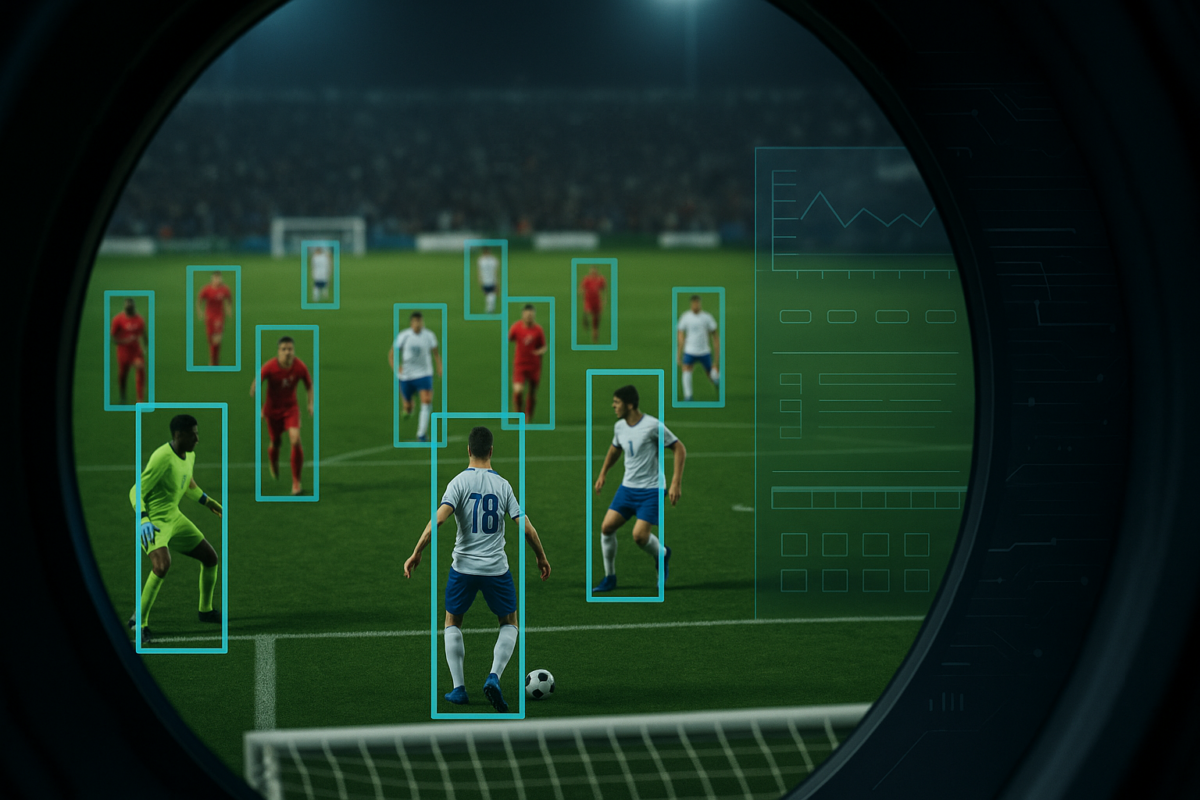
Beyond the tactical and technical aspects, individual analysis also plays a significant role in confidence building. Highlighting a player’s strengths, such as well-timed tackles or intelligent movement, reinforces positive behaviours and motivates them to continue improving. For players who may be struggling, personalised feedback can identify specific areas to work on, giving them a clear path to progress.

Moreover, youth development is not just about the player’s current performance but also about setting them up for long-term success. By tracking their development over time through consistent analysis, coaches can create tailored plans that evolve as the player grows and matures.

How to carry out individual player match analysis?

the zone14 camera.

The process of individual match analysis involves several steps, all designed to provide a clear and actionable evaluation of a player’s performance. Here’s how it typically works:

  1. Footage Collection: Match footage is reviewed to identify key moments, from successful passes and tackles to errors and missed opportunities.
  2. Tagging Key Events: Using video analysis tools, analysts can tag moments such as goals, defensive actions, or transitions, allowing for efficient review and organisation.
  3. Combining Data and Video: Metrics such as passing accuracy or distance covered are linked to relevant video clips, providing context and deeper understanding.
  4. One-on-One Feedback Sessions: The most crucial step is sharing findings with the player. Coaches can use organised playlists of each player to illustrate their points, offering visual proof of both successes and areas for improvement.

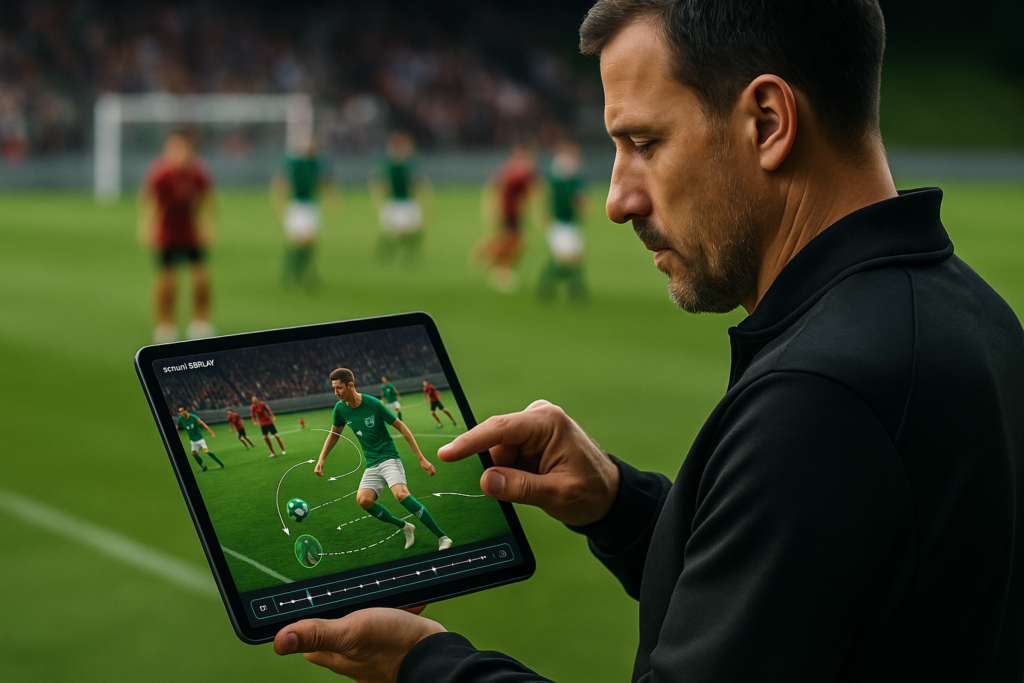
  5. Application in Training: The feedback is then integrated into training sessions, allowing players to practice specific skills or tactics highlighted during the analysis.

Making the Performance Analysis Process Efficient with Video Analysis Software

Manually analysing individual performances can be a time-intensive process, particularly for teams that lack dedicated analysts. This is where video analysis software becomes invaluable.

With tools like Tagging Boards coaches can mark key events during matches in real time, making it easier to locate and review specific moments later. Organisation features allow analysts to sort clips by player, match phase, or skill category, ensuring that feedback is focused and relevant.
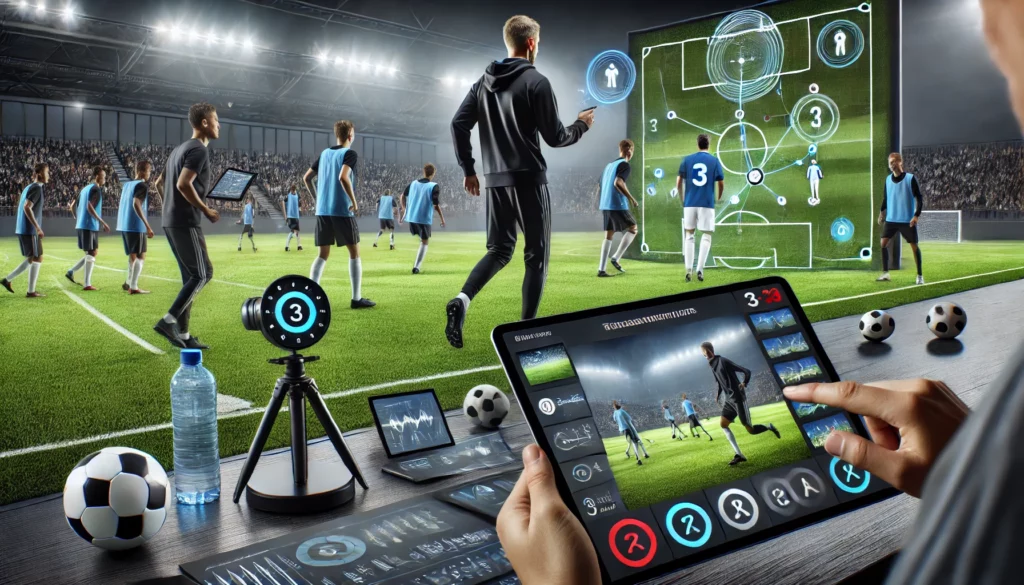
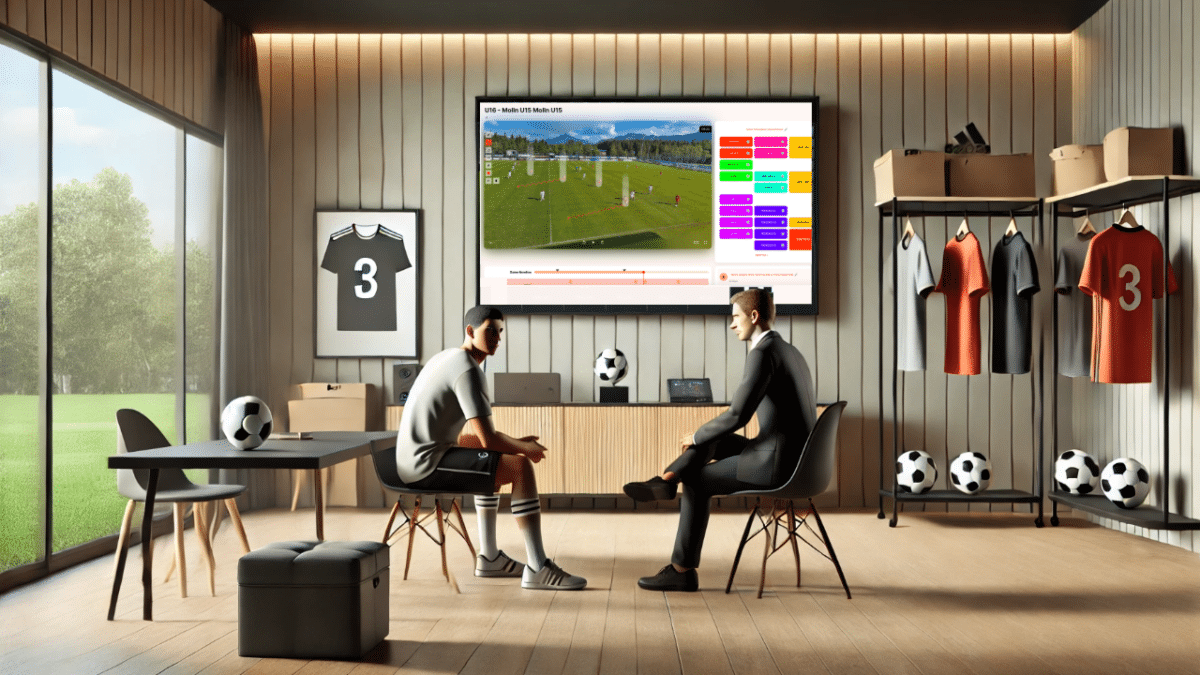
Additionally, modern platforms often include collaborative features, such as cloud-based sharing, enabling players and coaches to share and review analysis remotely. This is particularly useful for youth teams, where time constraints might limit the opportunity for in-person review sessions. By streamlining the analysis process, software not only saves time but also makes individual feedback more accessible and impactful.

Using zone14 REPLAY for player analysis sessions

At zone14 our mission has always been to democratise sports technology in football, make tools like individual player performance analysis available to clubs of all levels, not just the pros! 

The zone14 REPLAY platform makes organising and sharing your analysis clips simple. With completely customisable tagging boards, you can easily mark key events and then organise them into individual playlists to share with your players either directly through our platform or simply by downloading the playlists. 

Thanks to the All-In-One Camera System, REPLAY ‎‎‎‏‏‎ ‎and STATS from zone14, grassroots teams are now able to gain the advantage of performance analysis as seen by the pros! Click here to get in touch and find out how you can elevate your team’s performance together with zone14.

Start your video analysis.

Sign up now for a completely free demo account.

Conclusion: Enhancing Football Through Individual Analysis

The evolution of football has made individual performance analysis an indispensable part of the game. By combining video analysis with data and delivering personalised feedback, coaches can unlock the full potential of their players. Whether you’re working with youth players just starting their football journey or seasoned professionals seeking an edge, understanding and leveraging individual analysis is key to success.

Share on Facebook
Share on Twitter
Share on Linkedin
More related content from zone14
Categories
Video Analysis

The Advantages of In-Game Video Analysis in Football

Contents

The Advantages of In-Game Video Analysis in Football

Football has undergone a significant transformation in recent years with the support of advanced technological advancements. One key advancement is the development of video analysis technology, which has changed the way teams are able to prepare, perform, and even adapt strategies in real-time. You might have noticed professional football coaches on the sidelines glued to their tablets or iPads during matches. No, they’re not just checking social media or catching up on the latest news, these devices are crucial tools for real time analysis in football.

In what was once just a post-match tool, video analysis has now evolved into a critical real-time resource that allows teams to make instant adjustments based on what’s happening on the pitch. Live analysis enables coaches to fine-tune tactics, identify underperforming players, prevent potential injuries, and provide more effective feedback to players both during and after the game.

In this blog post, we'll explore the growing role of real-time video analysis in football, its numerous benefits, and how platforms like zone14 REPLAY make this possible not only for elite teams but also for amateur and grassroots clubs.

The Benefits of In-Game Analysis in Football

Real-Time Tactical Adaptations

Football is a fluid game, with tactics constantly shifting in response to the opposition, game context, and player performance. By using real-time analysis, coaches can immediately spot patterns and weaknesses that are able to be addressed immediately.

For example, a team may be struggling to press effectively, or a full-back could be constantly out of position, leaving the team vulnerable to counter-attacks. With the aid of live football analysis, coaches can identify and review these situations in real time and adjust their team's tactical setup to close gaps, adjust positioning, or change formation to counter their opponents’ strengths. These tactical tweaks can be the difference between holding onto a lead or conceding a late goal.

Real-Time Personnel Adjustments

Player performance varies from match to match, and a player that looked sharp in training might not necessarily carry that form into the game. By utilising in-game analysis, coaching staff can quickly identify players who are underperforming, fatigued, or struggling to make an impact. This allows for swift personnel changes, such as substitutions or positional adjustments, that can have a significant impact on the game’s outcome.

In some cases, teams are even able to carry out live data analysis, by tracking a range of metrics such as sprint speed, passing accuracy, or duel success rate, giving coaches quantifiable data to support their in-game decisions.

Injury Prevention and Player Workload Management

Injuries can derail a team’s season, and fatigue is often a major contributor to injuries during games. With real-time video analysis, it’s possible to monitor a player's movements and exertion levels throughout the match. Coaches can identify players who are at risk of overworking themselves, allowing them to either adjust their playstyle or bring in a substitution before an injury occurs.

Additionally, using in-game football analysis, coaches can ensure that high-risk players, such as those returning from injury, are monitored more closely. This proactive approach to injury prevention helps maintain a healthier squad and could extend the careers of key players by reducing their exposure to potential harm during matches.

A Different Angle for Coaches on the Sidelines

The view from the sidelines is often limited, which can make it difficult for coaches to get a complete picture of the game. With live video analysis, coaching staff can view the match from a different, normally higher angle. This allows coaches to spot opportunities or dangers that might not be visible from their view at pitchside.

For example, a coach may not realise that a player is constantly drifting out of position or that an opposing forward is exploiting space between the centre-backs. Live football analysis enables the coaching staff to address these issues by presenting the game from a different perspective, resulting in more informed and effective decisions being made during the match.

Instant replays to review match-changing moments

Start your video analysis.

Sign up now for a completely free demo account.

Every match has multiple key moments, whether it’s a defensive lapse, a game-changing chance, or even a controversial refereeing decision. By using real-time video analysis, coaching staff can immediately access instant replays to review these key moments. This allows for rapid decision-making and feedback to players.

For example, a coach may want to show their team a replay of a defensive breakdown or a missed scoring opportunity to provide instant feedback and ensure they’re more prepared for similar situations as the game progresses.

Informed Half-Time Team Talks

One of the most effective uses of in-game football analysis is during half-time, where coaches can use the footage or data gathered in the first half to deliver a more structured and evidence-based team talk. Instead of relying solely on subjective observations, coaches can show players visual examples of tactical missteps or areas where improvement is needed, giving them the chance to make the necessary adjustments for the second half.

Armed with this objective feedback, players can take to the pitch after half-time with clear and precise instructions on how to exploit their opponent’s weaknesses or fix issues from the first half, giving them a competitive edge.

From professional football to grassroots: The rise of real-time analysis at all level of the game

In the past, live video analysis has only been accessible to top-tier clubs with vast resources and big budgets. However, advancements in technology, through platforms like zone14 REPLAY , have made this capability available to clubs at every level, from professional outfits to even grassroots and amateur teams.

In today’s football landscape, even a local youth team can benefit from real-time analysis, using video footage to enhance player development and tactical awareness. Amateur teams can now review their performances and make instant adjustments, providing them with the same opportunities to improve as their professional counterparts. This democratisation of football technology ensures that no matter the level of play, teams can benefit from the power of live football analysis.

How zone14 REPLAY brings real-time football analysis

At zone14, we are proud to offer an all-in-one cameraand video analysis platform that enables football teams to take advantage of cutting-edge in-game analysis tools. Our LIVE package is designed to give teams of all levels, from professional to grassroots, the ability to conduct live video analysis during matches.

On the zone14 REPLAY platform you can instantly review key moments, and provide real-time feedback to players and coaches (or even referees!). Whether it’s making tactical adjustments, identifying underperforming players, or preventing injuries, zone14’s real-time analysis feature ensures you have the tools you need to make objective and effective decisions during the heat of the game.

What sets zone14 apart is its accessibility. Our platform is easy to use and affordable making it the perfect solution for clubs at any level. From improving individual player performance to refining team tactics, you are able to deliver powerful insights to your squad that can make the difference between winning and losing.

zone14 LIVE

Your real-time advantage

Conclusion

The importance of in-game video analysis in football cannot be overstated. Whether it’s making tactical tweaks, managing player workloads, or preparing for half-time team talks, real-time analysis offers a competitive edge that can turn the tide of a match. And thanks to providers like zone14, this technology is now available to teams of all levels, not just the elite.

Share on Facebook
Share on Twitter
Share on Linkedin
More related content from zone14
Categories
Video Analysis

How to become a video analyst in football?

Contents

How to become a video analyst in football?

The role of the video analyst in football has developed rapidly over the last few decades. From an analysis tool for coaches to a key role in modern football clubs, both professional and youth, video analysis has become an indispensable part of the game. In this blog, you will learn step-by-step how to become a video analyst, what skills and qualifications you need and what special routes there are in Austria to gain a foothold in this profession.

Abstract representation of video analysis

1. The role of the video analyst in football

What does a video analyst actually do in football?

A video analyst is a highly specialised employee of a football club or association whose main task is to analyse matches and training sessions in order to improve the team's performance and support the coach in tactical preparation.

Match analysis: After each match, all the footage is analysed by the video analyst. This involves looking at tactical patterns and the performance of individual players, as well as evaluating specific match situations such as set-pieces, pressing behaviour and counter-attacks.

Opponent analysis: An important part of the work is the detailed analysis of opposing teams. The video analyst examines the style of play, typical attacking patterns, defensive weaknesses and key players in order to provide the coaching team with a precise overview.

Training evaluation: Video analysts also film training sessions to evaluate their effectiveness. By analysing the training footage, suggestions for improvement can be made and specific weaknesses of the players can be identified.

Reporting and presentation: The collected data and video clips must be prepared and be easily presentable, often for the coaching team and the players themselves. Video clips with tactical comments, PowerPoint presentations or reports with visualisations are used here.

Live analysis: For many professional and amateur teams, the video analyst sits directly in the stands or near the coaching bench during the match and provides the coaching team with real-time data. This enables tactical adjustments to be made during the game.

2. Requirements for video analysis

Footballing understanding: A solid understanding of tactics and strategy is the foundation for any video analyst. Without this knowledge, it is almost impossible to recognise the correct meaning behind the game situations captured on video.

Tactical knowledge: You need to know how different formations work, the principles of play behind them and how different tactical aspects such as pressing, switching play or possession play.

Game analysis perspective: It is important not only to observe the game, but also to understand the deeper tactical motivations behind the decisions of the players or the coach. Understanding ‘invisible’ aspects such as spatial awareness, running routes and defensive strategies is crucial.

Technical knowledge: A video analyst needs to be familiar with a variety of software tools and technologies in order to work efficiently.The following technologies and programmes are usually essential:

  • zone14: REPLAY is attractive to video analysts as it provides an AI-based platform that automatically records and analyses football matches, significantly reducing manual work. The software enables real-time analysis and provides extensive data visualisations to facilitate tactical adjustments and player development. In addition, the user-friendly technology is also accessible to amateur clubs, providing efficient tools for video analysts at various levels of performance.
  • Sportscode (Hudl): This is one of the most widely used software solutions for video analysis in professional football. Sportscode makes it possible to encode videos, i.e. to tag and categorise match scenes (e.g. all shots on goal, ball recoveries, counter-attacks).
  • Coach Paint: This software is used to visualise tactical explanations by placing markers, arrows or highlights on videos.
  • Nacsport: Another popular tool, especially in academy and semi-professional environments. Nacsport offers similar features to Sportscode, but at a lower price and with a more user-friendly interface.
  • InStat and Wyscout: These two platforms offer extensive databases and analyses for games worldwide. They provide access to extensive video clips and statistics of players and teams, which is particularly useful for analysing opponents.

Data analysis and statistics: Data analysis is playing an increasingly important role in modern football analysis. In addition to pure video processing, video analysts must be able to interpret data and prepare it in a way that is understandable for coaches and players. 

Statistical tools: It is an advantage if you can work with Excel or Google Sheets and carry out basic statistical analyses; advanced knowledge of programs such as Tableau or R can help you to visualise data and carry out in-depth data analyses.

Football analysis platforms: Platforms such as Opta, FBref or StatsBomb are important sources for comprehensive statistical analyses and can be combined with video analysis to gain in-depth insights.

Attention to detail: You need to be able to recognise the smallest details that often make the difference between winning and losing. An eye for tactical subtleties and player movements is essential. 

Communication skills: A video analyst works closely with the coaching team. You must be able to present your analysis clearly and comprehensively. Often the analysts also work directly with the players, so clear communication is essential. 

Modern video analysis presented

3. Educational opportunities in Austria

Austria offers a wide range of training opportunities to qualify as a video analyst in football.

University education: An academic education in sports science or related subjects provides a solid theoretical foundation. Many universities in Austria offer courses in sports analysis and football tactics.

One example is the University of Vienna. There is a special sports science specialisation that also includes modules in game analysis and tactics. The advantage of a university education is that not only technical skills are taught, but also theoretical knowledge of sports economics, psychology and management.

Coach licences with the ÖFB: Another option is training through the Austrian Football Association (ÖFB). Important tactical modules that are relevant for working as a video analyst are offered as part of coaching education such as the UEFA B or A licence.

These courses not only offer the necessary football-specific training, but also a good network of other coaches and analysts that can help you get started in the profession.

Specialised courses and workshops: There are also specialised training courses for video analysts in Austria. 

Private courses and online programmes: Platforms such as Coursera or edX offer courses on sports analysis. These are often a good addition to practical experience and allow you to expand your knowledge in a targeted manner.

4. Practical experience and networks

Internships: As in many areas of sport, practical experience is invaluable. Worldwide, there are numerous opportunities to complete internships within the performance analysis departments at professional or semi-professional clubs.

Networking: A strong network is crucial for success as a video analyst. Attend coach training courses, sporting events or conferences to get in touch with like-minded people. In Austria, there are regular events as part of the ÖFB coaching courses or at major tournaments that are ideal for networking.

Own projects: Many successful video analysts have made a name for themselves with their own analysis projects. This means, for example, that you record and analyse games and share the results on platforms such as YouTube or your own blog. Such projects can serve as work samples and help with job applications.

The path to becoming a video analyst, abstract

5. Career prospects for video analysts in Austria

The profession of video analyst is on the rise in Austria - as in other countries. Professional clubs and national teams in particular are increasingly relying on analysis to improve their sporting performance. Here are some possible career paths:

Professional clubs: The highest level is working for a Bundesliga club or an international club. These positions usually require a lot of experience and a strong portfolio.

National team: The ÖFB also employs video analysts for its national teams. These positions offer the opportunity to work at the highest level and cover international tournaments.

Academies and youth centres: Starting at the youth level is often a good way to gain experience and qualify for higher positions.

Start your video analysis.

Sign up now for a completely free demo account.

The exemplary path: from beginner to Bundesliga analyst

Let's take a look at a possible career path that leads from enthusiasm for football to employment as a video analyst at an Austrian Bundesliga club.

Step 1: Develop a passion for football

It all starts with a passion for football. Many video analysts come from an environment in which they have either played football themselves or have a keen interest in football. This stage is about consuming as much football as possible and developing a deep understanding of tactics, player roles and strategies.

Practical football experience: Perhaps you play for an amateur club yourself or are a passionate football fan. The aim is to develop a deep understanding of the game. This includes understanding different formations, phases of play (build-up, switching, counter-attacking) and tactical systems.

First insights into tactical analysis: You can read books on football tactics such as ‘Inverting the Pyramid’ by Jonathan Wilson or follow online tactical analyses and podcasts to deepen your knowledge.

Step 2: Develop technical skills

The next step is to develop the technical skills that a video analyst needs. In this phase, you will learn how to use video analysis tools and software. A good video analyst not only needs to be football savvy, but also be able to use modern technology.

Learn video editing: Learn basic software such as Adobe Premiere Pro or Final Cut to cut and edit simple video clips.

Learn more specialised analysis software: Use software such as zone14, Nacsport or InStat, which is widely used by different clubs. These programs make it possible to encode match recordings, mark scenes and create comprehensive analyses.

Acquire data analysis skills: Data interpretation plays a major role in modern video analysis. Learn basic Excel skills and work with statistics programs such as R or Python to analyse and visualise football statistics.

Example: You decide on a course in video editing or take one of the online courses for an introduction to sports code. At the same time, you analyse football matches on your own and publish them on platforms such as YouTube to gain your first practical experience.

Stage 3: Training and first internships

After developing initial technical skills, the next step is formal training and gaining practical experience in football analysis.

Studying sports science: A degree programme in sports science or training theory at universities provides theoretical knowledge about sports analysis. Many degree programmes include modules on match analysis and offer you the opportunity to combine these with practical modules.

Coaching licences: As an alternative or parallel to your studies, you can obtain coaching licences from the ÖFB (Austrian Football Association), such as the UEFA B licence, which covers tactics and match analysis. These licences definitely help in order to be taken seriously as an analyst.

Internships at clubs: To gain valuable practical experience, you can look for internships at local amateur or semi-professional clubs. Here you can put into practice what you have learnt during your studies and make your first contacts in the world of football.

Example: After graduating, you start as an intern at a regional football club in the second division. There you will have the task of filming the first team's matches and preparing initial analyses for the coaching team. You will gain an insight into the life of an analyst and make your first valuable contacts.

An abstract representation of the video analysis

Stage 4: First jobs

With your degree or coaching licence and practical experience under your belt, you are ready for your first professional jobs.

Work for amateur and semi-professional clubs: Entry into professional football is often via the youth sector or semi-professional clubs. Here you can work as an analyst and develop your skills. Many analysts start their career in youth academies or at amateur clubs to gain experience.

Example: You get a part-time job as a video analyst at a club in the Austrian 2nd Bundesliga. Here you will work closely with the coaching team, analyse the opponents and prepare weekly reports. You will learn how to prepare your analyses in such a way that they are easy to understand for the coaching team and the players. At the same time, you regularly attend ÖFB training courses to expand your network.

Stage 5: Promotion to the Bundesliga

With a few years of experience as a video analyst and a solid network, you now have the opportunity to take the next step in your career.

Promotion to the professional ranks: The path to the Austrian Bundesliga is based on experience, reputation and contacts. Many analysts become interesting through their work in the lower leagues or through recommendations for professional clubs.

Specialisation: Specialisation: Some analysts specialise further in this phase - for example in certain tactics or working with certain areas of the squad (strikers, defenders). This makes them valuable experts in the team of a Bundesliga club.

Growing responsibility:As a Bundesliga analyst, your responsibility grows. You work closely with a team of analysts and are responsible for detailed opponent analyses, real-time analyses during the match and match preparation.

Example: Due to your successful work in the 2nd division, you are contacted by a club in the Austrian Bundesliga, e.g. Austria Wien. You start there as an analyst and support the head coach in match preparation. Your work includes analysing your team's matches in detail and preparing for upcoming opponents. You will analyse video recordings and data from platforms such as zone14 and present this information to the coaching team. At the same time, you help to implement tactical changes in the live game.

Everything to do with football, abstract

Conclusion

However, the path shown is just one of many. Becoming a successful video analyst requires patience, dedication and a good balance between football knowledge and technical expertise. In Austria, there are many ways to enter this profession, be it through university education, specialised coaching courses or independent further education. If you can combine your passion for football with technical understanding and are willing to keep learning, you can look forward to an exciting career as a video analyst.

The key to success lies in the combination of theoretical knowledge, practical experience and a strong network. The more time you are prepared to invest in your education and training, the greater your chances of gaining a foothold in this up-and-coming industry.

For prospective coaches, however, this also means that the path to the top requires discipline, patience and a great passion for the game. Those who take on this challenge can be sure that they will receive an education that prepares them for the highest level of football.

Already have a camera but looking for an affordable analysis platform?

zone14 COACH is the solution

Share on Facebook
Share on Twitter
Share on Linkedin
More related content from zone14
Categories
Video Analysis

The Role of Video Analysts in Football

Contents

The Role of Video Analysts in Football

In the modern era of football, technology seems to have been integrated into every aspect of the game, from training sessions to post-match reviews. Among the technological advancements, video analysis stands out as a critical tool for enhancing team performance and strategically preparing for matches. The often unsung heroes behind this revolutionary change are the video analysts themselves. Their role extends beyond merely recording matches; they delve into detailed scrutiny of every move, play, and tactic to provide crucial insights to coaches and players.

The Scope of Video Analysis in Football

Video analysis in training

Video analysis in football involves recording, breaking down, and scrutinising match footage to extract meaningful data that can inform team strategy and individual player development. 

The process begins with capturing the game from multiple angles, ensuring that every detail and player movement is in frame. Advanced video analysis software is then used to analyse the footage, providing a comprehensive overview of various aspects such as player positioning, movement patterns, and tactical execution.

Key Responsibilities of Video Analysts

Match Recording and Data Collection

The primary responsibility of a video analyst is to record matches and training sessions. This involves setting up cameras to capture the right angles, ensuring that no aspect of the game is missed. Beyond just recording, analysts also collect and organise data on various performance metrics such as distance covered, number of passes, and possession statistics. This data is critical for creating an objective view of the team’s performance.

Performance Analysis

Once the footage is collected, video analysts use specialised software to break down the game into smaller segments, or in some cases use tagging boards, to make this process more efficient. They analyse individual and team performances, identifying strengths and weaknesses. This involves evaluating player movements, decision-making processes, and the effectiveness of different plays. The insights gained from this analysis help in understanding what worked well and what needs improvement.

Tactical Analysis

Tactical analysis is another crucial aspect of a video analyst’s role. By studying historic footage as part of pre-match preparation, analysts can dissect the opponent’s strategies and formations. This information is used to prepare the team for upcoming matches, devising counter-strategies to exploit the opponent’s weaknesses and mitigate their strengths. Tactical analysis also involves reviewing the team’s formations and making both team and individual adjustments to enhance performance.

Player Development

Video analysts play a significant role in individual player development, particularly in youth players.By providing detailed feedback on their performance, analysts help players understand their strengths and areas for improvement. This personalised feedback is essential for player growth, as it allows them to understand and focus on specific aspects of their game that need refinement. 

Communication with Coaching Staff

Effective communication with the coaching staff is vital for the successful implementation of video analysis. Video analysts work closely with coaches to present their findings and suggest strategic adjustments. This collaboration ensures that the insights derived from the footage are actionable, and turn into improvements on the field. Regular meetings and presentations help in aligning the coaching strategies with the analytical findings, supporting the modern data-driven approach football coaching.

Step by Step Role Breakdown

Eine Gruppe Jugendspieler und ein Trainer sind Spielszenen auf einem großen Bildschirm am schauen. Der Trainer zeigt auf dem Schirm um die Taktik zu erklären

Pre-Match Preparations

Before the match, video analysts focus on gathering and reviewing footage of the opponent’s previous games. This involves identifying key players, their strengths and weaknesses, and the tactical patterns they tend to employ. Analysts prepare detailed reports and highlight reels to inform the coaching staff and players about the opponent’s strategies, supporting the coaches to set up the right game plan. 

In-Game Analysis

During the match, video analysts provide real-time insights to the coaching staff. By monitoring the game live from a different viewpoint to the coaches on the sidelines, they can quickly identify critical factors such as tactical shifts or individual player performance issues. This immediate feedback allows coaches to make informed decisions on substitutions, formation changes, and other tactical adjustments to counteract the opponent's strategy mid game. 

Post-Match Analysis

After the match, video analysts conduct a thorough review of the game, focusing on both team and individual performances. They use advanced software to tag and categorise both successful and unsuccessful moments, such as goals, build up play, and set piece strategies. These insights are then compiled into detailed reports and video presentations for the coaching staff and players, highlighting what worked well and what areas need improvement.

Find out how TWL Elektra’s analyst is analysing every single match using zone14

The Impact and Result of Video Analysis on Football

The integration of video analysis has massively impacted football, bringing numerous benefits to teams and players. Here are some of the key impacts:

Enhanced Team Performance

By providing detailed insights into team dynamics and individual performances, video analysis helps in fine-tuning strategies and improving overall team performance. Coaches can make informed decisions about player selection, formations, and tactics, leading to more effective game plans.

Improved Tactical Awareness

Video analysis enhances tactical awareness by providing a deeper understanding of both the team’s and the opponents’ strategies. This heightened awareness allows teams to adapt more quickly during matches, making real-time adjustments to counteract the opponent’s moves.

Personalised Training Programs

With detailed performance data at their disposal, coaches can design personalised training programs tailored to each player’s needs. This targeted approach helps players to work on their specific weaknesses and enhance their strengths, contributing to their overall development.

Injury Prevention and Management

Video analysis also plays a role in injury prevention and management. By studying movement patterns and identifying any anomalies, analysts can help in detecting potential injury risks. This proactive approach enables the medical team to intervene early, reducing the likelihood of injuries.

Post-Match Reviews and Feedback

Post-match reviews are an integral part of the learning process in football. Video analysts prepare detailed reports and highlight reels that showcase key moments from the match. These reviews are used to provide constructive feedback to players, helping them learn from their mistakes and replicate successful actions. Video analysis supports making feedback objective, increasing team cohesion. 

Challenges Faced by Video Analysts

Despite the numerous benefits, video analysts face several challenges in their roles. The sheer volume of data to be processed can be overwhelming, requiring significant time and effort. Keeping up with the latest technological advancements and updates is also essential to stay efficient and effective in the role

Additionally, ensuring clear communication and collaboration with the coaching staff can be challenging, especially in high-pressure environments where quick decisions are needed.

Similarly, as video analysis is a relatively new development within the sport, it can sometimes be initially difficult to get every coach ‘onboard’ and supportive of the idea.

How are zone14 supporting football video analysts?

At zone14 our aim is to democratise technology, and make tools such as video analysis available to coaches at all levels of the game. Our analysis platform, zone14 REPLAY zone14 REPLAY, has been developed by coaches, for coaches (and analysts!). At zone14 we saw a problem in video analysis being extremely time consuming, particularly for coaches in the amateur and semi professional leagues. Our tagging boardsolution allows events to be tagged throughout the game, and then organised into playlists, saving coaches a significant amount of time in organising their footage post-match. Our drawing tools are simple and easy to use, meaning visualisations can easily be presented to players during meetings, or coaches during planning. 

STATSis the most significant development so far at zone14, allowing coaches and analysts to view player running data for every match recorded with the zone14 ONE camera

Heatmaps by zone14 (Zoomed)
Streamline your analysis process

Test zone14 REPLAY for free now

Conclusion

The role of sport video analysts in football is indispensable in the modern game. Through the use of technology to provide detailed insights into performances and tactics, they contribute significantly to the success of teams and the development of players. As football continues to evolve, the importance of video analysis and data is only set to grow, making video analysts an integral part of every team's staff. 

Share on Facebook
Share on Twitter
Share on Linkedin
More related content from zone14
Already have a camera but looking for an affordable analysis platform?

zone14 COACH is the solution

Categories
Video Analysis

Video analysis in training

Contents

Video analysis in training

Football is more than just a game on the pitch - it's a science that is constantly evolving. The rapid development of technology has fundamentally changed the way teams train, analyse and prepare for matches. At the forefront of this revolution is video analysis - a tool that allows every movement, every tactic and every detail of a game to be captured and analysed. But how exactly is video analysis changing football training? How are top clubs using this technology to improve their players and optimise their strategies? In this in-depth look, we reveal the secret mechanisms of video analytics, discuss its role in modern football and show how it is revolutionising performance on the pitch. Prepare to discover the invisible threads that guide modern football teams to success and redefine the way games are analysed and played.

Video analysis in evening training

Detailed match analysis and preparation

Video analysis is an indispensable tool in match preparation. Coaches and analysts use match videos to study both their own team's performance and that of their opponents. Detailed analyses can be used to identify weaknesses in the opponent's build-up play and develop appropriate training strategies. For example, analysing the opponent allows certain recurring moves to be identified, which the coach can use to implement specific defensive drills in training.

Feedback and performance improvement

Video analysis makes it possible to precisely assess the individual performance of players. By recording and analysing training matches, coaches can provide targeted feedback based on visual evidence. This helps players to visualise specific situations and their own actions and to understand what they can specifically improve. For example, a midfielder's positional play can be analysed to improve the efficiency of their runs and decision making under pressure.

Long-term development and progress monitoring

Another important aspect of video analysis in training is the ability to monitor the long-term development and progress of players. Through regular video analyses, the coach can track a player's development over the course of the season and adjust training plans to ensure that each player achieves their personal and team goals.

Integrating video analysis into everyday training

To effectively integrate video analysis into everyday training, many clubs use special software and mobile applications like for example zone14 that allow coaches and players to access analyses and feedback directly on the training pitch. These tools often also offer the opportunity to repeat and discuss certain match scenes directly on the pitch, which significantly improves the players' ability to learn and adapt.

Easy video analysis in training

Video analysis in the various training areas

Technical training

Video analysis plays a crucial role in improving players' technical skills. Coaches can use training recordings to analyse players' technique when receiving the ball, passing or shooting. Using slow motion and zoom functions, it is possible to recognise exactly how a player hits the ball or which foot position he adopts when receiving the ball. Such analyses lead to targeted feedback that helps to correct technical weaknesses.

Tactics training

In tactics training, video analyses are used to improve the players' understanding of moves and formations. Coaches can pick out specific sequences of play to discuss the positioning and movement behaviour of the players. This is particularly useful for improving the effectiveness of pressing situations, block defence or switching from defence to attack. Players can better understand how their actions affect the team game through visualisation.

Standard training

Standard situations such as free kicks, corners and penalties are often decisive for the game. Video analysis helps to assess the effectiveness of execution and defensive work in these situations. By analysing past matches or training sessions, the coach can give specific instructions on how the players can improve their positioning and running routes in order to be more effective in set-piece situations.

Player-specific training

Video analysis enables individualised coaching of players through detailed observation of their performance. For example, the analysis can show how well a striker overcomes the offside trap or how a midfielder deals with pressure situations. Such individual analyses are crucial for creating customised training plans that are tailored to the specific needs of the players.

Rehabilitation and return to training

After an injury, a gradual return to regular training is crucial. Video analysis can help monitor and analyse the player's movements to ensure there are no unfavourable patterns or asymmetries that could encourage re-injury. Visually reviewing a player's progress in real time is an essential tool for medical teams and coaches.

Dynamic training with focus on video analysis

Use of video analysis and artificial intelligence in football training

Artificial intelligence in video analysis

AI significantly expands the possibilities of traditional video analysis. Those systems are able to analyse large amounts of video data much faster than human analysts ever could. They are able to automatically recognise and categorise certain player movements, ball positions and even the posture of players. Such systems not only help to measure player performance, but also to create predictive analyses for future matches.

Statistics easier than ever before

Tracking AI can replace additional hardware such as GPS trackers, simplifying data collection and ensuring that players' performance is not affected by external devices. This technology enables professional insights and objective feedback, improving tactical execution and communication within the team. zone14 STATS is able to record data such as distances, sprints and speeds directly from the pitch. The comparability of the data enables a new dimension of coaching, improves the quality of the coaching team's decisions and increases the motivation of the players.

Intervene live in the game

With zone14 LIVE allows important moments during the game to be captured and tagged in real time so that instant summaries can be created and nothing is missed. The tags can be customised, which significantly reduces post-match analysis time as the tagged events can be retrieved instantly rather than having to re-watch the entire game. In addition, all tagged events can be summarised in playlists to provide a clear overview of the most important moments and to compare current match scenarios with past ones.

Professional analysis for everyone

zone14 REPLAY offers a user-friendly video analysis platform that has been specially developed by coaches for coaches. The solution is used worldwide by analysts in various football leagues, from professional to amateur football. It aims to save time and costs while providing efficient and professional analysis options. Videos can be uploaded and saved to the cloud with just a few clicks. Users have the option of customising their tagging board, organising drawings and clips, saving them in playlists, downloading them or sharing them via WhatsApp.

Future prospects

The technology behind video analysis and artificial intelligence is developing rapidly. In the coming years, we could see even more intelligent systems that can provide even more accurate analyses in real time. These developments could fundamentally change the way coaches and players play football.

Start your video analysis.

Sign up now for a completely free demo account.

High-tech video analysis with AI

Examples from top clubs

FC Barcelona - ‘La Masia’ and Tiki-Taka

FC Barcelona is known for its ‘La Masia’ academy and its unique Tiki-Taka system of play. Video analysis is used intensively to teach the players the principles of passing, ball control and spatial awareness. Analysing training and match videos allows coaches to provide individual feedback and highlight specific areas for improvement, which supports the precise execution of the Tiki-Taka style.

Liverpool FC - Moves and opponent analysis

Under coach Jürgen Klopp, Liverpool FC have developed specific training sessions focussing on set pieces. Video analysis is used to assess the execution of free kicks and corner kicks both in training and in matches. In addition, the technical team analyses the opponent's style of play in order to identify weaknesses in the opponent's defence in set-piece situations, which are then incorporated into the pre-match tactical briefing.

Manchester City - Spatial analysis and player positioning

Under Pep Guardiola, Manchester City have utilised video analysis to perfect the spatial awareness and positioning of players. By analysing player positions in detail during training and matches, the coach can make adjustments to improve the possession game and help players use and create space more effectively.

Video analysis with young players

Conclusion

The integration of video analysis into football training has fundamentally changed training methods and match preparation. This technology allows coaches and analysts to scrutinise every element of the game with unprecedented accuracy and depth. From individual performance assessment to strategic match preparation, video analysis is a powerful tool to maximise strengths and minimise weaknesses.

Through detailed analysis of player movements, tactical formations and opponent strategies, coaches can develop bespoke training programmes tailored to the exact needs of their teams and individual players. This personalised approach not only promotes the development of each player's technical skills and tactical understanding, but also improves the dynamics and performance of the team as a whole.

Overall, video analytics has the potential to permanently change the landscape of professional football by providing an in-depth understanding of all aspects of the game and giving coaches and players the tools to compete and triumph at the highest level.

Already have a camera but looking for an affordable analysis platform?

zone14 COACH is the solution

Share on Facebook
Share on Twitter
Share on Linkedin
More related content from zone14
Categories
Spieldaten

Data analysis at the European Championship and World Cup

Contents

Data analysis at the European Championship and World Cup

The use of data analytics in football, particularly at major tournaments such as the UEFA European Championship (EURO) and the FIFA World Cup (WC), has evolved dramatically over the years. The history of this development, and in particular the practice of manual tagging, offers fascinating insights into the evolution of sports technologies and strategies. This blog post provides an overview of the history of data usage at football tournaments and highlights the changes that have taken place over the years.

1990s Data collection from football matches

Revolutions in data collection at football tournaments

The evolution of data collection and analysis at major football tournaments such as World Cups and European Championships reflects technological advances and the growing importance of data science in sport. Here's a look at the key changes and comparisons between different eras.

1980s: The beginnings

In the 1980s, data analysis methods in football were still in their infancy. Most of the data was collected manually and the concept of systematic analysis had barely been developed.

  • Manual recordings: Analysts noted events such as shots on goal or fouls on paper.
  • Limited statistical depth: The data collected was mostly limited to simple metrics such as goals, shots and fouls.
  • No real-time analysis: The data was often only used after the game for debriefing.

1990s: The beginning of systematic analysis

With the advent of the first computer programmes, teams began to use more systematic forms of data collection.

  • First software tools: Programmes for data collection and analysis are introduced, even if many processes are still manual.
  • Beginning of video technology: Games were recorded and analysed manually, which enabled subsequent but more detailed analysis.

2000s: The digital revolution

The 2000s brought a major technological leap with the introduction of automated systems and advanced analysis tools.

Introduction of Prozone: This tool enabled more detailed performance analysis through automated tracking systems.

  • GPS and RFID technologies: Player movements and positions could now be tracked accurately and in real time.
  • Analytical reports: Data was not only collected but also thoroughly analysed to improve tactics and performance.

2010s: Big data and AI

The use of big data and artificial intelligence has further revolutionised data collection and analysis over the last decade.

  • Machine learning: Algorithms can now recognise patterns and strategies that are too complex for human analysts.
  • Real-time feedback: Tools such as SAP Sports One enable coaches to make decisions based on live data.
  • Detailed player profiles: Each player can be analysed using a variety of physical and tactical metrics.

2020s: Future prospects

Current and future developments point to further automation and refinement of data.

  • Augmented reality and virtual reality: New technologies allow coaches and players to approach match analysis in innovative ways.
  • Integration of wearables: Players are increasingly wearing sensors that provide comprehensive health and performance data in real time.
  • Global data pools: The collection and analysis of data is becoming increasingly international and inclusive, further enhancing scouting networks and player preparation.

The history of data analysis in football shows a clear evolution from manual, paper-based methods to an era of digitalisation, automation and intelligent data management. Each decade has seen innovations that have not only changed the way games are analysed and understood, but have also had a direct impact on improving the performance of teams and players. The future promises to continue this revolution with even smarter and more connected systems that have the potential to transform football in unimaginable ways.

Success through data in football

Examples of success through data

Germany in the 1970s

Germany, particularly during the 1974 World Cup on home soil, utilised advanced statistical recording to improve the team's performance. Under the leadership of Helmut Schön and later Franz Beckenbauer, the DFB began to keep more detailed records of match behaviour, including players' running routes and the distribution of passes. These manual analyses helped to develop match strategies aimed at exploiting opponents' weaknesses.

Italy in the 1980s

Italy, who won the 1982 World Cup, also relied on traditional methods of data collection to gain deeper insights into their players' performances. The Italian Football Federation used match reports and manual statistics to analyse the fitness and tactical behaviour of its players. This data was used to strengthen the defensive tactic known as "catenaccio", a strategy that relies heavily on solid defence.

Spain (Euro 2008, World Cup 2010, Euro 2012)

Spain's dominance, winning the 2008 European Championship, the 2010 World Cup and the 2012 European Championship, was in part the result of sophisticated data analysis.Spain used data to perfect the famous tiki-taka system of play, based on precise passing, possession and utilisation of space. Analysing player patterns and evaluating opponents' strategies allowed coaches to maximise the effectiveness of their system of play.

Germany (World Cup 2014)

The success of the German national team at the 2014 World Cup in Brazil is a prime example of the effective use of data analytics, with the German Football Association (DFB) working closely with SAP to develop a special analytics tool that could be used to analyse player performance in detail and develop optimal match tactics, helping the German team to better analyse their opponents and adapt their own game strategy. The convincing victory against Brazil in the semi-final and the triumph against Argentina in the final showed how data analysis can help to optimise performance and tactics.

The mass of analysts it took to manually collect data from a game

The role of data analysts at FIFA and UEFA

Major football organisations such as FIFA and UEFA recognised the potential of data analysis early on and invested in personnel accordingly. At major tournaments such as the World Cup and European Championships, more than 100 people were often employed per match to collect and record all relevant data. 

These teams of data analysts and statisticians were tasked with tracking every action on the pitch and manually entering it into specialised systems.

The role of data analysts at FIFA and UEFA

Major football organisations such as FIFA and UEFA recognised the potential of data analysis early on and invested in personnel accordingly. At major tournaments such as the World Cup and European Championships, more than 100 people were often employed per match to collect and record all relevant data. 

These teams of data analysts and statisticians were tasked with tracking every action on the pitch and manually entering it into specialised systems.

Start your video analysis.

Sign up now for a completely free demo account.

The logistics behind manual tagging

At major football tournaments, FIFA and UEFA utilised impressive logistics to ensure the quality and quantity of data collected. 

Each team of analysts was responsible for specific aspects such as player actions (shots, passes, tackles), match events (goals, cards, substitutions) and positions on the pitch.

Challenges of tagging by hand

Manual tagging, especially in an environment as dynamic and fast-paced as a football match, presents significant challenges:

  • Accuracy: the accuracy of the data depended heavily on the attention, size and experience of the team of analysts.
  • Consistency: With so many people involved, standards and training had to be strictly managed to ensure consistency in data collection.
  • Real-time processing: Data had to be captured and processed quickly enough to provide useful information to coaches and teams while the game was still in progress.

Present and future

Today, data analysis and tagging in football is highly technical and automated. The use of AI and machine learning makes it possible to recognise complex patterns and strategies that human observers may miss. Recent tournaments, such as the 2020 European Championship and the 2022 World Cup, have utilised advanced tracking systems and analytics tools to provide detailed insights into almost every aspect of the game.

Artificial intelligence means that significantly fewer people are needed to collect data

Conclusion

The history of data collection and tagging in football clearly shows how technological advancements have changed the way we understand and analyse games. From the days of manual tagging to modern real-time analysis, data science has had a profound impact on football. While major tournaments such as the European Championship and the World Cup continue to serve as a stage for the latest innovations, it remains exciting to see what developments the future will bring.

Already have a camera but looking for an affordable analysis platform?

zone14 COACH is the solution

Share on Facebook
Share on Twitter
Share on Linkedin
More related content from zone14
Already have a camera but looking for an affordable analysis platform?

zone14 COACH is the solution

Categories
Video Analysis

Finding the best software for football video analysis

Contents

Finding the best software for football video analysis

In football, carrying out effective video analysis can make the difference between winning and losing. Coaches and analysts need tools that are not only powerful but also easy to use and time-efficient. Whether you're an amateur coach or a professional analyst, having the right software can transform your approach to training and match preparation.

Why Video Analysis is Crucial in Football

Video analysis in football is essential for breaking down complex plays, understanding team dynamics, and improving individual player performance. It provides coaches with the ability to visually communicate tactics and strategies, making it easier for players to grasp and execute their roles on the pitch. With advancements in technology, video analysis software has become more accessible and feature-rich, catering to both amateur and professional needs.

Eine Gruppe Jugendspieler und ein Trainer sind Spielszenen auf einem großen Bildschirm am schauen. Der Trainer zeigt auf dem Schirm um die Taktik zu erklären

Key Features of the Best Football Video Analysis Software

To ensure you choose the best video analysis software, look for these essential features:

User-Friendly Interface

The platform should be intuitive and easy to navigate, allowing users of all technical levels to operate it efficiently. This is particularly important for amateur coaches who may not have extensive experience with video analysis tools. A minimal learning curve ensures that users can start analysing videos right away without extensive training. An easy-to-use interface helps in minimising the time spent on organisation, allowing more focus on actual analysis and coaching.

Time Efficiency

The ability to quickly upload and process videos saves valuable time, allowing coaches to focus on analysis rather than technical issues. Advanced software sometimes includes automated tagging features that can identify key moments in the game, such as goals, fouls, and significant plays, reducing the time needed for manual tagging, or alternatively a live tagging system where users can manually tag moments throughout the match, in real time. Time efficiency is crucial in a sport where time for analysis and preparation can be very limited.

Comprehensive Drawing Tools

The best video analysis software offers a variety of drawing tools to annotate videos. Coaches can use these tools to highlight player movements, draw tactical formations, and illustrate strategic points. Annotations should be easily customizable, allowing coaches to tailor their analysis to specific needs and preferences. The ability to visually illustrate tactics and strategies helps in better communication with players, making it easier for them to understand and implement instructions during matches.

Tagging Board

A robust tagging board allows coaches to tag and organise key moments in a match. This makes it easier to review specific instances and discuss them with players. The ability to create custom tags ensures that coaches can categorise moments based on their unique analysis criteria, making the review process more efficient and tailored to individual coaching styles. Organised tagging helps in creating a structured approach to analysis, ensuring that no important moment is overlooked.

Playlist Management

Creating playlists is an essential feature for coaches who want to compile important clips to present during team meetings or individual sessions. The software should offer options to organise clips into categories, making it easy to access and review specific types of plays or tactics. This organised approach helps in delivering clear and focused feedback to players. Playlists can also be used to create highlight reels for individual players, showcasing their performance and areas for improvement.

Clip Sharing and Downloading

The ability to download clips is crucial for offline viewing and sharing with players or other coaching staff. Sharing options should include direct links, social media integration, and email, ensuring that clips can be distributed quickly and efficiently. This functionality enhances communication and collaboration within the team. Coaches can share clips with players for individual review, allowing them to study and improve their game outside of regular training sessions.

Multiple Upload Options

The software should support uploads from various devices, including directly from cameras, or from the user's own video source. Additionally, the ability to upload videos from URLs allows coaches to analyse footage from different sources, such as streaming services or online video platforms. This versatility is essential for comprehensive analysis, as it enables coaches to access and analyse footage from multiple sources, ensuring a more holistic approach to game preparation.

Benefits of Using Advanced Video Analysis Software

Advanced video analysis software not only helps in analysing and improving team performance but also plays a crucial role in scouting and recruitment. By using video analysis, coaches can identify potential talent, study opponents' strategies, and make informed decisions about player acquisitions. Furthermore, the use of video analysis in training sessions helps in creating a more engaging and interactive learning environment for players.

The ability to review and analyse past performances helps in setting realistic goals and benchmarks for the team. Coaches can track progress over time, identify trends, and adjust training programs accordingly. This continuous improvement cycle is vital for achieving long-term success in football.

Start your video analysis.

Sign up now for a completely free demo account.

The best video analysis tools currently on the market:

A youth soccer player watching game footage on a tablet looking focused and reflective. The background shows a soccer field and other players practice

Nacsport

Nacsport produces a high quality video analysis solution, often used by analysts and coaches of professional sport clubs such as Liverpool FC and Warrington Wolves. Nacsport offers various packages which are useful for coaches at various levels of the game. They offer drawing tools, presentation tools and also a platform for coaches to deliver feedback directly to players.

Catapult Pro Video

Similarly Catapult Pro Video, is another great analysis platform used by coaches at the top level. Multiple viewing angle can be incorporated, and also data from GPS devices can be imported into the platform to allow for advanced performance and data analysis. For data analysis, heat maps, graphs and various other visualisations are able to be produced directly in the Catapult platform.

An example of the zone14 REPLAY platform, showing the recording of a youth match and the analysis
Heatmaps on zone14

zone14 REPLAY is an easy to use video analysis solution made by coaches, for coaches. Used by analysts all over the world, from the top leagues all the way down to the amateur league, REPLAY has been designed to save users time and money, whilst also providing an effective and professional solution. Footage can be uploaded to and stored to cloud, in just a few clicks. Users can then customise their tagging board to their needs, organise drawings and clips into playlists, and download or share them via Whatsapp. 

Furthermore, for those also using the zone14 ONE camera to record their matches, all recordings are automatically uploaded to REPLAY platform. And player statistics are automatically generated through the camera, with no GPS devices required.

Conclusion

Choosing the right video analysis software can revolutionise how you approach coaching and match preparation. Look for software that combines ease of use with powerful features, ensuring that you can analyse games effectively and efficiently. With the right tools at your disposal, you can gain deeper insights into your team's performance, develop better strategies, and ultimately, lead your team to success.

Video analysis is not just a tool but a critical component of modern football coaching. Embrace the technology and leverage its capabilities to stay ahead of the competition. The future of football coaching is here, and it is powered by cutting-edge video analysis software.

Already have a camera but looking for an affordable analysis platform?

zone14 COACH is the solution

Share on Facebook
Share on Twitter
Share on Linkedin
More related content from zone14
Already have a camera but looking for an affordable analysis platform?

zone14 COACH is the solution

Categories
Fußball Kamera

Broadcasting and Analysing Football: A Look at AI Camera Technology

Contents

Broadcasting and Analysing Football: A Look at AI Camera Technology

Even in semi-professional and amateur football, the rise in use of advanced video technology is transforming how matches are broadcasted and analysed. 

For clubs at this level, selecting the right camera system is not just about capturing the game; it’s about enhancing the visibility of the club through streaming for fans and providing coaches with the latest analytical tools. Often there is a debate between the coaches and board of clubs of the priorities when choosing a camera system, but what are the key features needed from both sides and is there an all-in-one solution?

This article looks into the essential features of camera systems for both live streaming and performance analysis, and introduces zone14's all-in-one solution that expertly serves both purposes.

The most important features for a football camera for analysis

From a coach’s perspective, a camera system for game analysis needs to offer more than just basic video recording. Good video quality is critical as it provides the clarity required to analyse players movements and game tactics precisely. Not only is the clarity of the footage important, but also a camera which is able to provide a tactical view cam (wider angle) is important for positional analysis. 

For coaches working with limited resources at the lower level of the game, a camera and analysis platform which is easy to use and saves time is also key. This is where AI powered cameras are now coming into play - AI football camera systems record automatically, are easy to set up and save a considerable amount of time and money compared to using a traditional camera and cameraman. The advantage of using an AI camera system is also that footage is often automatically uploaded to an analysis platform, where clips can be organised and drawings made. All making a very much all-in-one easy to use system. 

The latest advances in AI technology also open the possibility of accessing player data and statistics through the camera systems. Data is a key part of modern day coaching, and accessing player data in the lower leagues can be a huge advantage that coaches often consider when choosing automatic camera systems. 

Automated event detection is a feature increasingly offered by AI soccer camera providers. This technology records all match scenarios automatically, significantly speeding up post-match analysis by eliminating the need to manually search through footage. Additionally, a live tagging system provides a reliable alternative. Coaches can tag important moments during the match, which are then synchronised with the video afterwards. This method saves coaches hours of review time as they don't need to sift through the entire match footage during analysis.

A camera for live broadcasting football matches

A scene of diverse fans watching a football match live on various devices

When it comes to live broadcasting of matches, club chairpersons and fans look for high-quality, reliable live streaming that captures every moment without fail. For supporters, the visual quality of the stream is crucial; they expect a clear, uninterrupted view that brings them as close to the live action as possible. This often means a different camera angle is required than is normally used for analysis. 

On the other hand, clubs need an easily accessible system that additionally supports easy integration of sponsor logos to allow them to generate extra revenue and cover the costs of their camera system.The possibility to produce social media content such as match highlights to enhance fan engagement. 

Above anything else, the ideal scenario for lower league clubs is that they are able to remain in control of their match footage, and not have third parties deciding on where the match can be streamed or how much fans should be charged. 

Similarly to dedicated analysis cameras, there is a growing range of automatic AI cameras on the market for live streaming purposes. Once again an all-in-one streaming solution, makes it easier and more cost effective as set up time is less. Additionally there is no need to pay a team of professional cameramen.

The Advantages of All-in-One Camera Systems

The true game-changer for lower league and grassroots football clubs is the adoption of an all-in-one system that is able to accommodate analytical needs whilst also supporting live broadcasting of matches. Combining these functionalities in one solution not only saves costs by reducing the need for multiple devices but also simplifies operations, making advanced, modern technology accessible to clubs with more restricted and limited resources.

With comprehensive solutions like zone14 , clubs can enjoy both panoramic and tactical viewing angles, ensuring no critical plays are missed for both the fans and coaching staff. This dual capability allows for seamless transition between player analysis and fan-focused broadcasting, enhancing both objective tactical coaching sessions and live game viewing experiences for fans.

zone14: The best all in one solution for your club

zone14 stands out as the best available solution with a robust all-in-one camera system, designed to meet the wishes of the board and the coaches with an innovative solution for both streaming and analysis. 

Leveraging state-of-the-art AI to ensure precise tracking, capturing every pivotal moment of the game. The zone14 system's design emphasises minimal one-time setup and ease of use, allowing teams to operate it without a dedicated operator, which is ideal for clubs of all sizes.

The zone14 ONE, fully automatic AI camera,offers high quality images whilst also providing a tactical camera view which is able to show all twenty two players positional, whilst also providing a panoramic ‘TV’ style viewing angle ensuring fans never miss a moment of the match when streaming. 

The latest addition of ClubTV, to the LIVE package from zone14allows clubs to remain in control of their streaming. With a dedicated page with every club match, the ability to display sponsors and also easily generate clips for social media, zone14 is now providing a solution which appeals to both coaches and the management of amateur football clubs. 

For coaches, the REPLAY analysis platform is the place where all match recordings are automatically uploaded too, drawing tools and playlists for sorting clips are easy and effective to use. And furthermore, post-match analysis can be taken to the next level with data, made possible with zone14 STATS.

All in all, zone14 is one of the best and most innovative all-in-one football camera solutions currently on the market. Both analysis, and streaming needs are covered all by one system, providing both coaches and club management with the perfect solution to satisfy their requirements to advance their club.

Looking for an innovative analysis and streaming partner for your club? Book a sales call with our team now to find out more!

Share on Facebook
Share on Twitter
Share on Linkedin
More related content from zone14
Categories
Fußball Kamera

Cover an entire league with video analysis from zone14

Contents

Cover an entire league with video analysis from zone14

In the modern football world, data and analysis plays an increasingly important role. From tactical preparation to match development, the right information can make the difference between winning and losing. Imagine if zone14 was used throughout a whole league. What would be the benefits and how could it best be implemented? Let's dive in.

Futuristic data analysis of an entire league

Benefits of comprehensive video analysis for the league

1. Standardised data quality and comparability

If all teams use the same standards and methods for collecting and analysing data, the result is uniform data quality. With zone14 STATS all coaches have access to running and position data based purely on the recorded video images. This standardisation makes it easier to compare performance between teams and helps to set objective benchmarks. Standardised data is the basis for accurate and fair performance assessments.

2. Increasing efficiency and optimising resources

By sharing video recordings and statistics, resources can be utilised more efficiently. All collected data on zone 14 REPLAY can be easily saved and used. Clubs no longer have to record and analyse all matches themselves, but can also access the data of other teams. This saves time and money by reducing the effort required to create and manage analyses.

3. Tactical variety and match quality

Access to comprehensive data on the opponent's style of play and tactics enables teams to better prepare for upcoming matches. This leads to greater tactical variety and more challenging matches. With zone14 LIVE all teams also receive direct insights during the matches so that they can adapt tactically to their opponents. The increased competitiveness makes the league more attractive for fans and sponsors.

4. Injury prevention and player development

By analysing shared data, clubs can identify patterns that lead to injuries and take appropriate action to prevent them. In addition, individual strengths and weaknesses of players can be better identified and targeted training programmes can be developed. This promotes the long-term health and development of players.

5. Improved knowledge transfer and shared learning

By sharing video footage and statistics, clubs can learn from each other and adopt best practices. Coaches and analysts have access to a broader database that enables them to develop new tactics and strategies. This promotes a culture of continuous learning and innovation within the league.

6. Promotion of fairness and transparency

Sharing data and analysis increases transparency within the league. All teams have the same information and conditions, which leads to fair competition. This transparency can strengthen trust in the integrity of the league and promote cooperation between the clubs.

7. Strengthening the community and network

The regular exchange of data and insights creates a stronger sense of community among the clubs. Network meetings, workshops and joint training sessions promote dialogue and cohesion within the league. This contributes to a positive and co-operative environment in which everyone involved works together on the further development of football.

Futuristic video analysis centre that looks at an entire league

A game changer for fans

As a fan, it's fantastic when you don't have to worry about the quality or access to your favourite league's games, isn't it? Imagine if the entire league was contracted to a single video analytics provider. This would mean that every single game would be streamed in the best quality - no differences, no fluctuations. Simply always the best quality available, both in terms of the picture and the analysis.

It gets even better when you consider that all games can be accessed via a single platform. No jumping back and forth between different providers, no different subscriptions - everything is neatly organised in one place. This makes it super easy to follow the entire matchday every weekend.

But it's not just about watching. The in-depth analyses made possible by such a partnership offer us fans real insights into the game. We receive detailed statistics on every player and every team, can better understand tactical line-ups and have access to direct performance comparisons. This information not only makes it more exciting to follow the matches, but also gives us more material for discussions with friends or in online forums.

In short, the exclusivity of a video analytics company for an entire league could take the fan experience to a whole new level. Not only would we see every game in the best quality, but we would also develop a deeper understanding and greater enthusiasm for the intricacies of the game.

Why zone14 is perfect for this

1. Expertise and experience

zone14 has years of experience in video analysis and has established itself as a reliable partner in both professional and amateur sport. Coaches can rely on working with experts who know what is important. Many years of collaboration with top teams and the continuous development of technology are clear indicators of zone14's expertise.

2. Customised solutions

zone14 offers individual analyses that are tailored to the specific needs of each team. These bespoke solutions help coaches to develop targeted strategies and maximise their team's performance. Taking individual needs into account ensures that each analysis provides real added value.

3. State-of-the-art technology

zone14 uses the latest AI technologies to deliver precise and reliable analysis. This enables teams to stay at the cutting edge of technology and gain a competitive advantage. Continuous innovation and the integration of the latest developments into the analysis tools ensure that zone14 is always one step ahead.

4. Comprehensive support

From implementation to ongoing support - zone14 is there to help teams every step of the way. A dedicated support team ensures that all questions and concerns are dealt with quickly and efficiently. This comprehensive service ensures that teams can get the most out of the technology.

Video analysis main centre that looks at an entire league

What could the implementation look like?

Integrating a video analytics provider into a sports league is an extensive process that requires careful planning and the co-operation of all parties involved. Below is a detailed overview of the possible steps in this process:

1. Needs analysis and goals

It always starts with the question: What do we need? We carry out a thorough analysis to understand the exact needs of the league and the teams. We then sit down together in workshops and meetings and define the goals, such as improving the fan experience, better training methods or how we can increase revenue on match days.

2. Selection of the provider

Once it is clear what we need, the next step is to find the right video analytics provider. We look at various providers and compare what they have to offer - from technology and experience to price and support. In the end, we decide on the provider that best suits our technical and financial requirements.

3. Contract negotiations

Once we have decided on a provider, the contract details need to be clarified. This involves everything from data security to the financial conditions. It is very important that everything is clarified down to the smallest detail so that both sides know exactly where they stand.

4. Technical integration

Now it's getting technical: the video analysis technology has to be integrated into the league's existing systems. This includes installing cameras and servers in the stadiums and setting up the software that the league and the teams will use. Here, the technical teams of the league and the provider work hand in hand.

5. Instruction and onboarding

Of course, everyone who will use the system - players, coaches, analysts and other league staff - must be trained accordingly. The provider offers comprehensive training so that everyone can make optimum use of the new tools.

6. Pilot phase and feedback

Before we introduce the whole thing across all leagues, we will start a pilot phase with selected teams. This will allow us to test everything under real playing conditions and gather feedback directly in order to rectify any problems.

7. Rollout and ongoing optimisation

After the successful pilot phase, it's time to get down to business: We roll out the technology to the entire league. But that's not the end of it: we continue to monitor how everything is going and optimise the systems to ensure that they really help us achieve our goals.

8. Feedback loops and updates

Regular feedback from everyone involved is very important to keep the system running and up to date. The provider should always stay on the ball and regularly introduce updates and improvements based on the latest technology and user feedback.

An analysis company that looks at an entire league

Case studies and insights from trainers

1. Case study: TWL Elektra

zone14 was able to overcome the barriers of conventional video analysis. With an innovative camera,‎‎‎‎ that captures the entire pitch in a single image, several cameras became unnecessary, which significantly reduced the financial and logistical outlay. Christoph, the coach of TWL Elektra, was able to efficiently record and analyse 220 matches of his U14 to U18 teams thanks to zone14. This led to detailed tactical analyses and improved team performance. The user-friendly interface of zone14 REPLAY has greatly simplified the process of recording and analysing video. Julio Alonso Ferrer, youth coach at TWL Elektra, emphasises that zone14 is driving their vision of professionalism and providing the youth teams with the best possible training experience.

2. Insights from coaches

Thomas Gstöttenmayr (USG Alpenvorland): Work in the amateur sector is becoming increasingly professional. Training sessions have increased to up to 4 per week. Thanks to zone14, we now have a tool that allows us to analyse the most important scenes in just a few minutes and draw the necessary conclusions.

Robert Weinstabl (SV Lafnitz): The zone14 system saves us hours of video analysis every week, as the entire pitch is recorded for 90 minutes and we can closely observe every player in every situation. Video and data analysis is also becoming increasingly important in amateur sport and the zone14 system has become indispensable for us.. 

Coaches and analysts who judge their players

Community and networking

1. Building a community of coaches

zone14 can help build a community of coaches and analysts who regularly share experiences and insights. This community can be supported by regular online meetings and forums where best practices and innovative strategies are discussed.

2. Online platform and forums

An online platform that serves as a central point of contact for all users of zone14 can promote the exchange of knowledge and experience. This platform could include forums, recordings of webinars, training materials and a library of successful analyses.

Coaches who exchange ideas in a group

Customer service and support

1. Comprehensive customer service

zone14 offers comprehensive customer service, including 24/7 WhatsApp support, an email help centre and a personal contact person. This service ensures that all users receive fast and effective support.

2. Continuous improvement

zone14 attaches great importance to user feedback and uses it to continuously improve its services and technologies. Regular surveys and feedback loops help to understand and respond to user needs.

The customer service area where someone is available around the clock to offer help and advice

Conclusion

The comprehensive introduction of a video analysis system by zone14 helps the entire league to work together better and more efficiently. Standardised data quality, improved match quality, injury prevention and an improved spectator experience are just some of the many benefits. The increased exchange between clubs promotes innovation and collaboration, which strengthens the entire league in the long term. Through careful planning and implementation, gradual integration and close collaboration with experts, potential can be fully realised. The future of football could be more data-driven and exciting than ever before.

Invest in the future of your team - trust the expertise of zone14 and see how data-based analyses pave the way to success.

Share on Facebook
Share on Twitter
Share on Linkedin
More related content from zone14
Categories
Video Analysis

The Importance of Video Analysis in Youth Football

Contents

The Importance of Video Analysis in Youth Football

Enhancing player and team performance through football video analysis

In youth football, the use of video analysis is becoming increasingly influential. Through offering a detailed and objective perspective on both individual player and team performance, football video analysis aids in identifying strengths and weaknesses that may not be visible during the heat of the game. It provides concrete visualisations that can significantly improve understanding and retention of key tactical and technical concepts.

Key benefits of video analysis in youth soccer

A youth soccer player watching game footage on a tablet looking focused and reflective. The background shows a soccer field and other players practice

Objective Feedback:

Unlike traditional coaching methods that rely heavily on verbal feedback, video analysis provides objective, visual proof of what occurs on the field. This can help in reducing misunderstandings and ensuring that young players have a clear visual picture of their performance. The ability to pause, rewind, and rewatch specific plays allows for a thorough breakdown of actions, decisions, and their results. This is crucial for young players developing their understanding of both technical and tactical aspects of the game.

Reflection and Learning:

Video analysis encourages players to reflect more on their actions and decisions during a game. This reflective practice can lead to better self-awareness and personal growth, allowing players to understand their role and impact within the team more deeply. For youth players, this visual learning process supports reinforcing coaching points and helps them internalise strategies and techniques more effectively.

Enhanced Communication:

By watching game footage together, coaches and players can discuss specific moments and decisions, leading to more meaningful and productive conversations. This collaborative approach can support a stronger coach-player relationship and a more cohesive team environment which is key for youth development. For young athletes, seeing their performance helps them engage more actively and openly in discussions supporting them to understand and action feedback better.

Tailored Training Programs:

The deeper insights gained from video analysis can be used to design personalised training and development programs that address the specific weaknesses and/or strengths of each player. This targeted approach can accelerate development and improve overall team performance. In youth football, this means identifying specific skill gaps and working on them with focused drills, enhancing the overall skill set and potential of young athletes.

Eine Gruppe Jugendspieler und ein Trainer sind Spielszenen auf einem großen Bildschirm am schauen. Der Trainer zeigt auf dem Schirm um die Taktik zu erklären

Psychological effect of video analysis in young players

The psychological impact of video analysis should not be underestimated. While it can be a powerful tool for improvement, it is crucial that coaches balance positive and constructive feedback to maintain player motivation and confidence. Coaches should be mindful of how they present video analysis sessions to ensure that young players in particular, feel supported and encouraged rather than criticised. Highlighting positive actions and improvements alongside areas for growth helps maintain a balanced perspective and fosters a growth mindset.

Talent identification and scouting in youth football

Video analysis is not only beneficial for improving current players but also serves as an invaluable tool for talent identification and scouting. By analysing footage of young prospects, scouts can make more informed and objective decisions based on a player's performance across a range of games.

This objective assessment can help in identifying potential stars who might otherwise be overlooked in traditional scouting processes.

Identify patterns over multiple games:

Scouts can observe how players perform across different matches and conditions, assessing their consistency and versatility. Video analysis allows for the evaluation of a player’s adaptability to various game scenarios and their ability to maintain performance levels under different pressures, which is critical for youth players aspiring to progress to higher levels.

Compare Players:

Video footage enables scouts to compare potential recruits side by side, offering a clear, visual comparison of their strengths and weaknesses. This method is particularly useful when making decisions about which players to invite for trials or sign to academies. For youth players, this means having more opportunities to showcase their abilities and be noticed by scouts.

Integrating modern video analysis solutions to your club

An example of the zone14 REPLAY platform, showing the recording of a youth match and the analysis

The incorporation of advanced video analysis solutions, such as zone14, can further enhance these benefits. Unlike other solutions with the zone14 ONE camera all teams are able to make use of the camera, meaning the entire youth setup at the club can feel the benefits of video analysis.

The zone14 REPLAY platform offers the ability of tagging, analysing, and easy sharing video clips, making the analysis process more efficient and effective for youth player development. Furthermore the development of zone14 STATS also makes more data available to youth players than what was possible in the past.

Conclusion

Incorporating video analysis into youth football clubs and academies is essential for modern coaching. It provides a clear, objective, and detailed assessment of performance, improves the process of communication and reflection, and supports the identification and development of future talent. By making use of the latest technology, coaches can significantly increase the quality of training and development of young footballers. With the support of technology, the potential of the next generation of young footballers will reach greater heights than ever before.

Share on Facebook
Share on Twitter
Share on Linkedin
More related content from zone14
Categories
Video Analysis

The benefits of video analysis in amateur football

Contents

The benefits of video analysis in amateur football

Beyond the tactical advantages, video analysis offers numerous other benefits that can greatly enhance performance in football.

Video analysis has revolutionised the way athletes and coaches approach training and game preparation. It provides a wealth of information that can be used to enhance performance, improve communication, and gain a competitive edge. Let's explore some of the key benefits in more detail:

Enhancing communication and collaboration

People watching a live stream of a football match.

By reviewing game footage together, athletes and coaches can communicate and collaborate more effectively. It provides a visual reference for discussing strategies, making adjustments, and reinforcing team dynamics. The ability to see the game from different angles and perspectives allows for clearer communication and a deeper understanding of the game plan.

Furthermore, video analysis encourages open dialogue between athletes and coaches. It creates a platform for athletes to express their thoughts and ideas, fostering a sense of ownership and empowerment within the team. This collaborative approach leads to stronger team cohesion and a shared commitment to success.

Real-time feedback for immediate improvement

Video analysis allows for immediate feedback, enabling athletes to see their performance objectively. Coaches can pinpoint areas for improvement and provide specific guidance, leading to rapid skill development and performance enhancement. Athletes can visually analyse their movements, technique, and decision-making in real-time, allowing for quick adjustments and refinements.

Moreover, the instant feedback provided by video analysis helps athletes develop a growth mindset. They become more receptive to constructive criticism and are motivated to continuously improve their skills. This feedback loop accelerates the learning process and maximises the potential for development.

Objective Evaluation for Fair Assessment

When it comes to fair assessment, video analysis provides an objective and unbiased evaluation of performances. This eliminates any potential bias or subjective judgement and ensures that athletes are assessed on their actual abilities. Coaches and athletes can review the footage together, objectively analysing strengths and weaknesses.

By removing the element of personal bias, video analysis promotes a fair and transparent evaluation process. Athletes can trust that their performance is being assessed based on objective criteria, creating a sense of fairness and equal opportunity within the team.

Gaining a competitive edge over opponents

Video analysis gives teams a competitive edge by allowing them to fine-tune their strategies based on in-depth analysis. By identifying patterns and weaknesses in opponents' gameplay, teams can create effective game plans that exploit these weaknesses and increase their chances of success. Coaches can meticulously analyse opponents' tactics, formations, and individual player tendencies to devise counter-strategies.

Furthermore, video analysis helps teams identify their own strengths and capitalise on them. By studying successful plays and moments of excellence, teams can replicate and build upon those moments, elevating their overall performance. This comprehensive understanding of both their own capabilities and those of their opponents gives teams a strategic advantage on the field.

Elevating individual performance

DSC_0090

For individuals, video analysis helps identify areas for improvement and fine-tunes their techniques. By breaking down their performances, athletes can focus on specific skills and work towards achieving mastery in those areas. They can analyse their movements, body positioning, and decision-making, identifying areas that need refinement.

Video analysis also provides a platform for self-reflection and self-assessment. Athletes can review their performances independently, identifying strengths and weaknesses, and setting personal goals for improvement. This self-directed approach to improvement empowers athletes to take ownership of their development and strive for excellence.

Fostering team development and cohesion

Video analysis promotes team cohesion by providing a platform for collaboration and shared learning. By analysing gameplay together, athletes can better understand each other's strengths and weaknesses and work together to improve overall team performance. It encourages a culture of collective learning and continuous improvement.

Through video analysis sessions, athletes develop a deeper appreciation for their teammates' contributions and unique skill sets. They learn to trust and rely on each other, fostering a strong sense of camaraderie and unity. This shared experience strengthens the bonds within the team and translates into improved on-field chemistry.

Mitigating the risk of injuries

Video analysis is not only about performance improvement but also about player safety. Coaches can identify potential risk factors by analysing match footage and take preventive measures to reduce the risk of injuries. This proactive approach helps athletes stay fit. 

By closely examining athletes' movements and techniques, coaches can identify any issues or improper form that may lead to injuries. They can then provide targeted interventions, such as corrective exercises or workload adjustments, to mitigate the risk. This injury prevention aspect of video analysis ensures that athletes can perform at their best while minimising the chances of setbacks.

Overall, video analysis has become an indispensable tool in sports performance enhancement. Its benefits extend beyond the tactical realm, encompassing communication, collaboration, individual development, and injury prevention. As technology continues to advance, video analysis will undoubtedly play an even greater role in optimising performance.

Implementing video analysis in football

Effectively implementing video analysis requires careful consideration and appropriate tools and methods. 

Selecting the right platform for analysis

It is crucial to choose a video analysis platform that suits the specific needs of your club. The platform should offer features such as video tagging, annotation, and easy sharing capabilities. It should also provide the necessary performance metrics to analyse and track progress effectively.

Collecting and organising data effectively

To maximise the benefits of video analysis, it is essential to collect and organise data in a systematic and efficient manner. Coaches and analysts should establish a standardised process for capturing and categorising game footage, making it easy to retrieve and analyse specific plays or moments. With zone14 this is made possible through the easy to use REPLAY platform, allowing you to ‘tag’ moments throughout the match you wish to later analyse which are also then easily sortable through playlists and can be downloaded into shorter clips. With regards to data, zone14 STATS allows all player metrics to be easily viewed and heatmaps to be produced.

Nicht benannt (10)

Analysing performance for actionable insights

Lastly, the analysis itself should focus on extracting actionable insights from the collected data. Coaches should identify key performance indicators such as running data, and use them to evaluate team and individual performances. The insights gained from video analysis should guide training sessions, game strategies, and ongoing improvement efforts.

Share on Facebook
Share on Twitter
Share on Linkedin
More related content from zone14