← All newsNews
Football digitalisation after Spain's World Cup triumph: what should leagues and associations be asking now?
What Spain's World Cup success and a league-wide rollout in Cyprus show about digital infrastructure, video analysis and performance data in football.
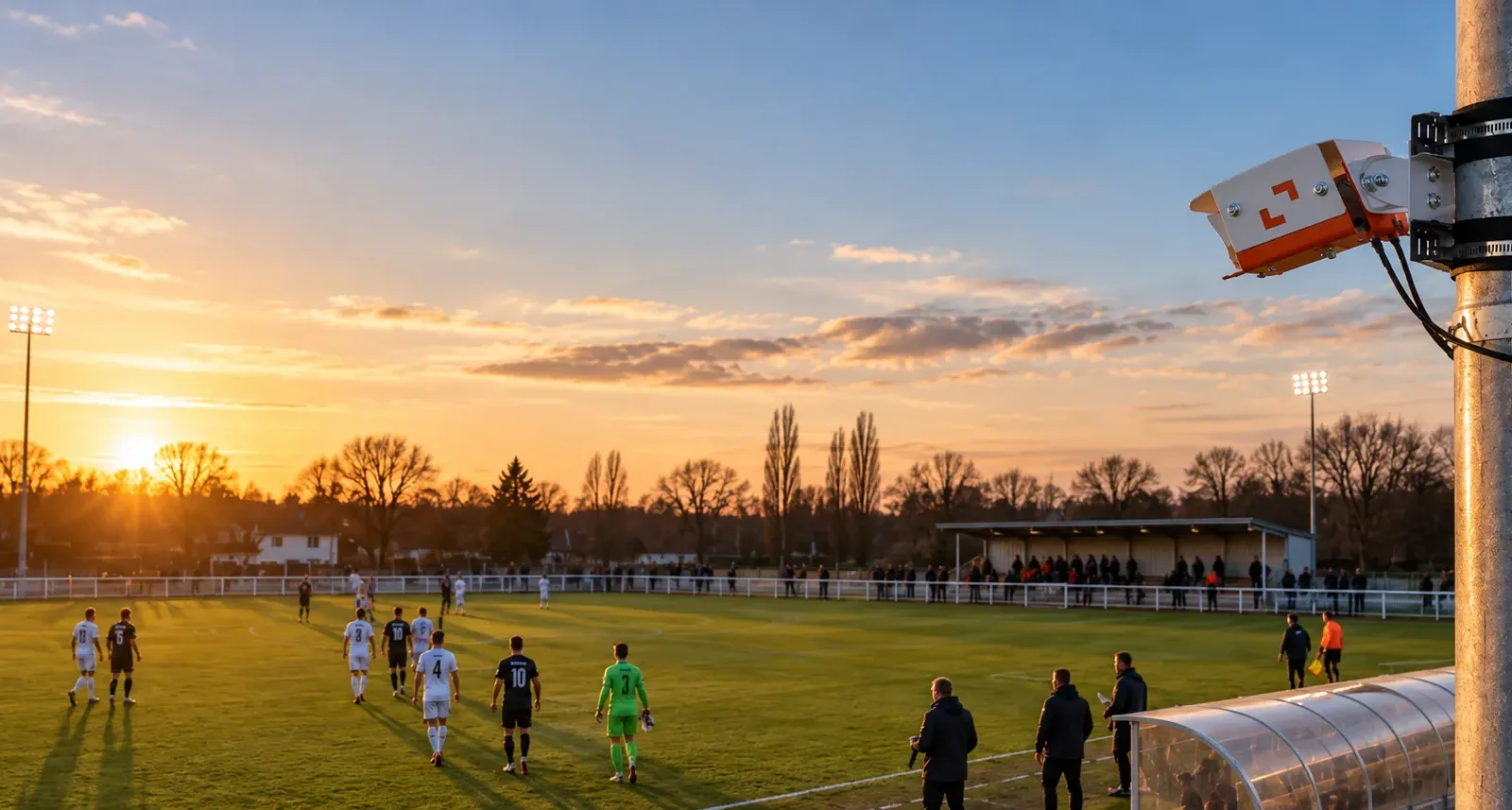
Spain’s second World Cup title was not won by a camera, an algorithm or a dataset. But lasting success is built on structures. For leagues and associations, that raises a more interesting question: what role can digital infrastructure play in making good football work more reliable and more accessible across an entire system?
In July, Spain became world champions for the second time, beating Argentina 1–0 after extra time in the final. In doing so, Spain also became the first country to hold the men’s and women’s FIFA World Cup titles at the same time (FIFA).
Success on this scale inevitably invites a search for explanations: an exceptional generation of players, a coach, an academy structure, a clear footballing identity. Increasingly, technology and data are part of that conversation too. Their place in it, however, deserves some caution.
No platform and no piece of software explains Spain’s success. Player development comes from coaching, competition, infrastructure, culture, talent development and thousands of decisions made over many years. What Spain does show, though, is that lasting success rarely begins with the senior national team.
In its post-tournament analysis, FIFA also put the continuity of Spanish football at the centre: a recognisable understanding of the game that runs from youth development through to the national teams (FIFA). Luis de la Fuente’s own path is a good example of that continuity. He joined the Spanish federation as U19 coach in 2013, later took charge of the U21s and the Olympic team, and then moved up to the senior national team (UEFA).
Continuity like this cannot be built with software. It comes from people, institutions and a shared idea of how players should be developed. At the same time, it leads to another question: what infrastructure helps make good football work possible across an entire system, season after season?
Digitalisation means more than extra technology
Every football match generates information. Decisions can be analysed, movements understood, tactical patterns recognised and physical output assessed. At the top of the game, clubs have long had the people and systems to turn that information into concrete feedback.
Analysts prepare clips. Physical performance data is recorded. Coaches can review match situations within hours. Players get detailed feedback between games.
Further down the football pyramid, the sporting questions are often similar. The resources are not. A youth coach also wants to show a player why a particular run created space. A regional club also benefits from understanding how its shape changed over 90 minutes. Players reflect on their own decisions differently when they can see them, rather than relying only on memory and verbal feedback.
That is where digitalisation becomes relevant: when it makes more of this work practical. The goal cannot be to build a Champions League analysis department at every pitch. What matters is making processes such as reliable match recording, structured feedback, video analysis and objective performance information accessible, without requiring the staff and technical resources of a top club.
At league and association level, a second factor comes in alongside access: consistency. When the same digital infrastructure supports many clubs within a competition, more matches can be analysed, more players can be developed on the basis of real match situations, and clubs with very different starting points can be put on a stronger shared foundation.
Spain is investing in this broader digital layer too. The Spanish football federation RFEF’s digitalisation programme for its regional federations supports technology solutions in administration, sports management and communication, while also aiming to strengthen information systems and digital skills across the federation’s structure (RFEF).
That does not explain a World Cup title. But it does show that one of today’s most successful football systems treats digitalisation as a much broader organisational question.
When digitalisation becomes league infrastructure
A single club can introduce a new tool. A competition needs a system.
For one team, video can improve preparation, analysis and feedback. Across an entire league, consistent technology can create a shared digital foundation. One match recording can serve coaching, player development, opposition analysis, livestreaming and media content, and increasingly also act as the basis for performance data.
A league solution is therefore not simply the same club product multiplied by twenty teams. Once technology works reliably across an entire competition, it starts to become part of football’s infrastructure.
This is where zone14’s experience comes in. The Vienna-based sports tech company develops automated match recording, video analysis, livestreaming and video-based performance data for clubs, academies, leagues and associations. Its experience in Spain and Cyprus shows two sides of the same challenge: designing digital infrastructure at association level, and making it work in practice across a competition.
In Spain, zone14 reached the final stage of a digitalisation process at association level. It made very clear what scale means in this context. Technical capability alone is not enough. Facilities differ, clubs have different resources and staffing, and a league or association solution has to remain practical under all of these conditions.
Cyprus shows the other side of the picture. There, zone14 systems are used as part of a league-wide solution, moving the technology from individual club installations towards a more consistent digital foundation for an entire competition.
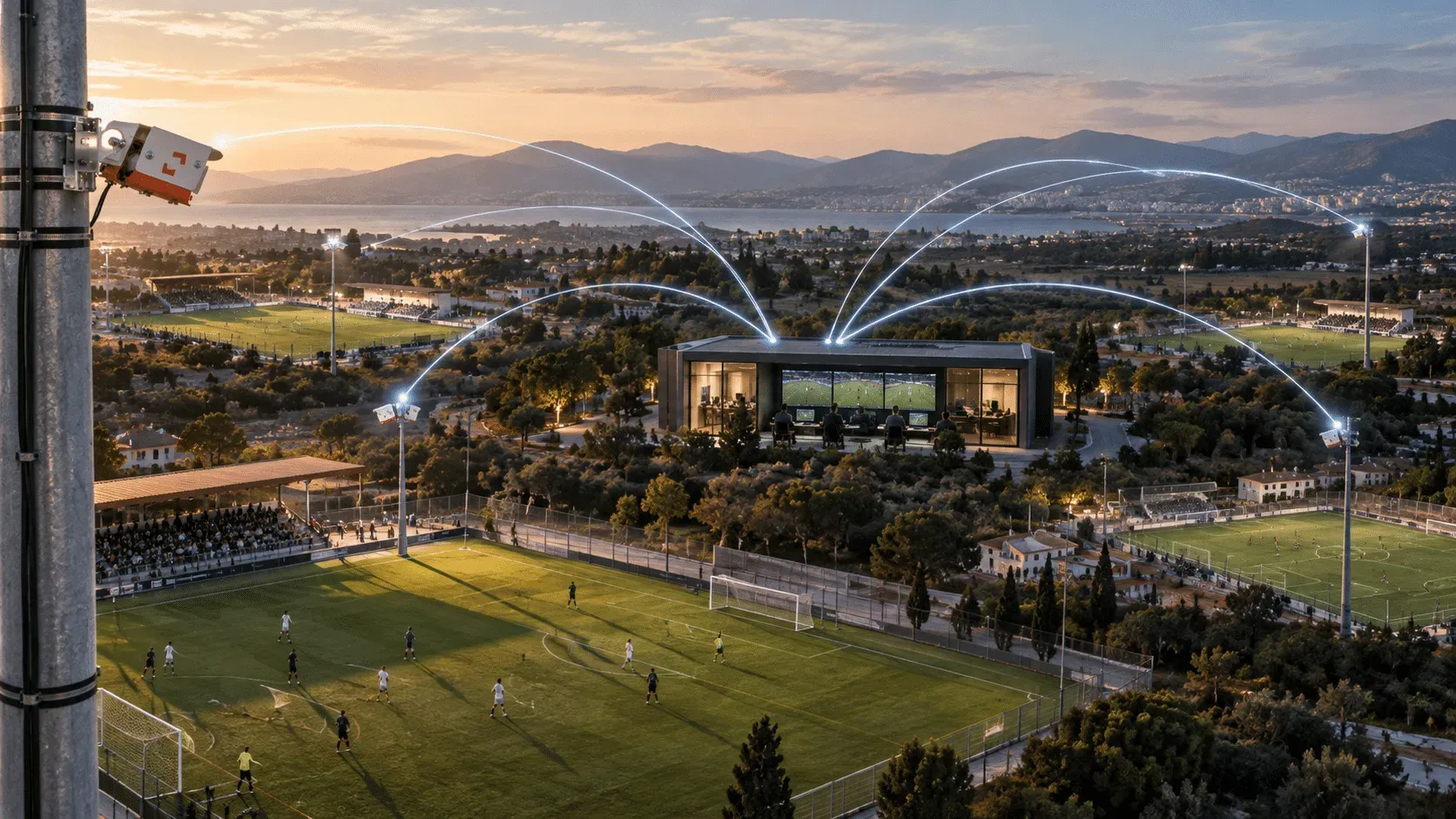
Connected digital football infrastructure across multiple clubs and venues
The value lies not only in recording more matches. What matters is what consistent coverage makes possible. Coaches and players can work with a more complete picture of a season. Livestreaming can extend the reach of matches beyond the stadium. Clubs and the competition receive usable video on a regular basis, while analysis can become a fixed part of everyday league life instead of something each club has to organise on its own.
Performance data adds another layer to this infrastructure. zone14 STATS generates metrics such as distance covered, sprints and heatmaps directly from match video, without players having to wear additional GPS hardware. The same recording used for tactical analysis can therefore also provide information about physical performance.
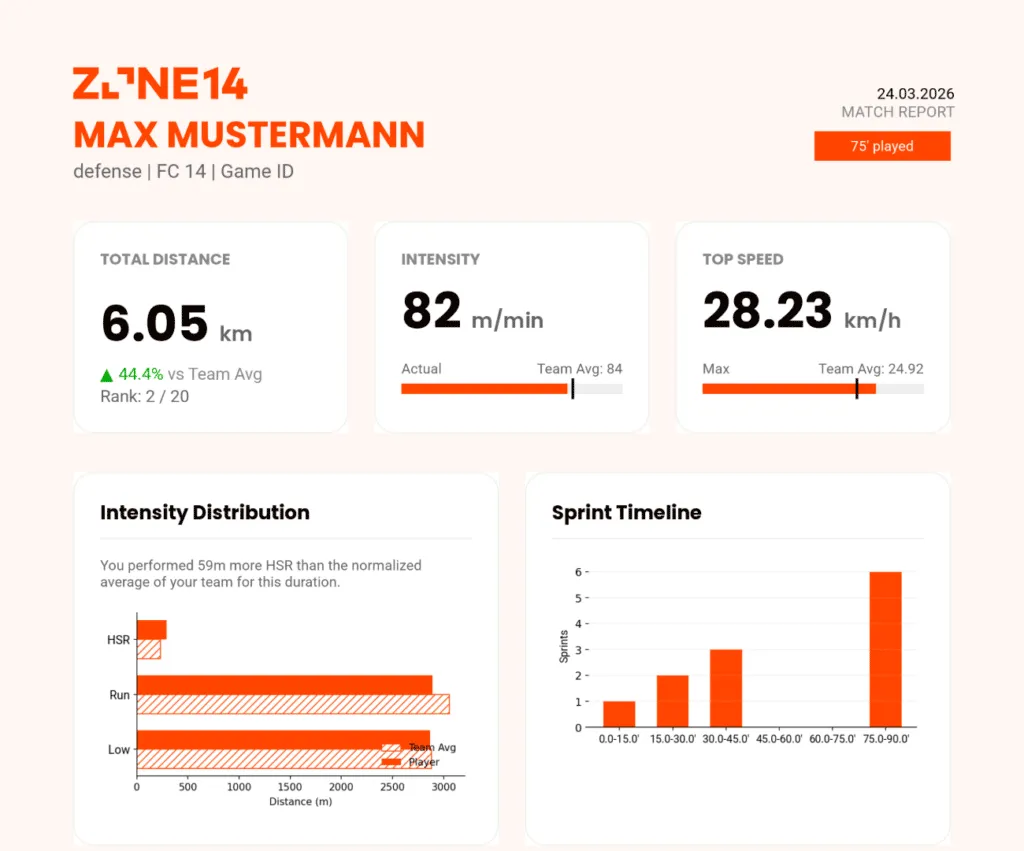
Individual zone14 STATS player report with video-based performance data
At league level this is especially relevant, because the same infrastructure can take on several jobs. Clubs do not each have to build a separate tracking system before they can work with performance information. Video, analysis and data can come together in the same environment, creating a more consistent foundation for coaches and players across the whole competition.
This is not about adding even more data to football. Professional football already produces enormous amounts of it. The real opportunity lies in making useful information available where collecting it used to require far more staff, hardware and time.
The bigger significance of digital league infrastructure therefore lies less in introducing technology for its own sake. What matters is reducing the effort it takes to turn a football match into usable information.
The opportunity reaches beyond professional football
This question of access also plays a central role in Marc Janko’s recent investment in zone14.
During his career, the former Austria captain played in a range of international football markets, and he comes on board at a time when zone14 is growing internationally and increasingly working at club, league and association level. His experience gives him first-hand insight into how preparation, feedback and performance analysis work in elite football, and how wide the gap to other levels of the game can still be.
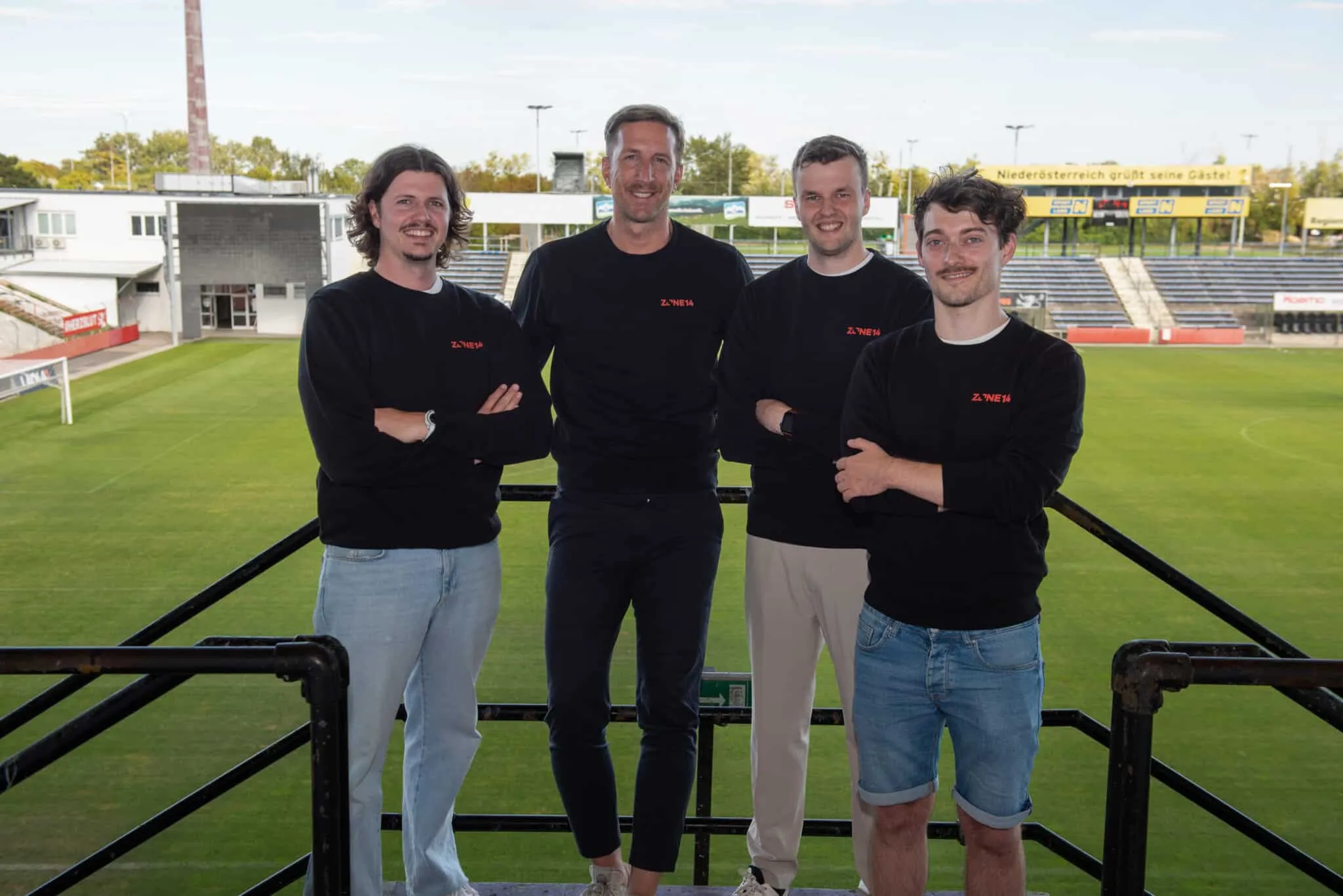
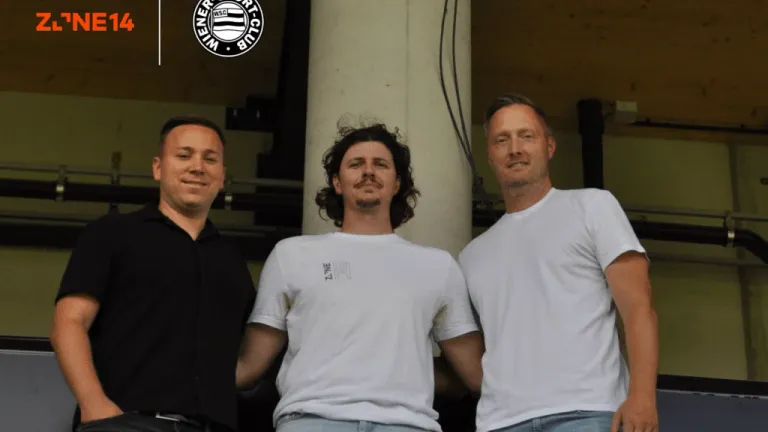
Simon Schmiderer, Marc Janko, Tobias Gahleitner and Lukas Grömer at zone14 · © Gabler
What excites me is that this gives not only top clubs, but also the wider football community the opportunity to work like the professionals.
 Marc JankoStrategic investor at zone14
Our goal is to use AI-powered automation to simplify complex analysis workflows, making valuable insights accessible in day-to-day training environments around the world without the need for a large team of analysts.
 Simon SchmidererCo-Founder & Co-CEO of zone14
Both perspectives lead to the same point. It is not about amateur or lower-league clubs recreating elite analysis departments. Rather, technology is changing which professional ways of working still require professional resources at all.
Video analysis used to mean manual filming and hours of preparation. Physical performance data traditionally meant extra tracking hardware. Livestreaming needed its own production process. These boundaries are becoming increasingly blurred when the same match recording can support several of these functions.
The partnership with Wiener Sport-Club shows that this can work beyond a club’s first team. There, video analysis and performance data are being embedded across the whole club, from the first team through the academy to the women’s team.
Janko’s investment also fits zone14’s international development. Football structures differ considerably from country to country. The same is true of budgets, facilities and how competitions are organised. A league solution in Cyprus therefore cannot simply be transferred one-to-one to Spain, Germany or Austria.
What repeats across different markets is the underlying question: how can digital infrastructure give more coaches, players and competitions reliable access to tools that improve the football work they are already doing?
 Read alsoMarc Janko invests in zone14: Former Austria captain backs zone14
What should other leagues and associations take from Spain?
Spain’s World Cup title is not a case study in football technology. Its foundations run much deeper: coaching, player development, competition structures and a footballing identity developed over many years.
That is exactly why the question of digitalisation is worth asking.
Technology delivers the most value when it strengthens existing football structures. Better access to video can improve feedback. More consistent performance information can support player development. Shared infrastructure can give a league a stronger foundation for analysis, coverage and further services that benefit more than just its best-resourced clubs.
The challenge, then, is not simply choosing the latest technology. What matters is which digital processes are useful enough to become part of everyday football, and how they can work across clubs with very different starting points.
Spain’s system cannot be copied with software. Nor is Cyprus a blueprint that every league should adopt exactly. But the two examples show different sides of the same development: one highlights the scale and complexity of digitalisation at association level, the other shows what shared digital infrastructure can make possible within a professional competition.
The discussion is therefore increasingly moving beyond individual tools bought by individual clubs.
For leagues and associations, the question is rather what the infrastructure beneath their competitions should make possible. Better access to video? More consistent player development? League-wide analysis? Performance data without yet another layer of extra hardware? Perhaps all of it together.
These are the questions zone14 is increasingly working on across different football markets, from the individual club to league-wide rollouts.
Technology will not create a football culture or develop players on its own. But how well it is integrated into the structures around football can make all the difference to how widely its benefits actually reach.
That is where the next phase of football digitalisation starts to get interesting.