The Best Football Trackers 2026: A Comparison of GPS Vests, Wearables, and Video-Based Tracking
The best football trackers of 2026 compared: GPS vests, wearables and video-based tracking. Find out which solution fits your club.
Contents9 sections
- What is a football tracker?
- What should a good football tracker measure?
- STATSports: Well-Known GPS Solution for Players and Teams
- Catapult: GPS Tracking for Professional Performance Management
- PlayerData: GPS Tracking for Clubs from Amateur to Professional
- Playermaker: Wearable for Technical Player Development
- zone14 STATS: Football Tracking Without GPS Vests
- GPS vests or video-based tracking: What is better?
- Conclusion: The Best Football Tracker for Clubs 2026
Tracking has long since arrived in football. What was once almost exclusively reserved for professional clubs is becoming more and more interesting for academies, ambitious amateur clubs, youth teams and individual players.
Coaches no longer want to rely on statements like “We weren’t intense enough”, “We lacked runs” or “We got tired at the end”. They want objective answers. How many kilometres were covered? How many sprints were there? Where did the intense runs take place? How compact was the team? Which players could still accelerate repeatedly in the final phase?
This is precisely why the market for football trackers, GPS vests, wearables and video-based analysis tools is growing. However, not every solution is made for the same purpose.
Some systems focus on individual performance data. Others measure technical actions like ball contacts or foot usage. Still others, like zone14 STATS, take a different route: they generate performance and tactical data directly from the match video — completely without GPS vests or wearable sensors.
In this comparison, we show which football tracking solutions are particularly relevant in 2026 and which solution makes the most sense for which club.
What is a football tracker?
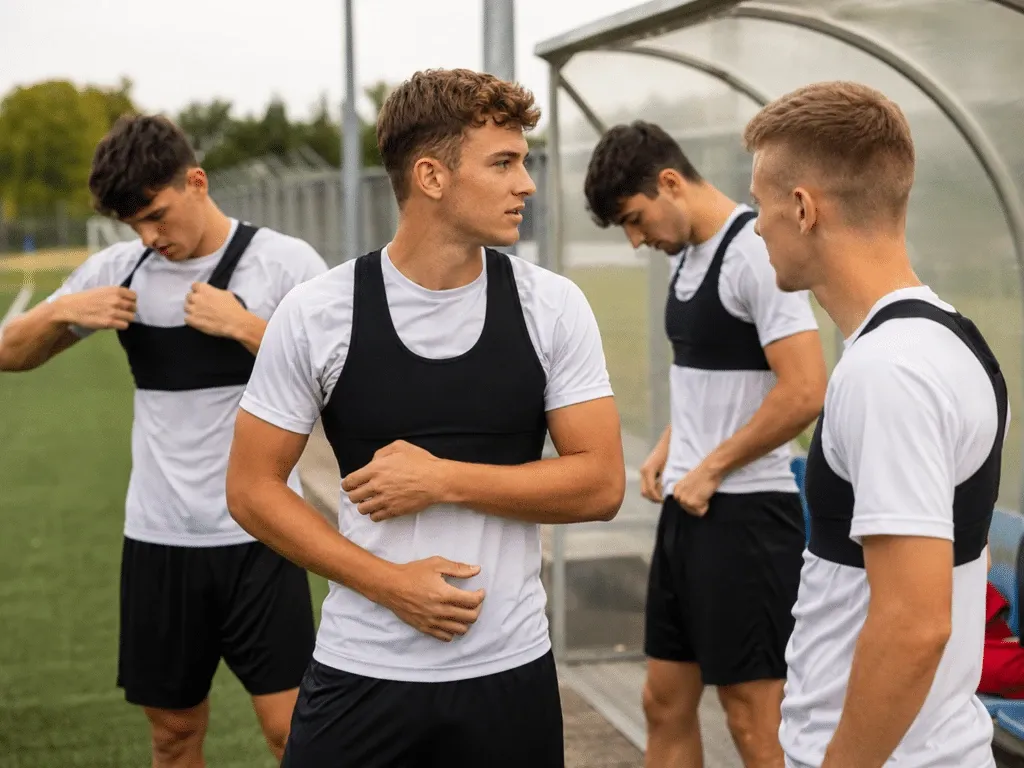
A football tracker is a system that collects performance data from players or entire teams. Many people first think of GPS vests: the tight vests that players wear under their shirts, usually with a small sensor between the shoulder blades.
These devices measure classic physical data such as total distance, sprint distance, top speed, accelerations or load. They have long been established in professional football, and academies and amateur clubs are using them more and more often too.
However, GPS vests are no longer the only option. Football tracking today includes, among other things:
- GPS vests
- wearable sensors
- sensors on the boot
- camera-based tracking systems
- AI-powered video analysis
- all-in-one platforms for video, data and coaching
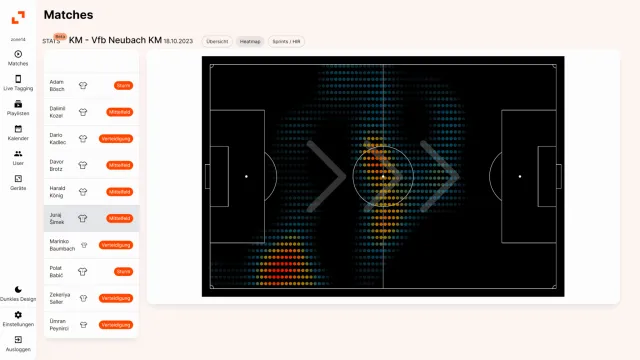
This last category includes zone14 STATS. Instead of equipping each player with a sensor, zone14 uses the match video to create performance data such as distances, sprints, sprint maps, heatmaps, team compactness, team dominance and individual player reports.
What should a good football tracker measure?
A good football tracker shouldn’t just collect data. It should help coaches make better decisions.
Typical metrics in football tracking are:
- total distance covered
- sprint distance
- number of sprints
- high-intensity runs
- top speed
- average speed
- accelerations and decelerations
- heatmaps
- sprint maps
- player load
- team structure and compactness
- individual player reports
Classic GPS trackers are strongest at physical data. They show how far a player ran, how fast they were and how hard they worked.
Video-based tracking goes a step further. It connects these numbers to the actual match. A coach doesn’t just see that a winger made many sprints, but also where these sprints happened, whether they created dangerous situations and how they fitted into the team structure.
This is an important difference.
GPS provides player statistics.
Video-based tracking provides in-game statistics.
STATSports: Well-Known GPS Solution for Players and Teams
STATSports is among the best-known brands in football GPS tracking. The name is particularly prominent in professional football and academies. The systems capture classic performance data such as top speed, sprint distance, distance covered and load.
For individual players who want to track their own development, STATSports is an interesting solution. Teams that want to collect physical data from training and matches will also find an established GPS system here.
Suitable for: individual players, academy players and teams who want to use GPS data in a targeted way.
Strengths:
- well-known brand in football
- measures important physical performance data
- suitable for individual development
- usable in training and matches
Limits:
- players have to wear GPS vests
- devices have to be charged, assigned and managed
- tactical video analysis is not automatically part of the workflow
So the question for clubs is: is running data alone enough? Or does the coaching staff need the link between data, match video and tactical context?
Catapult: GPS Tracking for Professional Performance Management
Catapult is another major brand in sports technology and performance analysis. Its systems are most interesting where clubs work with clear sports science processes and want to manage load over longer periods.
Catapult records data such as sprint distance, total distance, top speed and other load metrics. For professional clubs, academies and ambitious performance centres, this is very valuable.
Suitable for: professional clubs, performance centres and teams focused on fitness and load management.
Strengths:
- strong position in professional sports
- good solution for physical performance data
- helpful for managing training
- suitable for sports science workflows
Limits:
- possibly too complex for many amateur or non-league clubs
- requires wearables
- video analysis and tactical evaluation often run in separate systems
Catapult is a strong solution when a club knows exactly how it wants to integrate GPS data into its performance management. In everyday practice, though, many coaches don’t just need more numbers, but clear insights that are directly linked to match situations.
PlayerData: GPS Tracking for Clubs from Amateur to Professional
PlayerData positions itself as a GPS solution for teams from grassroots to professional level. The focus is on wearable GPS trackers, team data, heatmaps and practical use in clubs.
This makes PlayerData particularly interesting for teams that want to get into GPS tracking without investing in a very complex professional system straight away. Clubs use it to better understand distance covered, intensity and load in training and matches.
Suitable for: amateur clubs, academies and semi-professional teams that want to use GPS vests.
Strengths:
- practical approach for clubs
- team-oriented GPS tracking
- running and intensity data
- also interesting for smaller structures
Limits:
- still dependent on portable devices
- vests have to be organised and managed
- video analysis and tactical feedback are not automatically integrated
PlayerData shows well that GPS tracking is no longer just a topic for professional clubs. Still, it remains a wearable system. The club still has to manage devices, equip players and then translate the data into everyday training.
Playermaker: Wearable for Technical Player Development
Playermaker differs from classic GPS vests. The sensors are worn on the boot and capture not only physical actions but also technical data such as ball contacts, foot usage or specific movement patterns.
This makes Playermaker particularly interesting for individual player development. If you want to measure technical actions more precisely, you get data here that classic GPS vests don’t provide in this form.
Suitable for: individual players, technical development, and ball contact analysis.
Strengths:
- measures technical actions and physical activity
- interesting for individual development
- focus on ball contacts and footwork
- different data from classic GPS vests
Limits:
- stronger focus on individual players
- not a complete team and video analysis system
- does not replace tactical game analysis
Playermaker is therefore less a classic competitor to a club platform and more a specialised tool for individual development.
zone14 STATS: Football Tracking Without GPS Vests
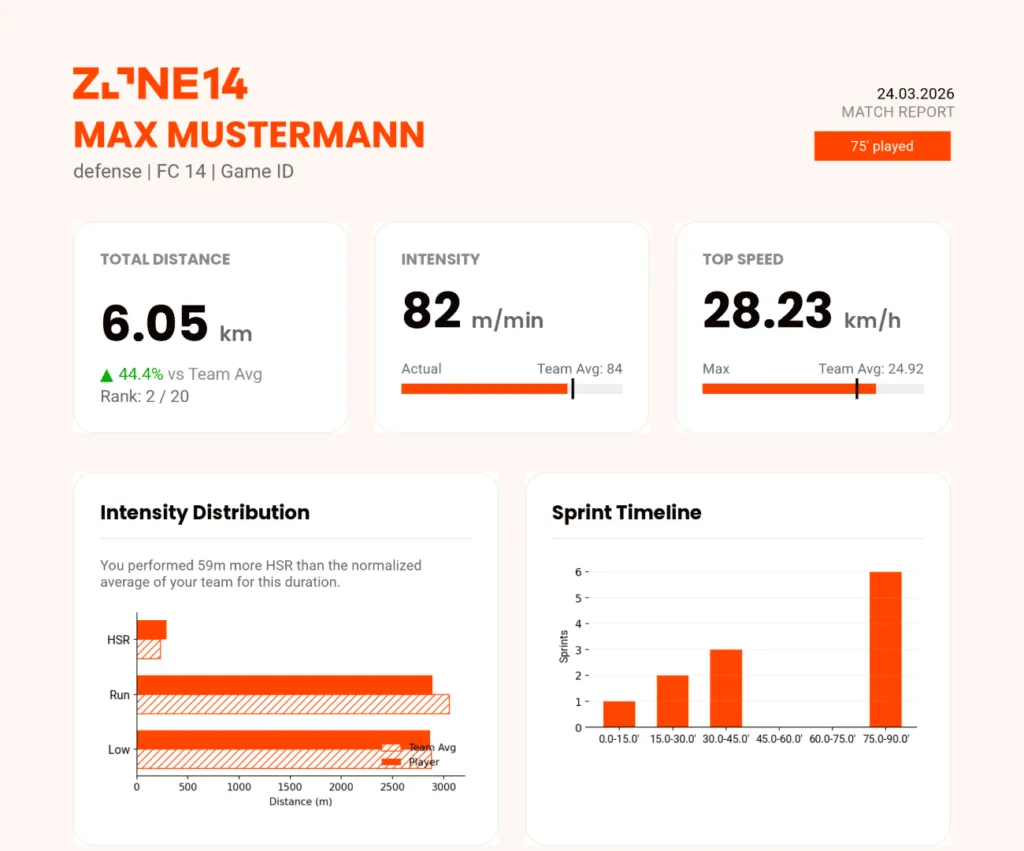
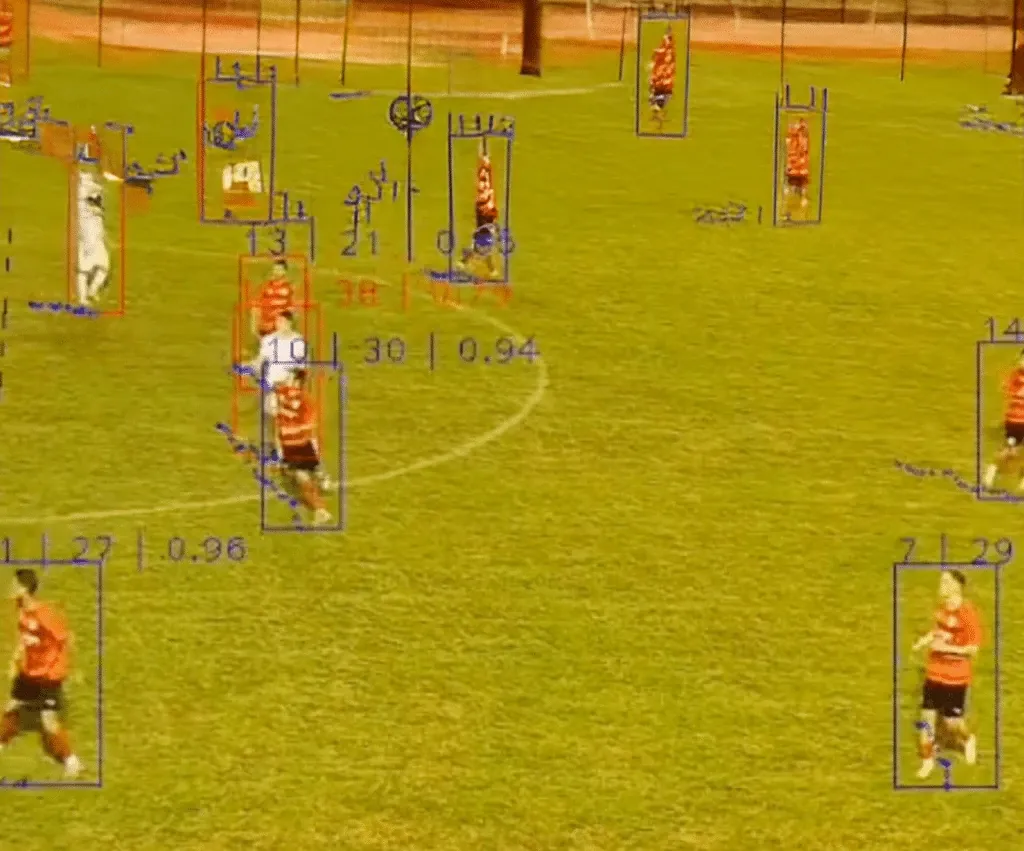
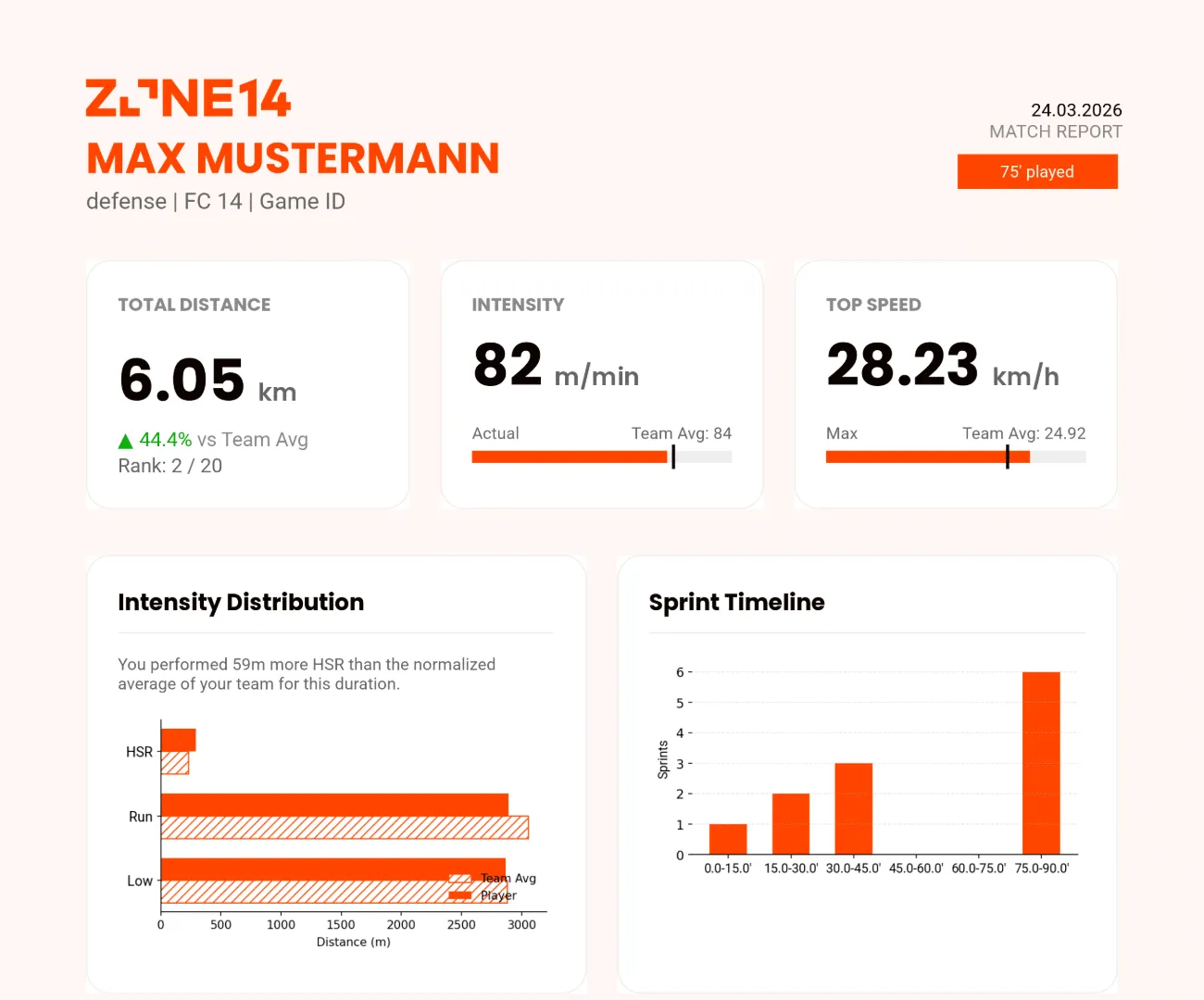
zone14 STATS takes a different approach. The performance data comes directly from the match video. Clubs receive, among other things, distances, sprints, sprint maps, heatmaps, team compactness, team dominance and individual player reports — without GPS vests, without sensors and without manual tracking.
This is especially interesting for clubs that film their matches anyway or want to professionalise their analysis. zone14 is not just a tracker, but part of a larger analysis workflow.
zone14 TWO records matches automatically from a fixed 180-degree perspective. In zone14 REPLAY, coaches analyse the video, create clips, build playlists and share feedback with players. zone14 LIVE streams the matches. And with zone14 STATS, the match video also becomes a source of objective performance and tactical data.
That’s precisely where the difference lies.
A GPS vest shows how many kilometres a central midfielder has run. zone14 also shows where these runs took place, how they fitted with the team’s compactness and which match situations explain the performance.
Suitable for: clubs, academies, non-league teams and ambitious amateur coaches who want performance data, video analysis and tactical context in one system.
Strengths:
- no GPS vests needed
- no sensors to charge, hand out or collect
- performance data comes straight from the match video
- heatmaps, sprint maps and player reports
- tactical metrics such as team compactness and dominance
- data is directly linked to the video analysis
- part of the larger zone14 system with camera, REPLAY and LIVE
For many clubs, this is exactly the most practical approach. Coaches don’t just want to collect data. They want to understand matches, show players specific scenes and turn them into better training content.
Request a sample report
Top speed, sprints and distance covered as a PDF for every player, straight from the match video: with football tracking without GPS vests from zone14 STATS.
On its way!
Your sample player report will be sent to your email shortly.
Test mode: no webhook is configured for this form, nothing was forwarded.
GPS vests or video-based tracking: What is better?
There isn’t one right answer for every club.
If a single player wants to measure their own running data, a GPS vest like STATSports or Catapult makes sense.
If a performance centre wants to monitor load, training management and body data in great detail, GPS systems still have their place.
If technical ball contacts and foot actions are the focus, a tool like Playermaker is exciting.
If a club wants to connect match video, performance data, tactical insights, heatmaps, player reports and coaching feedback in one workflow, zone14 STATS is the more complete solution.
This is especially true for amateur clubs, academies and non-league teams. They often lack the time, staff or budget to manage GPS vests for every player. What these clubs need is a simple process: record the match, analyse it, get the data and show the players clearly what happened.
Conclusion: The Best Football Tracker for Clubs 2026
The best football tracker depends on the problem you want to solve.
For individual physical data, GPS vests remain useful. For technical ball actions, boot sensors are interesting. For clubs that want to combine performance data with video analysis and tactical context, zone14 STATS offers the more comprehensive approach.
Modern match analysis means more than knowing how far players have run. What matters is understanding why they ran, where they ran, what that meant for the team structure and how these findings carry over into the next training session.
This is precisely where zone14 comes in.
With zone14 STATS, the match video becomes more than just a recording. It becomes the foundation for objective performance data, tactical insights and clear player feedback — all without GPS vests.