← Back to the blogVideo analysis
Football Tactics Glossary: 24 Essential Terms for Match Analysis, Coaching, and Match Data
24 football tactics terms explained: half-spaces, wing play, build-up play, pressing, xG and performance data – with tips for video analysis and coaching.
Contents6 sections
This glossary summarizes 24 terms that regularly appear in football tactics, match analysis, and performance data work. The topics range from spatial division and attacking patterns to pressing, transition play, and expected goals.
The terms are divided into five areas. Further links lead to matching articles and show when a complete match recording, working with zone14 REPLAY or the evaluation with zone14 STATS makes sense.
How to analyze these concepts on video in practice is shown in our overview of video analysis technologies and tools.
Use of Space and Game Structure
Spatial organization and basic structure shape almost every phase of the game. The following terms describe how a team creates numerical superiority, opens up passing lanes, and occupies the field with or without the ball. The article [What the important zone 14 in football is all about] takes an in-depth look at central attacking spaces(/en/blog/coaching/the-zone-14-in-football/).
What are half-spaces in football?
The half-spaces are the vertical zones of the field, each located between the center and one of the two flanks. If you imagine the field divided into five longitudinal strips, these are the second and fourth corridors.
Why are half-spaces important?
They are considered the most strategically valuable zones in modern attacking play. Players who receive the ball here have an open, diagonal field of vision to the goal and can threaten multiple options simultaneously with just one body turn. They force the opposing defense into difficult decisions and can more easily break up compact defensive blocks.
What is overloading in football?
Overloading is a tactical maneuver in football in which a team deliberately creates a numerical advantage in a specific area of the field. This is typically done to secure possession, set up attacks, or tie up the opponent.
Why is overloading important?
Overloading is important because it allows a team to gain control over specific zones and put the opponent under pressure. By intentionally creating a numerical advantage around the ball, a team can facilitate build-up play, open up spaces, or quickly win back possession after a turnover. It forces the opponent to adjust their defensive structure and risks opening up gaps elsewhere.
What is a switch of play in football?
A switch of play is the deliberate and quick shift of play from one side of the field to the other in order to create space or to surprise and break down the opposing defense.
Why is switching play important?
It serves to get the opposing defense moving and break up their compactness. By quickly shifting the ball to the unoccupied or less occupied side of the pitch, new attacking spaces can emerge that didn’t exist before. A well-timed switch of play can play a decisive role in creating scoring opportunities and dictating the flow of the game.
What is triangulation in football?
Triangulation is a fundamental positional principle in football where three players position themselves relative to each other to form a triangle, enabling passing options and territorial gain.
Why is triangulation important?
Triangulation is crucial for ball circulation, building up plays, and breaking through opposing defensive lines. By creating multiple passing lanes and keeping the ball under pressure, teams secure possession and control the game. It allows players to escape pressure by always having at least two passing options and promotes dynamic positional play.
What is positional play in football?
Positional play refers to a player’s ability to position themselves optimally on the field in any game situation in order to advance their own objectives and prevent opponent actions. It encompasses behavior both with and without the ball.
Why is positional play important?
Optimal positional play is fundamental for any successful team tactic, as it directly influences spatial control, passing options, and defensive stability. Players with good positional play can intercept passes, initiate attacks, or effectively block opponent runs, often without direct ball contact. It requires anticipation, game intelligence, and continuous adaptation to dynamic game situations. Good match analysis in football is essential to understand and improve these aspects.
What is build-up play in football?
Build-up play is the deliberate process a football team goes through after winning the ball or following a goal kick or goalkeeper throw to move the ball from its own defensive third into the middle and attacking thirds of the field and create scoring opportunities.
Why is build-up play important?
Build-up play is the foundation of every organized attack and significantly determines a team’s success. Well-structured build-up play makes it possible to overcome the opponent’s pressing line, open up space, and bring players into promising positions. It requires not only technical skills but also tactical understanding and precise communication within the team to develop offensive dynamics from stable defensive positions.
What are formations in football?
A formation (or basic shape) describes the tactical setup of a team’s players on the pitch. It’s usually indicated by numbers from defense to attack, e.g., 4-4-2.
Why are formations important?
The formation forms the tactical foundation of a team, defining the basic distribution of players and their primary roles. It’s crucial for stability in defense and structure in attack. However, modern formations aren’t rigid; they change dynamically depending on the phase of play (with or against the ball).
What to look for in your analysis:
- Does the actual formation on the pitch match the nominal lineup?
- How does the formation behave with opponent possession compared to your own possession?
- Does the formation create gaps or numerical advantages in certain zones?
- How well do the player types fit the demands of their positions within the formation?
What is ball possession in football?
Ball possession is the share of total playing time in which a team controls the ball. It is usually given as a percentage and is a crucial indicator of dominance in the game.
Why is ball possession important?
Ball possession is key because it allows a team to control the game, tire out the opponent, and create scoring opportunities. Teams with the ball can dictate the tempo, keep the opponent moving, and minimize the risk of conceding goals. It’s the foundation for attacking plays and defensive stability.
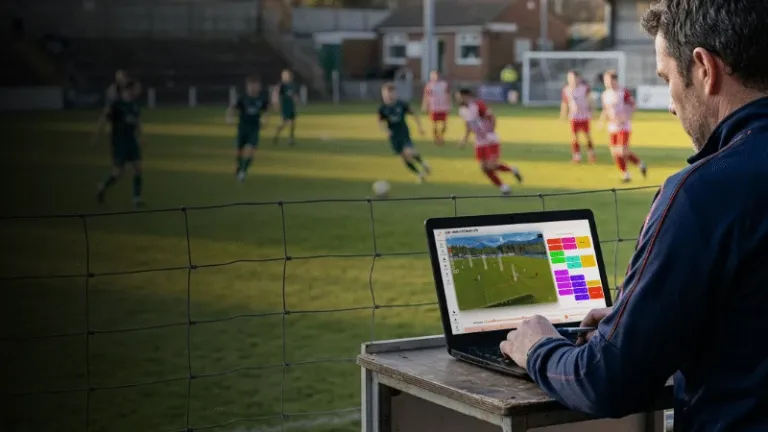
Evaluating spaces within the overall picture: When it comes to formations, build-up play, and spatial distribution, a tight crop is rarely sufficient. The zone14 TWO football camera covers the entire pitch. In zone14 REPLAY, you then mark zones, passing lanes and positional changes directly in the video. zone14 STATS complements the recording when you compare ball possession and spatial patterns across multiple games.
Attacking Patterns, Passing Lanes and Runs
Attacks do not just happen on the ball. Overlaps, runs in behind, and through passes only work when timing, spacing, and spatial distribution come together. The guide Football match analysis: Your ultimate guide shows how to analyze such sequences on video.
What is overlapping in football?
Overlapping is a tactical attacking principle in football in which a player without the ball runs into open space behind a teammate who has the ball in order to create a passing option or a numerical advantage.
Why is overlapping important?
Overlapping is an effective way to get the opposing defense moving and open up passing options in dangerous zones. It’s often used by full-backs or wingers to exploit the width of the pitch and create an overload by stacking one side. It forces the opponent to abandon their defensive shape and creates space that can be used for further attacks.
What is box presence in football?
Box presence describes the number and strategic distribution of your attacking players in the opponent’s penalty area during an attack, especially during cut-backs, crosses or shots on goal.
Why is box presence important?
Effective box presence is crucial for scoring goals, as it increases the likelihood of winning second balls, capitalizing on rebounds, or taking direct shots on goal. It forces the opposing defense to be highly concentrated and creates numerical advantages that can be used for finishing. Good box presence creates goal-scoring opportunities and keeps the pressure high on the opponent.
What is wing play in football?
Wing play describes an attacking tactic in football in which attacks are primarily launched down the flanks of the field – the “wings” – in order to break through the opposing defense.
Why is wing play important?
Wing play is a fundamental element of many tactical concepts, as it serves to create width in attack and stretch the opposing defense. Through quick dribbles, precise crosses, or overlapping runs, spaces can be created in the center or numerical advantages can be generated on the flanks, leading to scoring opportunities.
What is a vertical pass in football?
A vertical pass is a pass played along the longitudinal axis of the pitch, meaning from back to front, to break opponent lines and quickly shift the play.
Why is the vertical pass important?
A vertical pass is a crucial tactical tool to bring tempo into the game and surprise the opposing defense. It aims to quickly advance into goal-threatening areas or bypass deep-lying defenses. By quickly covering ground, it can initiate direct scoring opportunities and significantly influence the dynamics of an attack.
What is a deep run in football?
A deep run is an attacking movement by a player without the ball that goes directly towards the opponent’s goal behind the opponent’s defensive line. The goal is to gain space, destabilize the defense, and create a passing option for a through ball.
Why are deep runs important?
Deep runs are a fundamental element in modern attacking play, as they are crucial in overcoming the opposing defense and creating scoring chances. They force defenders to leave their positions or change their orientation, creating gaps that can be used by other players or for a through ball. A well-timed deep run can break open a compact defense and pave the way to goal.
What is a through ball in football?
A through ball is a precise pass through the gaps in the opponent’s defensive line that plays a teammate into a dangerous position behind the line or between two lines.
Why is the through ball important?
The through ball is an essential tool to overcome compact defenses and create clear scoring opportunities. It requires a high level of game awareness, precision, and timing from the passer, as well as the correct running movement from the receiver. A successful through ball can dismantle the entire opposing defense and create a promising attacking position.
What are runs in football?
A run describes a player’s planned or spontaneous movement on the field without the ball, with the aim of achieving a specific tactical objective, such as creating space or getting free.
Why are runs important?
Runs are the foundation of structured attacking and defensive play. They allow teams to create numerical advantages, disorganize opposing defenses, and generate scoring opportunities. Effective runs without the ball are often more crucial for success than simply controlling the ball, as they significantly influence the game’s dynamics and space.
Capture runs in full: Many decisive movements happen away from the ball. A wide shot shows overlaps, deep runs and box presence in full. In zone14 REPLAY, you mark these scenes, add running and passing lines and prepare them as a playlist for the team.
Defensive Organization
A solid defense relies on tight spacing and coordinated movements. Shifting, compactness, and zonal marking are therefore closely intertwined. The article Team compactness in football explains how to check these structures with video and match data.
What is shifting in football?
Shifting describes the coordinated horizontal and vertical movement of a team as a block on the pitch to maintain compactness and close down spaces for the opponent.
Why is shifting important?
Collective shifting is crucial for ensuring high defensive stability and offering the opponent little space to develop attacks. By all players moving together towards the ball, the team remains compact as a unit and passing lanes are blocked, making it easier to win the ball or at least prevent dangerous attacks. It is a fundamental aspect of any well-organized defense.
What is compactness in football?
Compactness is a central tactical principle in football that describes the tight spatial organization and coordination of a team’s players in order to deny the opponent space and win back the ball.
Why is compactness important?
High compactness is crucial for defensive stability, as it keeps the distances between players small, blocks passing lanes, and enables effective pressing. It prevents the opponent from finding open spaces and initiating dangerous attacks. At the same time, compactness also forms the basis for quick transitions and effective ball recoveries, as the team can quickly transition into an offensive structure after winning the ball.
What is zonal marking in football?
Zonal marking is a defensive strategy in football where players do not primarily follow an opponent, but instead defend specific zones of the pitch and close down space to stop opposition attacks.
Why is zonal marking important?
It is of crucial importance as it enables a team to establish compactness and keep the distances between players small. This blocks passing lanes into the center and forces the opponent to resort to the flanks or long balls, which can make winning the ball back easier. Modern zonal marking requires high discipline, communication, and good collective shifting of the entire team to avoid gaps and create numerical superiority. To improve your defensive organization, try these 5 top defensive drills.
Check distances with video and data: zone14 STATS uses heatmaps and the team compactness metric to show how the distances between the lines of the team change during the match. You then check striking phases in zone14 REPLAY in the context of the video. That way, you see why the team stayed compact or where a gap opened.
Pressing, Ball Recovery and Transition
After losing or winning possession, there are often only a few seconds left for the next play. Pressing, winning the ball, transitioning, and counterattacks are therefore all part of the same analysis. The article Video Analysis in Football: The Practical Workflow from Match Video to Player Feedback describes a possible workflow with tags and playlists.
What is pressing in football?
Pressing is an attacking tactic in football where a team puts the opponent under high pressure after losing possession or in specific zones of the pitch in order to regain the ball as quickly as possible or force a bad pass.
Why is pressing important?
Pressing is a key element of modern football, as it not only serves to win the ball back, but also disrupts the opponent’s build-up play and creates opportunities for quick attacks. It enables a team to increase control of the game through possession and prevent the opponent from developing their own game. Well-organized pressing requires a high level of running and precise timing from the entire team.
What is ball recovery in football?
Ball recovery is the moment or action in which a team wins the ball back from the opponent. This can happen through sliding tackles, tackles, intercepting passes, or purposefully closing down spaces.
Why is ball recovery important?
Ball recovery is a fundamental aspect of the game, as it forms the basis for the transition from defense to offense and is crucial for controlling the flow of the game. Quick and effective ball recovery allows a team to put the opponent under pressure, initiate attacks, and dictate the pace of the game. It is often the trigger for dangerous transitional moments.
What is transition play in football?
Transition play is the lightning-fast transition of a football team from defense to attack after winning the ball (offensive transition) or from attack to defense after losing the ball (defensive transition).
Why is transition play important?
Transition play is one of the crucial phases in modern football, as these moments often create the biggest gaps and disorganization in the opponent’s play. Effective offensive transition allows you to surprise the opponent and create goal-scoring chances before they can reorganize. In turn, quick and organized defensive transition prevents the opponent from becoming dangerous after losing the ball and uses the resulting disorganization for your own ball recovery.
What is a counter-attack in football?
A counter-attack is a quick attack launched after winning possession, typically from a deep and compact defensive formation, in order to break through the disorganized opposing defense.
Why are counter-attacks important?
Counter-attacking is a highly effective tactic for creating scoring opportunities, especially against possession-based teams that play with a high line and commit many players forward. It exploits moments of disorganization and the opponent’s lack of defensive cover. A successful counter requires precise transition play, quick decision-making, and often a few, but well-aimed, passes.
Compare pressing moments side by side: With zone14 REPLAY, you tag pressing triggers, ball recoveries and counter-attacks and compare them across multiple scenes. zone14 STATS adds sprint maps, high-intensity runs, and data on team compactness. This helps assess not only individual actions but also the behavior of the entire team.
Match Data and Performance Evaluation
Numbers do not replace watching the game, but they can make it more accurate. Expected goals and performance data help you assess chance quality, workload, and recurring patterns. Which metrics are actually useful for coaches is shown by the World Cup 2026 Statistics Guide.
What are expected goals (xG) in football?
Expected goals (xG) are an advanced football metric that measures the probability that a shot on goal from a specific position and under specific conditions will result in a goal. They quantify the quality of a scoring opportunity.
Why are expected goals (xG) important?
xG revolutionizes match analysis by allowing coaches and analysts to evaluate the true quality of scoring chances regardless of the actual outcome. This helps to objectively assess the performance of a team or player, identify over- or underperformance, and better understand attacking efficiency and defensive robustness. It shows whether a team creates many good chances but fails to convert them, or if it scores many goals from few poor chances.
What is performance data in football?
Performance data are quantitative metrics and statistics that capture and evaluate the actions of players and teams on the field.
Why is performance data important?
Performance data provides coaches, analysts, and players with objective insights into individual and collective performance. It helps identify strengths and weaknesses, inform tactical decisions, and track player development. In modern football, it is an indispensable tool for data-driven analysis and decision-making.
Put performance data in the context of the video: From the recordings of the zone14 TWO football camera, zone14 STATS generates distances, sprints, heat maps, sprint maps and player reports, among other things. The metrics remain linked to the game video and can therefore be reviewed directly alongside the corresponding scenes. REPLAY doesn’t calculate expected goals automatically, but you can place shot positions and how a chance developed in the video.
From Definition to Practical Match Analysis
A tactical term is useful above all when the coaching staff and the team understand the exact same thing by it. Therefore, connect the definitions with concrete match situations and clear observation questions. zone14 TWO provides the complete recording, zone14 REPLAY makes processes visible using clips, drawings, and playlists, and zone14 STATS adds movement and team data to the video context. Which module is needed depends on the question to be answered.