Categories
Coaching

The Winter Break in Football: Your Ultimate Guide to the Perfect Second Half of the Season Preparation

Contents

The Winter Break in Football: Your Ultimate Guide to the Perfect Second Half of the Season Preparation

How to use the most important phase of the season for regeneration, in-depth analysis, and the decisive performance leap – and the role smart video analysis plays in it.

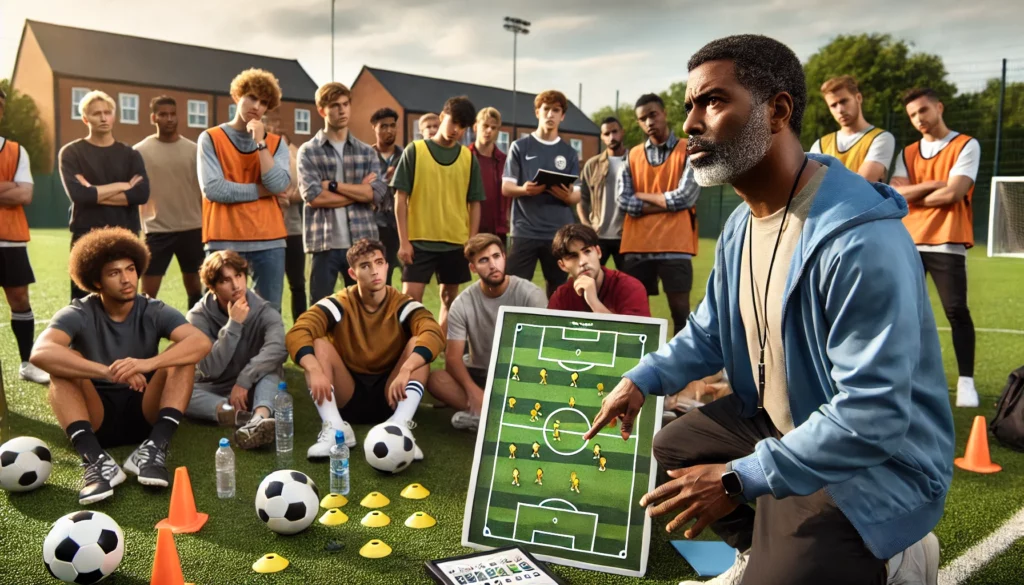
The final whistle of the year sounds. The players are tired, the coaches are burned out, and the pitches are often heavy and difficult to play on. The winter break in football has arrived – a time that is like a double-edged sword for many clubs. On one hand, it's the much-needed recovery phase for body and mind. On the other hand, it's the crucial, often underestimated period where the course for success in the second half of the season is set.

Many clubs make the mistake of seeing the break only as a football-free time. But the most successful teams know: Championships are made in the winter. It is the only time of the year when you can dive deep into analysis and make fundamental adjustments without the pressure of the next game.

This comprehensive guide shows you how to divide the winter break into its three decisive phases, get the most out of each phase, and how modern tools like video analysis can help you send your team into the second half of the season not just fitter, but also tactically smarter and mentally stronger.
Phase 1: The Art of the Break – Targeted Regeneration & Reflection (The First 1-2 Weeks)

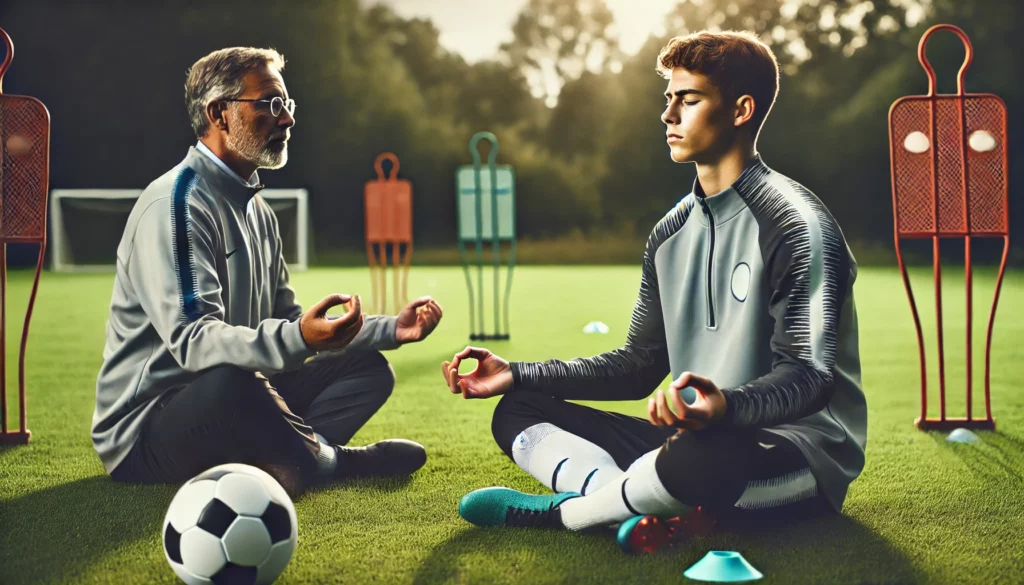
Before getting back to work, the battery needs to be recharged – and properly. Simply "doing nothing" is often the wrong approach and can make getting back into training more difficult.

  • Active Recovery Instead of Complete Rest: Light, alternative sports activities promote blood circulation and help the body to break down lactate. Recommendations: Light swimming, cycling, or jogging.
  • The Mental Reset for Players and Coaches: The most important task at the beginning of the break is to switch off mentally. No tactical meetings, no performance pressure talks. Use the time to recharge your own creative and strategic batteries.
  • Nutrition & Sleep: Remind your players to maintain a balanced diet and get enough sleep to maximize regeneration.
  • Individual Goal Setting: Give your players a small "homework" assignment: to formulate 1-2 personal goals for the second half of the season (e.g., "improve my weak foot").

Phase 2: The Truth is in the Video – The Unsparing First Half Analysis

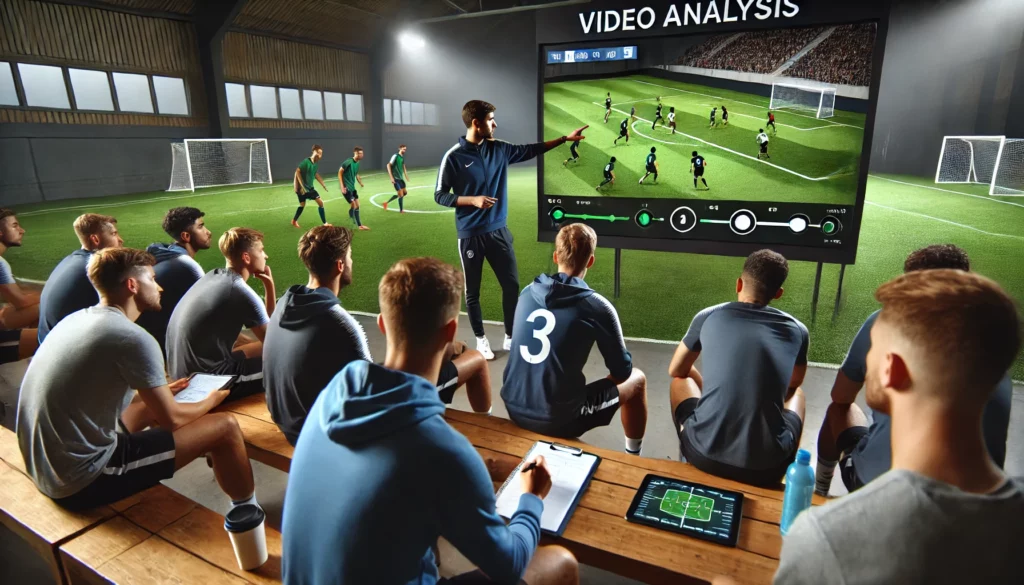
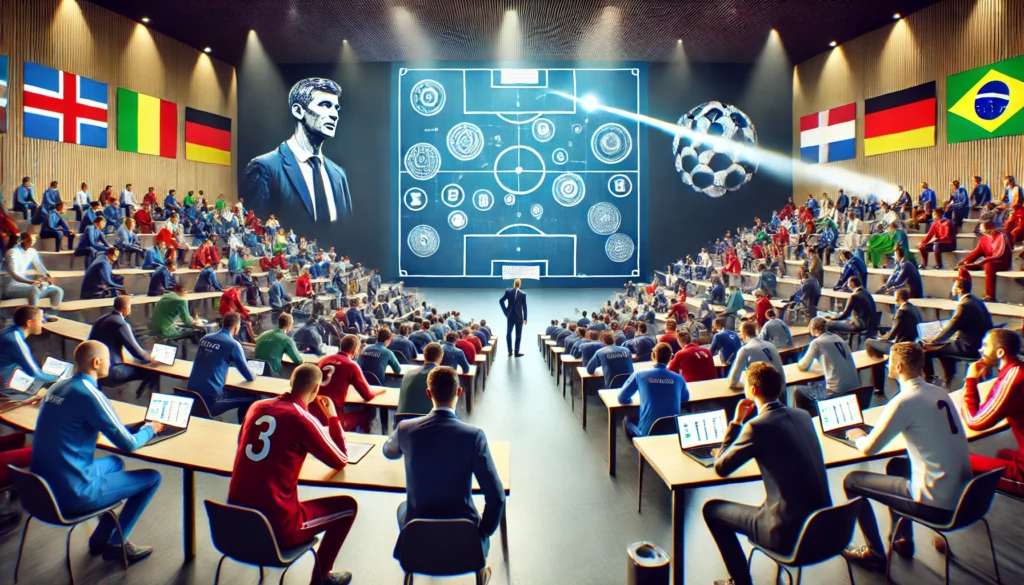
Once the mind is clear, the most important strategic work begins. Now is the time you never have during the season: the unsparing but fair analysis of the entire first half. This is where gut feelings are replaced by irrefutable facts.

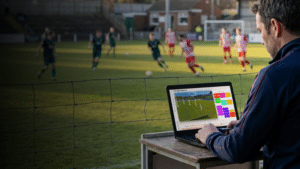
The Game-Changer: Video Analysis with zone14

Instead of relying only on vague memories, video analysis gives you the objective truth. With a platform like zone14 REPLAY, this process becomes incredibly efficient and in-depth.

No zone14 camera? No problem: Getting started with zone14 COACH Perhaps you already have a dedicated volunteer filming with a drone, a tripod, or even a phone. That's a great foundation! This is exactly why we developed zone14 COACH. It's the pure power of our REPLAY analysis platform as a standalone software solution. Simply upload your existing video material and use the same professional analysis tools (tagging, drawing, playlists) to turn your video chaos into structured insights. It's the perfect first step to experience the efficiency and quality of the zone14 software before perfecting the workflow with our automated camera.

Step 1: Team Tactical Analysis – The Big Picture

Look for recurring patterns across the entire first half of the season.

  • Offensive Patterns: How do we score our goals? From set pieces? On the counter?
  • Defensive Patterns: What types of goals do we concede repeatedly?
  • The zone14 Advantage: With the tagging system in REPLAY or COACH, you can filter all scenes of a specific category from all games and watch them in a single playlist. This makes patterns instantly visible.

Step 2: Group Tactical Analysis – The Interaction of Team Units

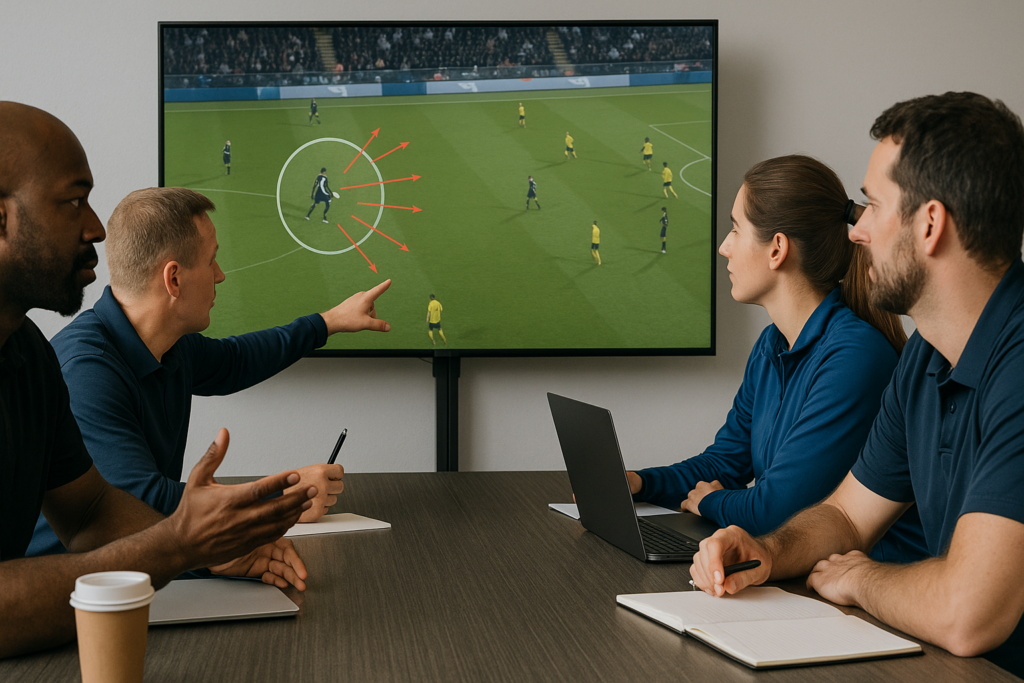
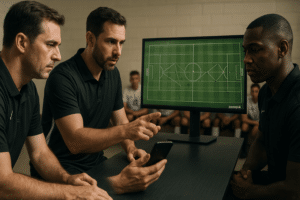
Now, go deeper into the analysis. The panoramic view in REPLAY (available with the zone14 TWO camera) is indispensable for this.

  • Defensive Line: How well does the back four shift? What are the distances?
  • Central Midfield: What is the staggering like? Do the holding midfielders cover each other?

Step 3: Individual Analysis – The Fusion of Tactics and Physics

Now, you look at individual players. This is where the combination of video and data excels.

  • Decision-Making: Does the player make the right decision under pressure?
  • Technical Execution: How clean is their first touch or their finishing?

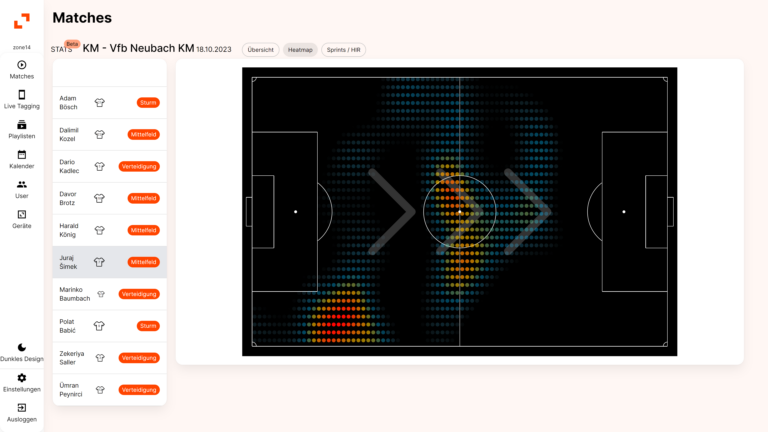
The zone14 STATS Advantage - Combine your tactical observation with the objective performance data that zone14 STATS extracts directly from the video. Imagine not only seeing that a player seemed unfocused but being able to prove it with data. The number of his High-Intensity Runs dropped significantly. This fusion of tactical video (the 'Why?') and physical data (the 'How Much?') gives you a complete picture.
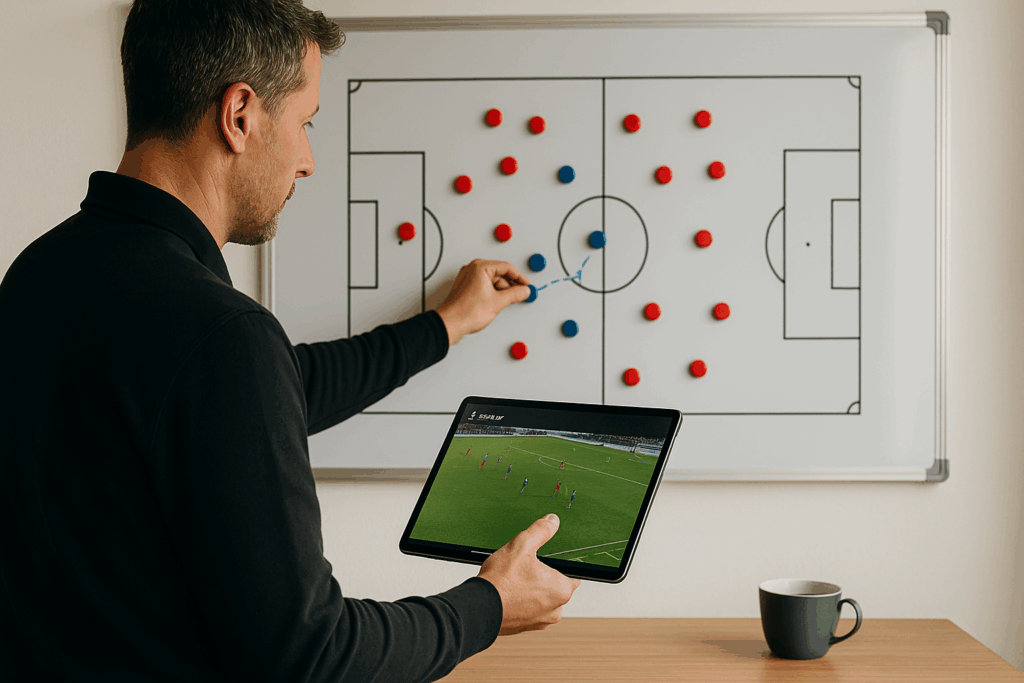
Phase 3: From Plan to Pitch – The Perfect Second Half Preparation

The insights from your analysis are the blueprint for your preparation.

  • Training Plan with a Common Theme: Derive your training priorities from the 2-3 most important findings from your analysis.
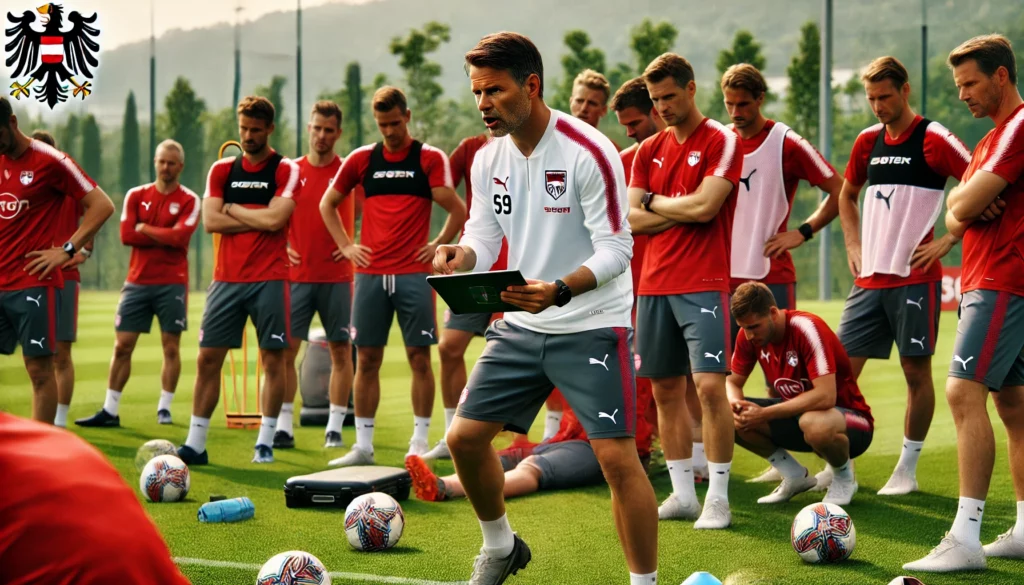
  • Individual Development Talks: Use the winter break for short, effective one-on-one meetings. Create a playlist in REPLAY or COACH for each player with 2-3 positive scenes and 1-2 learning moments.
  • Use Friendly Matches as an opportunity: Friendly matches are perfect for testing tactical adjustments.
    • The zone14 Advantage: Record your friendly matches as well. Analyze immediately afterward whether the new running paths are working. This direct before-and-after comparison is the fastest way to measure progress.
  • Opponent Preparation: Also use the break to analyze the first few opponents of the second half of the season (if video material is available).
zone14 STATS

Statistics for football without a GPS Tracker.

Your Checklist for the Perfect Winter Break

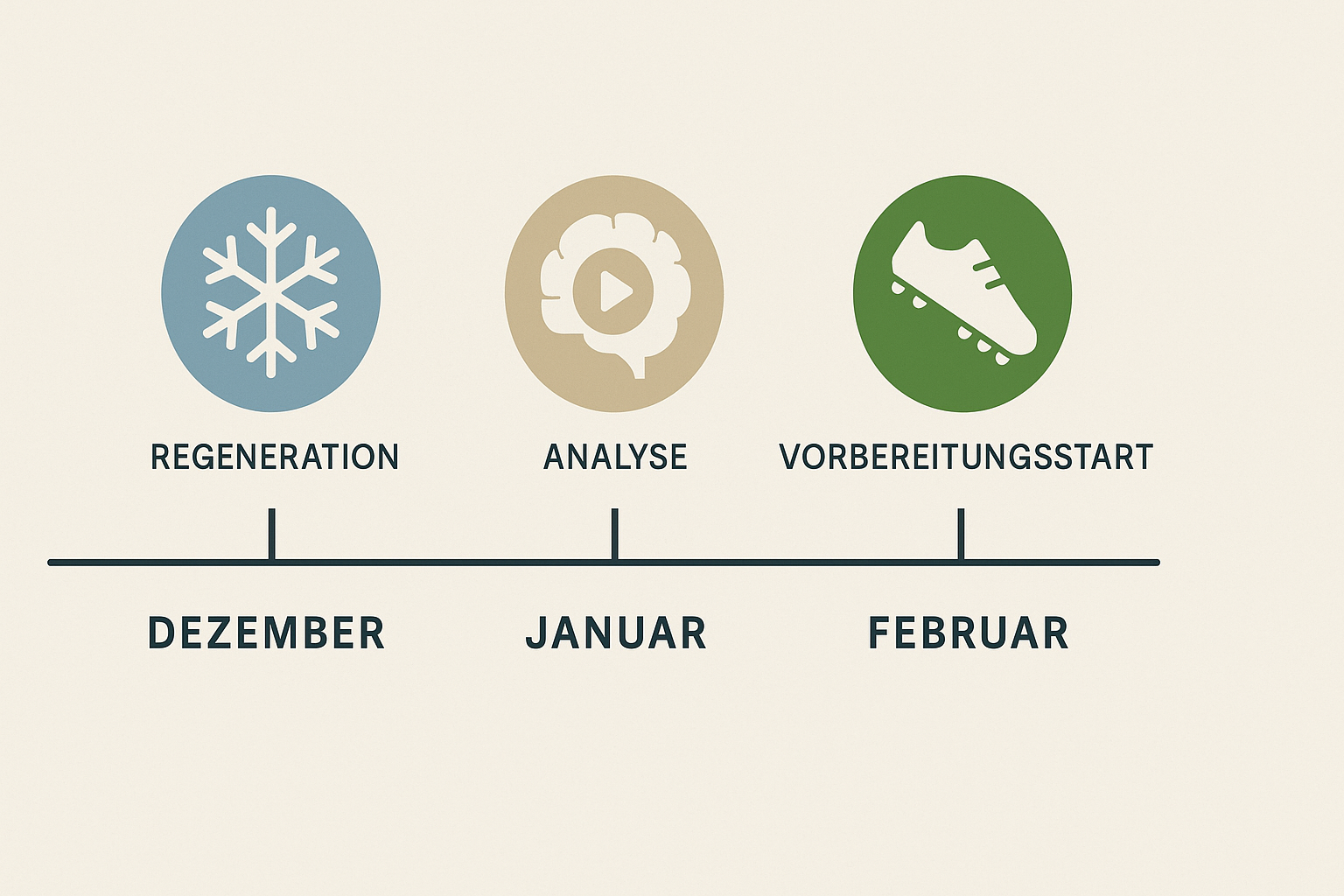
  • Week 1-2: Active regeneration & mental reset. Players formulate personal goals.
  • Week 3-4: Intensive analysis of the first half with zone14 REPLAY/COACH & STATS.
    • Identify team tactical patterns.
    • Prepare individual player playlists for feedback talks.
    • Evaluate physical performance development.
  • Week 5: Create a training plan, conduct individual talks.
  • Week 6-8: Start of preparation. Film & analyze friendly matches. Analyze opponents.
Conclusion: Use the Winter Break to Rewrite the Story of Your Season

The winter break is the strategic heart of the season. While other clubs switch off, the most successful teams lay the foundation for their success here. A thorough, data-driven analysis is the decisive lever.

Solutions like those from zone14 make this process accessible and efficient – whether you start with the software-only solution COACH or unleash the full potential with the automatic TWO camera and STATS. Use this opportunity to make your team not just fitter, but above all, smarter in the winter break.
zone14 REPLAY

The football video analysis software for coaches and clubs.

Share on Facebook
Share on Twitter
Share on Linkedin
More related content from zone14
Categories
Coaching

Your Goalkeeper's Playbook: The Best Drills & Analysis Techniques

Contents

Your Goalkeeper's Playbook: The Best Drills & Analysis Techniques

He is the last bastion, the first attacker, often the loneliest, but also the most decisive player on the pitch: the goalkeeper. While club football often focuses on outfield play, specialized goalkeeper training frequently falls short. But the days when it was enough to put a "good catcher" in goal are long gone. The modern goalkeeper is a complex athlete whose abilities extend far beyond just saving shots and who actively shapes the game.

This comprehensive guide dives deep into the world of modern goalkeeper training. We break down the complexity into understandable components, present the best goalkeeper drills with detailed step-by-step instructions, and show how video analysis – especially with specialized tools like a behind-the-goal camera – can revolutionize your coaching.

1. The 4 Pillars of Complete Goalkeeper Training

Holistic training is based on four inseparable pillars that intertwine and should be present in every drill:

  1. Technique: The clean execution of fundamentals (catching, punching, diving, 1-on-1s).
  2. Tactics: Game understanding (positioning, decision-making, coaching the players in front).
  3. Athleticism: The physical requirements (jumping power, speed, agility, reflexes).
  4. Psyche: Mental strength (courage, concentration, dealing with mistakes, presence).

2. The Best Goalkeeper Drills: Explained Step by Step

Here are three practical goalkeeper drills that specifically train these pillars and can be adapted for different age and performance levels.

Drill 1: "The Wall" – Reaction, Technique & Rebound Control

Focus: Technique (hand shape, body position), Athleticism (reaction), Psyche (concentration)

  • Goal of the Drill: To improve reaction speed to shots from close range and the ability to control rebounds.
  • Setup (Step 1):
    • The goalkeeper stands centrally in the goal.
    • The coach is positioned approx. 6-8 meters in front of the goal with several balls.
    • Two small cones are placed approx. 2 meters to the left and right of the goalkeeper.
  • Execution (Step 2):
    • The coach shoots 5-8 balls in quick succession, medium-height and hard, towards the goalkeeper's body.
    • The goalkeeper does not try to catch the balls but uses a clean blocking technique (firm hands, tensed body) to parry them in a controlled manner to the outside, behind the cones.
    • The last ball of the series is shot low next to the goalkeeper, requiring them to dive and secure the ball.
  • Coaching Points & Variations:
    • Ensure the goalkeeper maintains a stable, slightly forward-leaning body position.
    • The hands should form a "scoop" to direct the ball down and to the side.
    • Variation (harder): A second player tries to score from the rebounds, increasing the pressure.
  •  
Drill 2: "Decision in the Box" – Tactics for Crosses

Focus: Tactics (decision-making, commanding the area), Technique (catching/punching), Psyche (communication, courage)

  • Goal of the Drill: To train the goalkeeper's timing and decision-making on whether to come off their line for a cross or to stay.
  • Setup (Step 1):
    • The goalkeeper is in the goal.
    • Two players (or coaches) are positioned as crossers on the wings, roughly level with the penalty area.
    • One or two attackers are positioned inside the penalty area.
  • Execution (Step 2):
    • The crossers alternate delivering different types of crosses into the box (high looping ball, driven cross, low ball to the six-yard box).
    • For each cross, the goalkeeper must make a clear decision: "Am I coming?" or "Am I staying?".
    • They must communicate their decision loudly and clearly (e.g., "Keeper's!" or "Away!").
    • If they come out, they must catch the ball at its highest point or punch it away decisively.
  • Coaching Points & Variations:
    • The decision depends on the trajectory of the ball, the position of the opponents, and the keeper's own position.
    • Encourage the goalkeeper to see the six-yard box as their "fortress."
    • Variation (harder): Add a defender to train the communication between the goalkeeper and the defense.
Drill 3: "The Playmaker in Goal" – Build-up Play Under Pressure

Focus: Tactics (game intelligence, press resistance), Technique (passing), Psyche (composure on the ball)

  • Goal of the Drill: To improve the goalkeeper's ability to make the right decision in build-up play when under pressure from an opponent.
  • Setup (Step 1):
    • The goalkeeper is in the goal.
    • Two teammates are positioned as available center-backs or full-backs.
    • An opponent starts at the halfway line.
  • Execution (Step 2):
    • The coach plays a back-pass to the goalkeeper.
    • At that moment, the opponent starts their run, approaching the goalkeeper in an arc to cut off one passing option.
    • The goalkeeper must quickly assess the situation and find the best solution: the safe pass to the free defender, beating the opponent with a body feint, or playing a long, accurate ball forward.
  • Coaching Points & Variations:
    • The goalkeeper's first look should always be forward.
    • Encourage the goalkeeper to find brave but safe solutions.
    • Variation (harder): Add a second opponent to further increase the pressure.

3. The Game-Changer: Video Analysis in Goalkeeper Training

The complex and lightning-fast movements of a goalkeeper are nearly impossible to assess objectively from the sideline. Milliseconds and centimeters determine success or failure. This is where video analysis is the key to the truth. Imagine being able to show your goalkeeper in slow motion why their hand shape in the "Wall" drill wasn't optimal, or to analyze frame-by-frame whether their decision in "Decision in the Box" was the right one.

The Power of the Right Perspective: The Behind-the-Goal Camera

The normal tactical recording from the side is good, but for detailed goalkeeper training, the perspective from behind the goal is pure gold. A behind-the-goal camera allows you to see things that would otherwise remain hidden:

  • Precise Positioning: Is the goalkeeper truly central to the ball's position? How are they narrowing the angles?
  • Organization on Set Pieces: How are they directing their wall? How do they position themselves for corners?
  • Evaluation of Distribution: What passing lanes do they see (or miss) during build-up play?

4. Insights from the Pros: The zone14 Analysis Workflow

Even at the highest level, automation and the right perspective are crucial. The importance of this is demonstrated in our case study with the SK Rapid Academy. There, based on the specific requirements of the professional coaches, a dedicated behind-the-goal camera from zone14 was designed to provide exactly these decisive insights.

A professional analysis workflow with zone14 REPLAY looks like this:

  1. Automatic Recording: The zone14 TWO main camera and the behind-the-goal camera automatically record the training session.
  2. Targeted Tagging: The goalkeeper coach marks all relevant scenes from the drills or game in REPLAY.
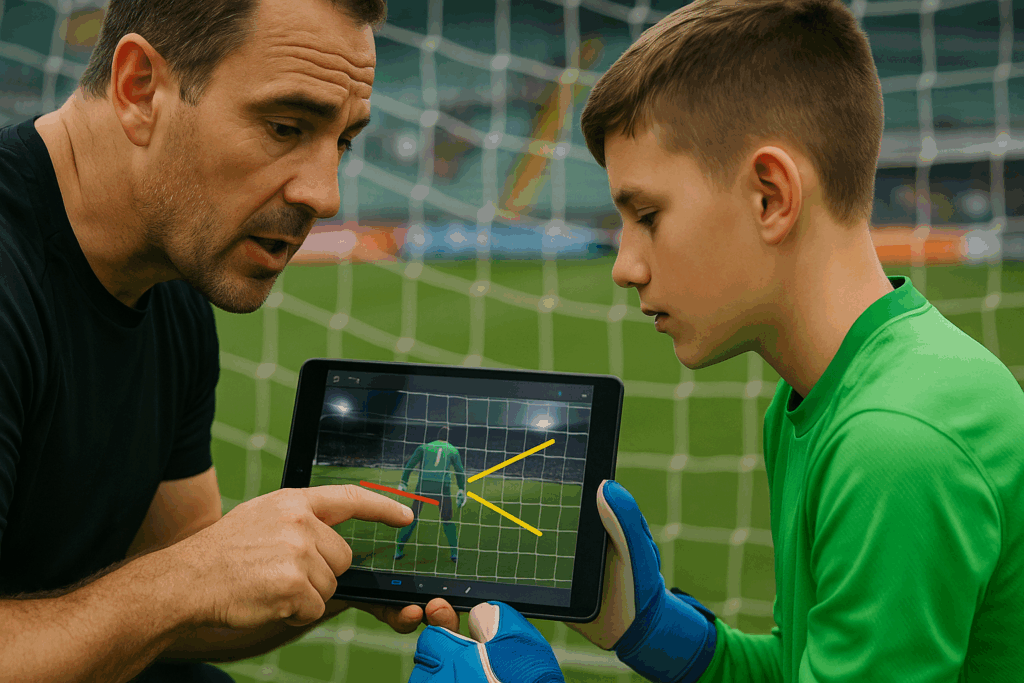
  3. Analysis with Drawing Tools: In the post-session review, the runs, positions, and passing options are visualized using the drawing tools in the behind-the-goal perspective.
  4. Individual Playlists: The goalkeeper receives a short playlist with their most important scenes to learn from for the next training session.

From Video back to the Pitch: The Analysis-Training-Cycle

The best analysis is useless if it doesn't flow into the next training session. Don't just show your goalkeeper the video scene; recreate the exact game situation from the "Playmaker in Goal" drill in training. Let them play through the situation again, but this time with the knowledge gained from the video analysis. Record this attempt as well. This direct before-and-after comparison is the fastest and most motivating way to make learning progress visible.

And what about the field players? To objectively evaluate the physical performance of your field players, zone14 STATS tracks valuable performance data such as running distances and sprints directly from the video—without the need for GPS vests.

Conclusion: The Complete Goalkeeper Starts with Complete Training

Modern goalkeeper training is a complex discipline that combines technique, tactics, athleticism, and psyche. The drills presented here are an excellent foundation, but only objective and detailed analysis enables targeted and rapid development. Video analysis, especially from the invaluable perspective of a behind-the-goal camera, is no longer a luxury but a crucial tool for unlocking a goalkeeper's full potential.

Solutions like those from zone14 make these professional methods accessible to every club today and help you make the decisive man between the posts even stronger.

Share on Facebook
Share on Twitter
Share on Linkedin
More related content from zone14
Categories
Coaching

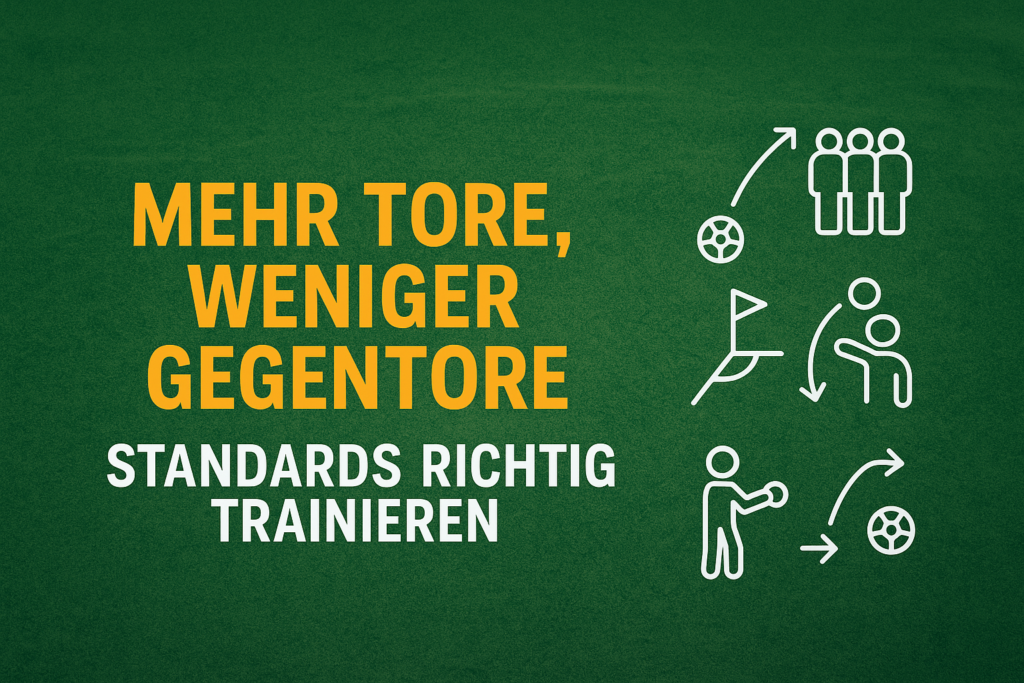
More goals, fewer goals conceded: Training set pieces correctly

Contents

More goals, fewer goals conceded: Training set pieces correctly

Set piece scenarios such as corners, free kicks, throw-ins and even indirect free kicks are among the decisive moments in football. They are not only opportunities for quick goals, but also critical points at which games can turn - in both a positive and negative sense. An unsuccessful free kick or a poorly defended corner can be just as decisive for victory or defeat as a perfectly executed move after a throw-in.

It is therefore all the more important that set-piece situations are not trained in isolation, but rather holistically - with a view to both phases of the game: Attack and defence. When offensive and defensive roles are trained in the same exercises, everyone involved benefits: attackers learn to assert themselves against real resistance, defenders improve their behaviour under real pressure. At the same time, the tactical understanding of the dynamics of such situations increases, leading to quicker decisions and better teamwork.
Foundations for successful set-piece situations

Set-piece situations require clear sequences, precise execution and coordinated running routes. Every player must know and internalise their role in order to successfully attack or defend against set pieces.
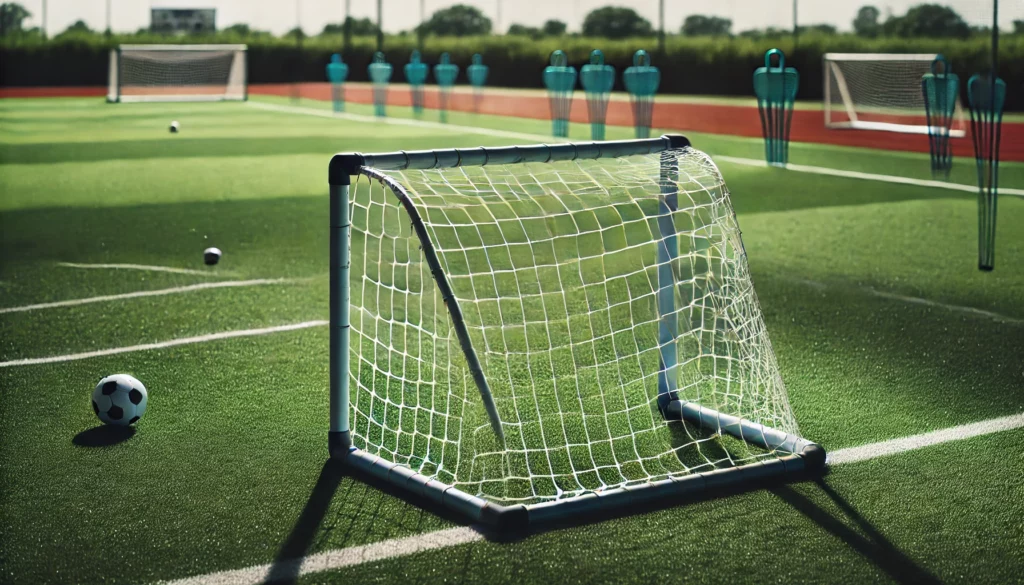
The forms of training presented here show in a practical way what systematic set-piece training can look like - with clear processes, defined roles and immediate feedback for both sides. This not only trains individual technique, but also strengthens collective coordination within the team. The alternation between different formats is particularly valuable: from targeted drills (e.g. direct free-kick with wall) to sequences similar to match formats (e.g. throw-in with transition movement).

Important principles:

  • Clear allocation of roles: Every player knows their exact role and position.
  • Precision and timing: Every movement and every pass is made according to a clearly defined timing.
  • Effective communication: Clear agreements and short, precise commands between the players.

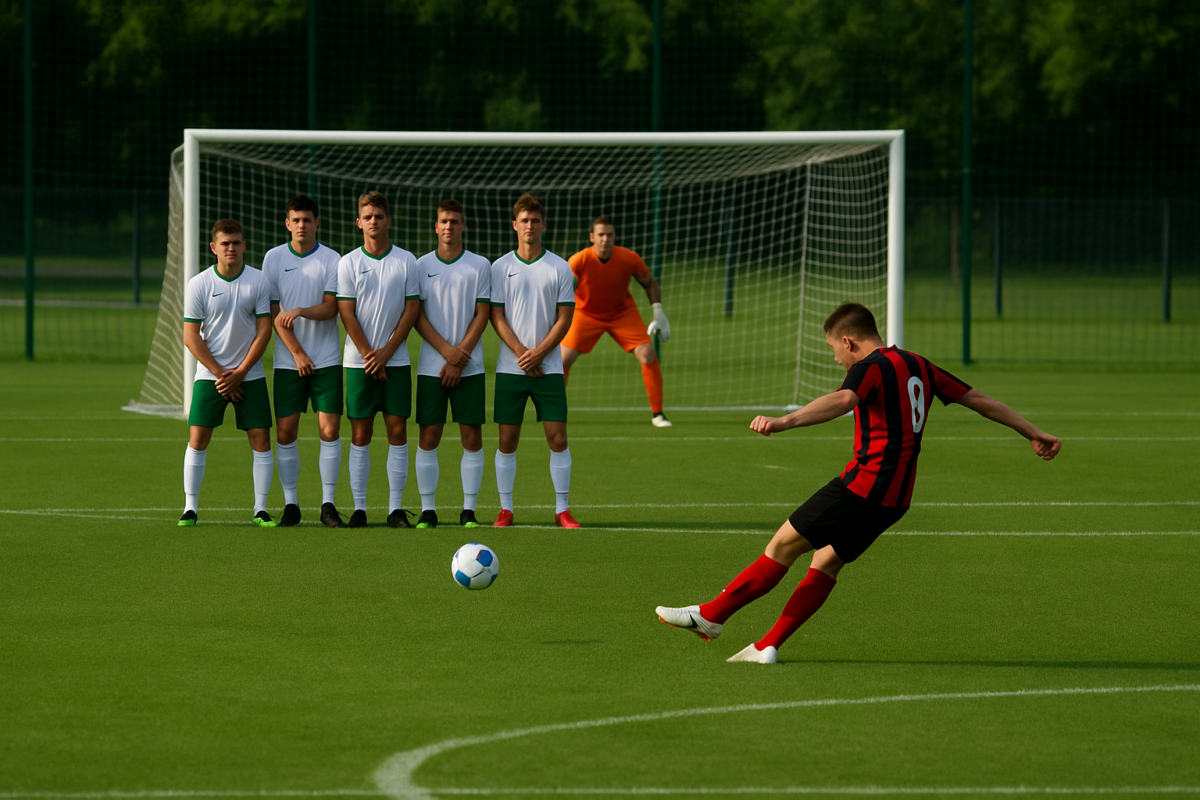
1. Direct free kicks with defensive wall - precision and defensive organisation

Objective: To improve the shooting technique and accuracy of the attackers and the positioning of the defenders and goalkeeper.

Set-up:

  • Three free-kick takers position themselves around the penalty area.
  • A defensive wall of 3-4 players and a goalkeeper actively defend.

Procedure: Each kicker takes it in turns to take five free kicks.

  • The defenders optimise their positioning and communication in the wall.
  • Feedback is given immediately, both offensively and defensively.

2. Indirect free kicks with active defense - combination and fast defending

Objective: Fast attacking actions and precise combination play under pressure as well as fast defensive reactions and blocking shots.

Set-up:

  • Free kick approx. 20-25 metres centrally in front of the goal.
  • Three attackers play quick, rehearsed combinations.
  • Two defenders actively try to interrupt the combination play and block shots.

Procedure:

    • The attackers try to complete the combination quickly and efficiently.
    • The defenders react to the movement of the ball and specifically block passing routes and shots.

3. Corner kicks - Offensive timing and defensive spatial coverage

Objective: Optimisation of offensive running routes and precise corner kick execution as well as defensive spatial coverage and efficient clearing actions.

Set-up: 

  • One player takes corner kicks with variable crosses.
  • Four attackers run into predefined zones.
  • Four defenders secure the spaces and cover the opponents in a team-orientated manner.

Procedure: 

  • Offensive players work on perfect timing and targeted finishing.
  • Defenders improve positioning, spatial coverage and active ball recovery.

4. Throw-ins - quick switching for offense and defense

Objective: Effective switching and quick decision-making in throw-in situations for both teams.

Set-up:

  • A playing field of approx. 30 x 20 metres.
  • Two teams play against each other; throw-ins must be completed within three ball contacts.

Procedure:

  • The team in possession of the ball must create chances immediately.
  • The opposing team actively works on quick defensive organisation and effective switching after winning the ball.

How can zone14 help with this?

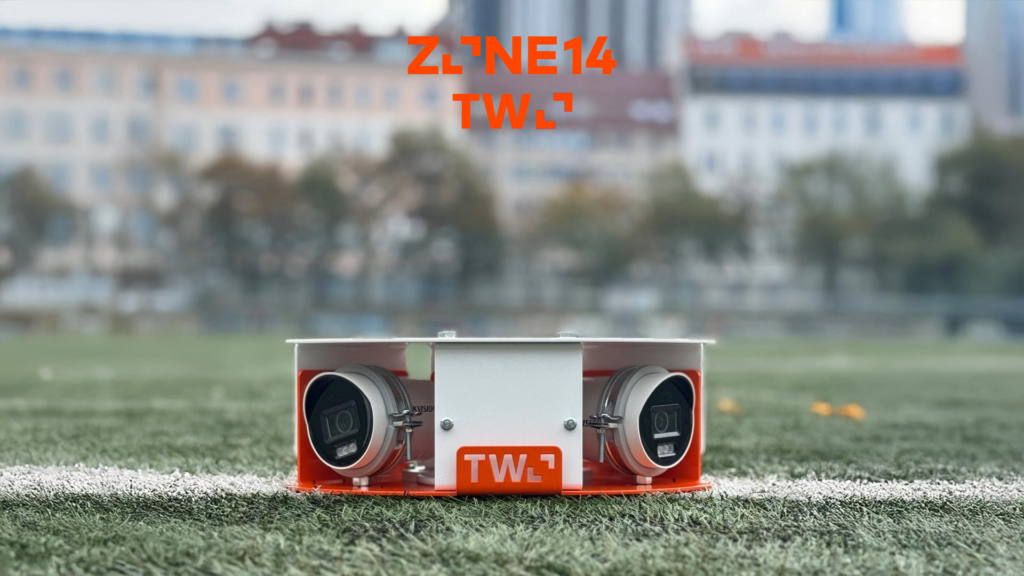
zone14 TWO

zone14 REPLAY - Analysing set pieces in a targeted manner

With REPLAY can be used to analyse set-piece situations in a detailed and structured way. Coaches can mark relevant scenes from matches or training sessions, comment on them visually and compile them into playlists for individual or team analyses. For example, repeated mistakes in wall positioning, imprecise running routes at corner kicks or coordination problems at indirect free kicks are visualised and discussed in detail. REPLAY makes tactical standard work understandable, comprehensible and effective in the long term.

zone14 LIVE - Analyse set-piece situations in real time

With zone14 LIVE , matches and training sessions focusing on set-piece situations can not only be streamed automatically and in high quality, but also analysed in real time. Coaches can immediately react to repeatable patterns during the game with the help of the live broadcast - for example, if running routes at corners are not coordinated or free kicks are not executed as rehearsed. The ability to make tactical corrections directly at half-time or even during short interruptions based on what has just been seen in the live stream is particularly valuable. This ensures immediate feedback and quicker implementation during the match. 

zone14 STATS - Making set-pieces actions measurable

STATS analyses how players behave physically in set-piece situations: Who sprints to the short post at a corner? Who consistently positions themselves incorrectly at free kicks? How many intensive runs are made during set-pieces in the final phase of play? By recording running routes, speeds and movement profiles, STATS provides objective data that is linked to specific video sequences. This creates a new understanding of efficiency, commitment and tactical discipline during set pieces.

Conclusion

Set-piece situations are increasingly deciding the outcome of matches. Systematic training that involves both offence and defence is needed in order to use them consistently and defend safely at the same time. The exercises presented create realistic game situations in which both parts of the team are challenged and encouraged at the same time - technically, tactically and in teamwork.

The targeted use of technologies such as zone14 REPLAY for video analysis, LIVE for real-time observation and STATS for objective performance evaluation makes standard training even more effective. The result is a modern training concept that not only trains standards, but also understands them in depth and develops them in a targeted manner - for tangible improvements on the pitch. zone14 REPLAY zur Videoanalyse, LIVE zur Echtzeitbeobachtung und STATS zur objektiven Leistungsbewertung wird das Standardtraining noch wirkungsvoller. So entsteht ein modernes Trainingskonzept, das Standards nicht nur trainiert, sondern auch tiefgreifend versteht und gezielt weiterentwickelt – für spürbare Verbesserungen auf dem Platz.

Share on Facebook
Share on Twitter
Share on Linkedin
More related content from zone14
Already have a camera but looking for an affordable analysis platform?

zone14 COACH is the solution

Categories
Coaching

What does it take to become a football coach?

Contents

What does it take to become a football coach?

Football captivates millions of people worldwide. What often appears at first glance to be pure talent and passion actually calls for structured planning and focused training. Whether you aim to enhance your performance as a player or lead a team to new heights as a coach, the right exercises and concepts form the foundation for success.

Yet many people ask themselves: How do you become a football coach? And what requirements do you need to fulfil to become a football coach? There really are a few steps needed to get started as a football coach. In this article, we not only explain how to become a football coach, but also shed light on the most important training areas in football—from intensive defence drills, precise passing drills, and varied goal-kicking exercises to the strategic significance of Zone 14.

You’ll also learn, what it takes to start a career as a football coach —from the essential coaching licences and qualifications to the right equipment. Ultimately, you might be wondering: What are the requirements to work in football as a coach? what do you need for a future as a football coach? The answers to these questions are diverse, covering both professional and personal aspects.

Tip: If you want to deepen your knowledge even further, you can find plenty of additional information and drills about football coaching here.!

Types of Training Exercises

Training

1. Defense Drills

Why Defence Is So Important

“Offence wins games, defence wins championships”—this quote hits the nail on the head. Successful teams often boast a stable defense that not only concedes few goals but also lays the groundwork for controlled build-up play. Strong defensive organisation can dominate a match and give the offence the security it needs to create dynamic attacks.

Especially if you’re thinking about becoming a football coach, you’ll quickly realise that defensive work must be a key element of every training plan. What qualifications are needed to become a football coach? Among them is the ability to teach complex defensive tactics and help your players understand the critical role of a cohesive defensive unit.

Typical Defense Drills

1-on-1 Duels

  • Focus on stance, timing in tackles, and “reading” your opponent’s movements.
  • Tip: Keep your centre of gravity low and maintain some distance to react quickly.

Zone Defense

  • Players practise shifting within a defensive chain to cut off opponents’ passing lanes.
  • Important: Good communication and clearly assigned roles (e.g., centre-backs vs. full-backs).

Pressing Exercises

  • Trains quick ball recovery in the opponent’s half.
  • Procedure: Players advance as a unit to press the ball carrier early and force errors.

Positional Play in a Back Four

  • Specific training for the classic four-defender line.
  • Players learn to adjust to the ball’s position and the opponent’s movements.

Frequent Mistakes in Defense

  • Leaving too much space between defenders
  • Poor communication or lack of clear commands
  • Impatience and hasty tackling, which can lead to gaps at the back

Want more inspiration for your defense training? Discover additional drills and training plans here.!

2. Passing Drills

Importance of the Passing Game
Training

A precise and flexible build-up play relies heavily on accurate passing. Good passes not only secure ball possession but also lay the foundation for dangerous attacks. A team that can move the ball reliably among its players controls both the tempo and overall flow of the match.

If you’re wondering what steps are required to become a football coach, remember that teaching proper passing techniques is vital. A solid passing game is the basis for any tactical system and plays an integral role in every coaching education programme.


Effective Passing Drills in Training

Rondo (Circle or Square Passing Game)

  • Several players form a circle or square and pass the ball to each other, while one or two defenders in the middle try to win it back.
  • Improves ball control, speed of play, and anticipation.

Short Passing in Tight Spaces

  • Two teams (e.g., 5 vs. 5) play on a reduced field.
  • Objective: Move effectively under pressure and develop quick, precise passes.

Long-Pass Exercises

  • Focus on passes of 20–30 metres.
  • Important: Players learn both the pass and the correct way to receive the ball.

One-Touch Passing

  • Immediate ball circulation without a controlling touch.
  • Raises game tempo and exploits gaps in the opposition’s defense.

Tips for a Better Passing Game

  • Master proper technique: shoulders facing the passing direction, weight balanced over the ball.
  • Practise inside and outside of the footto stay adaptable.
  • Keep your head upto see teammates’ positions and any approaching defenders.

Check out our collection of training ideas for even more drills and tips to fine-tune your technical abilities. Have a look here. here!

3. Goal-Kicking Drills

The Role of Goal-Kicking Training

Goals decide matches—so shooting practice should be a staple of every training session. It’s not just about powerbut also about accuracy, timing and confident ball handling before the shot.

If you’re considering what you need for a future as a football coach, you’ll quickly see that understanding various goal-scoring methods is key. Only then can you properly instruct your players and help them reach their offensive potential.

Examples of Goal-Scoring Drills in Training

Training

Finishing After a Combination

  • Players practise a passing sequence (e.g., a one-two or lofted ball) before shooting.
  • Promotes teamwork and simulates realistic match scenarios.

Crosses and Headers

  • Trains the interplay between crossers and attackers in the box.
  • Focus: Timing the jump and delivering precise crosses.

Position-Specific Shooting Drills

  • Forwards: Shots from turns or after rapid control of the ball
  • Midfielders: Long-range efforts
  • Defenders: Situational shots after set pieces or counter-attacks

Shooting Under Defensive Pressure

  • Creates game-like conditions, forcing the attacker to shoot while pursued by defenders.
  • Develops speed and mental resilience.

Success Factors in Shooting

  • Posture: Lean slightly over the ball with your standing foot firmly planted.
  • Focus on the Ball: Only look up at the goal in the last moment to adjust aim.
  • Variety: Practise different shot types (inside foot, laces, chips) and train both feet.

Want to learn more? We offer comprehensive articles with additional drills and methods—find everything here.!

4. Technique Drills

Why Technique Is the Cornerstone

Anyone who’s observed football at the highest levels knows it’s often the —beyond fitness and tactics—technical subtletiesthat truly stand out. Close ball control, rapid changes of direction, and pinpoint passes grant you multiple avenues to outwit opponents.

If you’re thinking about what it takes to start a career as a football coach, guiding your players in both basic and advanced techniques is vital. A team’s success hinges on solid individual skills just as much as on collective play.

Important Technical Drills in Training

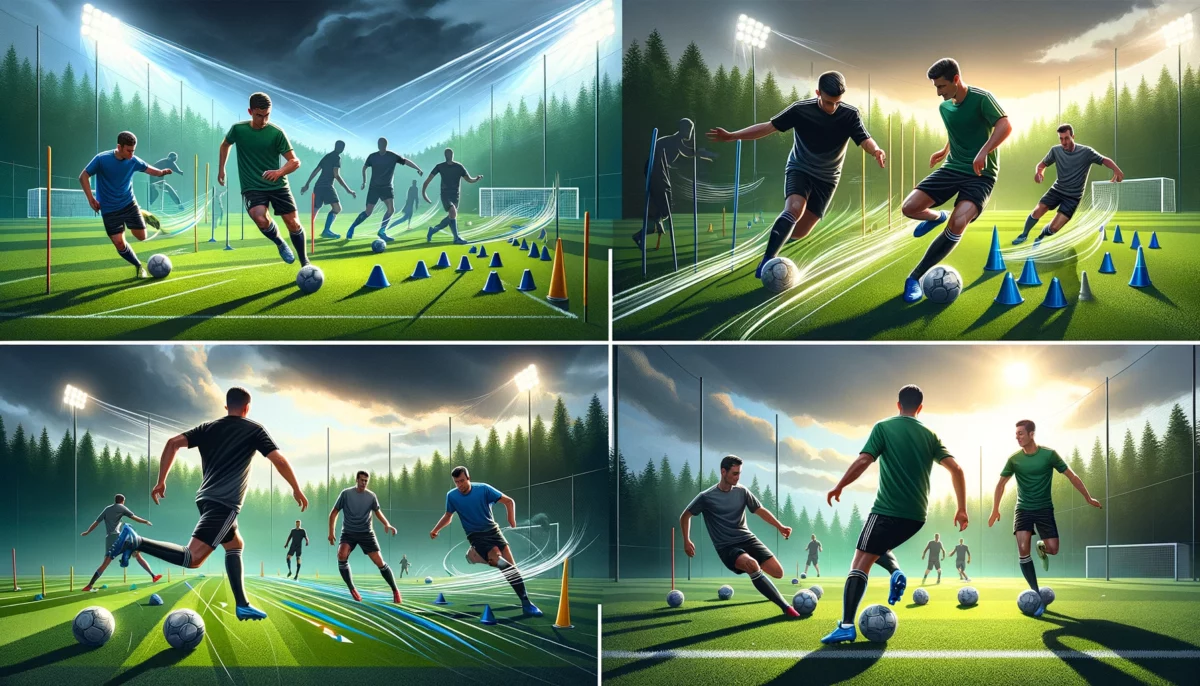
Dribbling Course

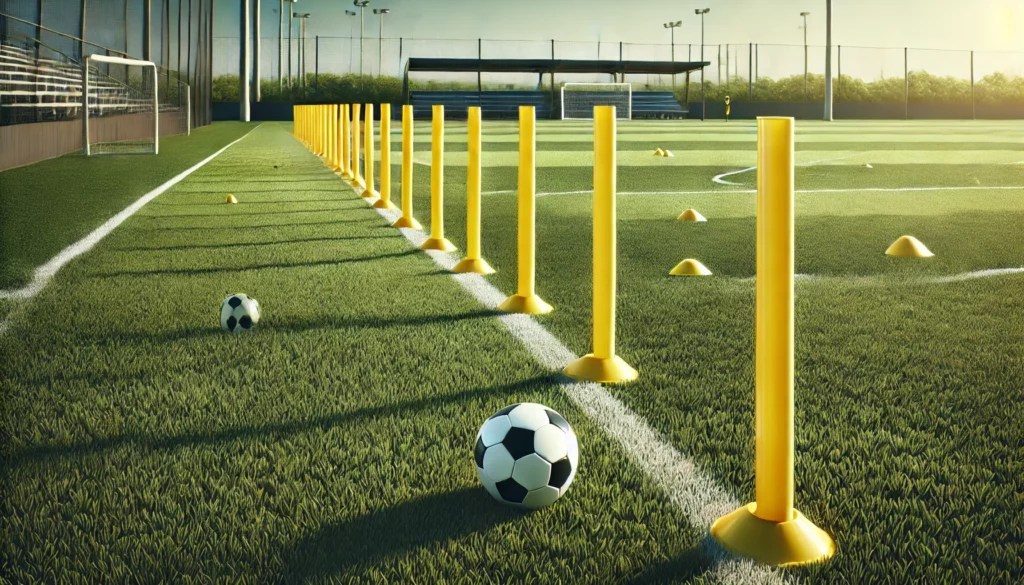
  • Set up cones, coordination ladders, or poles to practise varied movements and pace changes.
  • Goal: Keep the ball close while navigating obstacles.

Tricks & Feints

  • Overstepping moves, body feints, or the Zidane spin.
  • Key Point:Proper timing for the feint, followed by an explosive burst of speed.

Ball Control Under Time Pressure

  • Players receive passes and must control the ball swiftly before defenders close in.
  • Develops rapid decision-making and tidy technique.

Coordination ladder

  • Improves agility and acceleration.
  • Tip: Combine ladder drills with ball work to heighten real-game relevance.

Common Mistakes in Technical Drills

  • Changing pace too quickly before fully controlling the ball
  • Not enough two-footed practice.
  • Lack of patience: technique requires repeated, focused drills to perfect

Tip: For more detailed guidelines on extracting maximum technical potential from your players, take a look here.!

Training

Zone 14: The Key to Scoring Goals

What Is Zone 14?

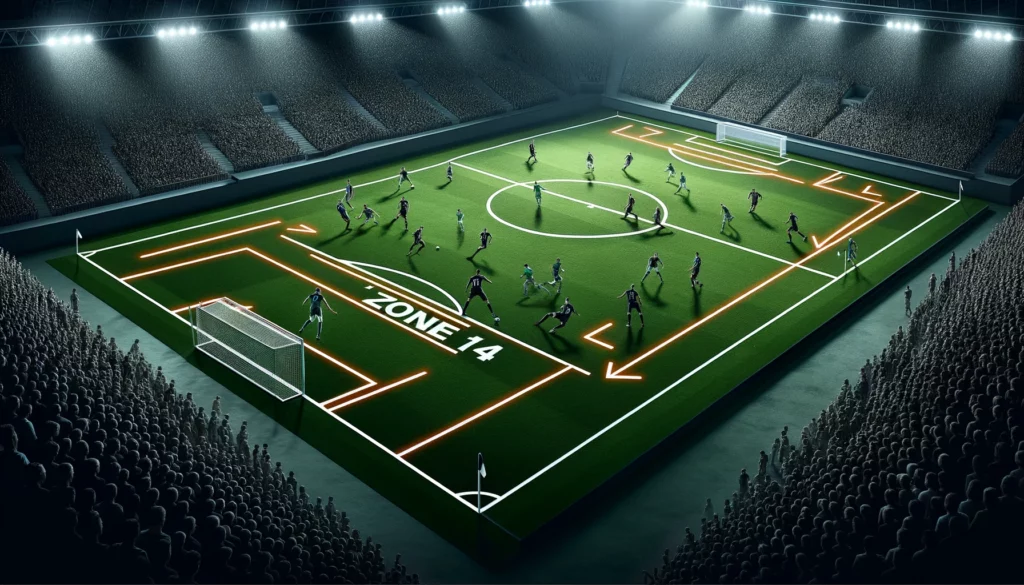
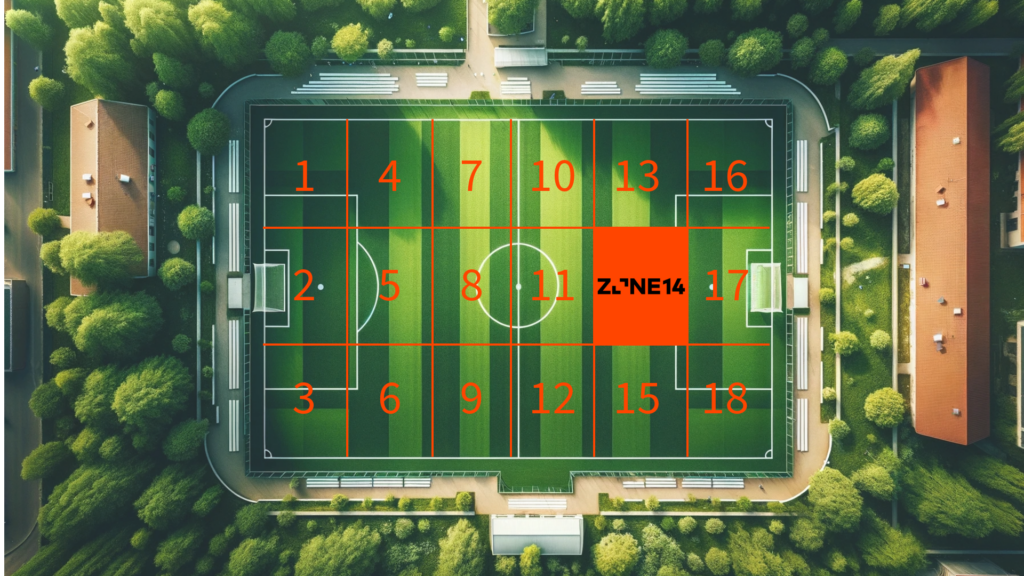
The Zone 14 refers to the area just in front of the opponent’s penalty box. Statistics show that this zone generates a large portion of match-winning opportunities. Dominating Zone 14 can dramatically boost your team’s chance of creating and converting scoring chances.

Why Is Zone 14 So Important?

  • Threat in Transition: Many teams aim to move rapidly through midfield, seeking that killer ball into Zone 14.
  • High Creative Potential: Playmakers and attacking midfielders frequently exploit this space with incisive through passes.
  • Tactical Nuance: Targeting pressure in this zone or spotting gaps here can turn the tide of a match.

Training Methods for Zone 14

  • One-Two Passes & Lofted Balls: Swift interplay to bypass defenders and penetrate the penalty area
  • Positional Games: 5 vs. 5 or 4 vs. 4 around Zone 14 to practise tight, controlled passing
  • Finishing Drills: Shots from distance or quick low balls into the box

Tip: Learn how to effectively move into Zone 14 and create dangerous shots on goal here! here.!

Training Drills for Zone 14

Specific Drills for the Decisive Area

Gaining control in Zone 14 can significantly influence a match’s outcome. Targeted exercises train your players’ combination play and decision-making skills in this crucial sector.

Tight Passing in a Square

  • An advanced rondo setup focusing on passing in and out of Zone 14.
  • Develop incisive passing and spatial awareness in congested areas.

Counter-Pressing in Zone 14

  • Emphasises rapid transition after losing possession.
  • Aim: Either keep the opponent from entering the zone at all or regain possession quickly.

Shots from the Second Row

  • Practises precision finishing from 16–20 metres out.
  • Incorporate direct hits, low drives, and curled attempts.

Vertical Passing

  • Trains your players to open up space behind the defence with minimal touches.
  • Teams that press high or hold a high defensive line.

TipFor further ideas on Zone 14 drills, check out our resources here.!

Football Coach education

Why a Comprehensive Education Matters

A great coach needs more than practical football knowledge. Methodology, pedagogy ‎‎‎‏‏‎ ‎and team leadership skills are pivotal for guiding a group to success. If you’re asking yourself how to become a football coach, you should start here: a structured Football Coach education gives you the expertise to unlock your players’ full potential.

You might also be wondering: What are the requirements to work in football as a coach? Besides practical experience, having an officially recognised licence is typically crucial, as clubs often look for certified coaches who bring a professional standard.

Contents of a Coaching Programme

  • Training Theory: Designing targeted and varied sessions
  • Tactics: Exploring various tactical systems and adapting them to your squad and opponents
  • Psychology & Pedagogy: Motivating players and effectively resolving conflicts
  • Practical Sessions: Teaching demonstrations and mentorship under experienced coaches

Career Prospects & Benefits

  • Expanding Network: Meeting other coaches and club managers can lead to future job opportunities
  • Quality Seal: Official licences boost the trust clubs and players have in your ability
  • Long-Term Development: Regular training keeps your methods fresh and up to date

Tip: Find out how to enrol in a coaching programme and everything else you need to know here! here.!

Licences in Coach Training

An Overview of Licence Levels

Most football associations offer different licence tiers, each stipulating who can coach at which level and under what requirements. If you’re looking to get started as a football coach, understanding the licensing framework is essential:

  • C licence: Entry-level qualification, ideal for youth and amateur sides
  • B licence: More advanced, suitable for higher amateur leagues and some semi-pro teams
  • A licence: Professional level, allowing you to coach top-tier clubs
  • UEFA Pro (Football Instructor Licence): The highest tier, mandatory for coaching in Europe’s elite professional leagues

Requirements & Procedures

  • Practical experience: You often need proven club coaching time
  • Courses & Exams: Covering theory (tactics, methodology) and practical sessions (live teaching demos)
  • Ongoing Education: Periodic refresher or advanced courses to keep your licence valid

Why Licences Are Worth It

  • Professional Standards: A structured education assures consistent quality
  • Competitive Edge: Clubs increasingly prioritise officially licensed coaches
  • Personal Growth: Networking with other coaches fosters continuous improvement

Thus, anyone asking how to become a football coach ‎‎‎‏‏‎ ‎and how to get a football coaching career and what qualifications are required to become a football coachshould delve deeply into these licence pathways.

Tip: For details on the costs and benefits of these licences, click here.!

Football Equipment

The Importance of the Right Equipment

Whether at amateur or professional level, football equipment is crucial for safety, comfort, and performance. While the ball may be central, many other essentials come into play.

Useful Training Gear

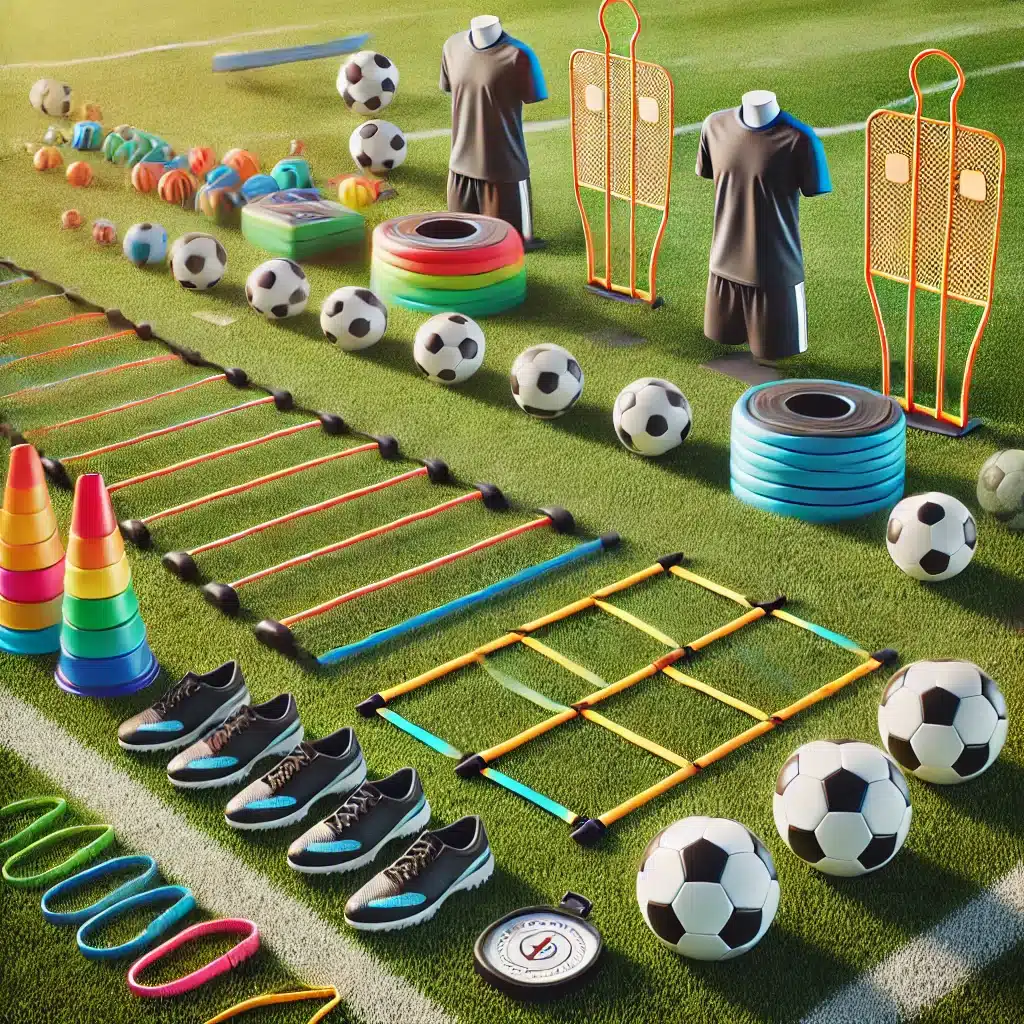
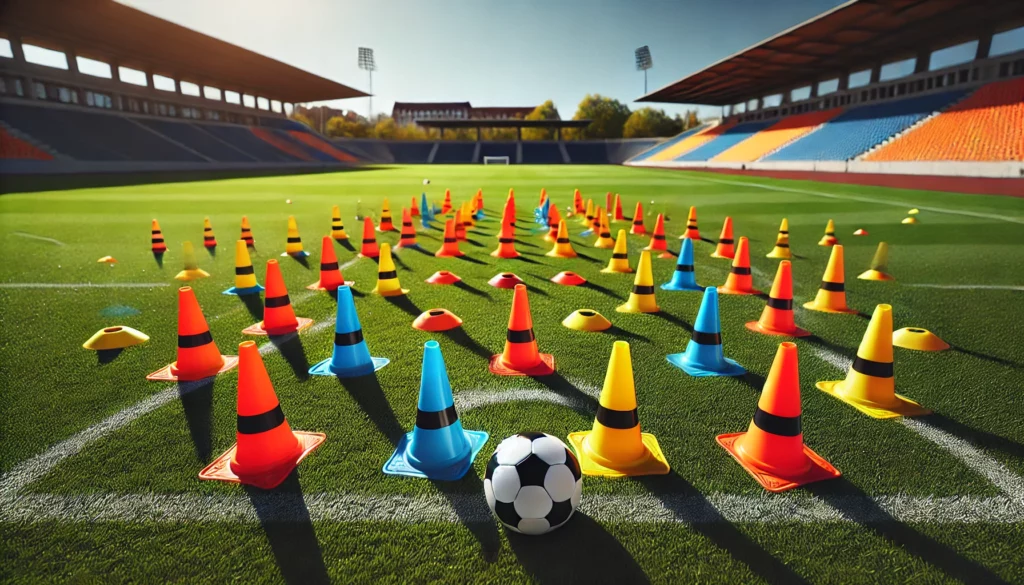
  • Cones, Coordination Ladders, Hurdles: Great for technique and sprint exercises
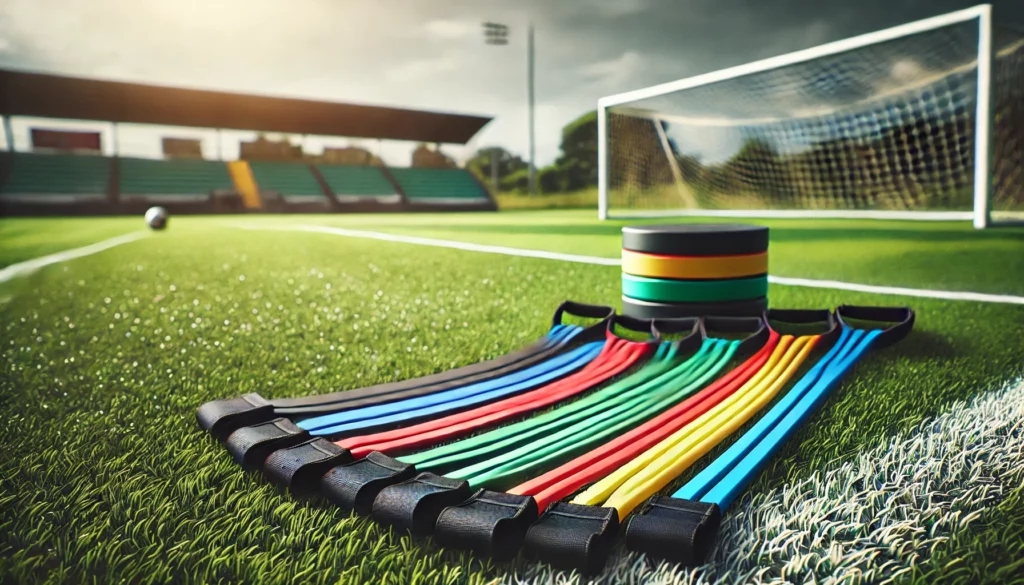
  • Weight Cuffs (use with caution): A tool for boosting explosive power
  • Medicine Balls or Resistance Bands: Effective for holistic athletic training

If you explore in depth what you need for a future as a football coach , you’ll quickly discover that having reliable equipment is often overlooked but absolutely vital. It can make structuring and running your sessions far more efficient.

TipSearching for extra training gadgets or more info? You’ll find it here. fündig!

Further recommendations: Coach insights from Ralf Rangnick and the rebuilding of Rapid Vienna

If you’re intrigued by modern training approaches and the success stories in professional football, check out these two articles:

  • Ralf Rangnick: Find out here.about the training philosophy and tactical vision that have made him so successful, and how you can adapt his methodology to your own coaching.
  • Rapid Vienna: Get a deep dive here. into Rapid Vienna’s playing and training culture, and see how this historic club continually improves its performance.

Both pieces offer valuable insights into structuring your sessions more strategically and expanding your coaching perspectives—from targeted player development to evolving your own coaching identity.

Fazit & Ausblick

Whether you’re an aspiring player looking to refine your skills or a coach aiming to master fresh tactics, Football Coaching is a multifaceted realm where countless factors interconnect. This article has highlighted key points that you should tackle if you’re wondering becoming a football coach.

For more specifics, curated training plans, and further instructional material, head over to Zone14.ai/blog/tag/training. You’ll discover a range of ideas to keep your training engaging and effective.

Always remember that beyond pure football expertise, passion,, discipline, and a willingness to keep learning are the driving forces behind successful coaching. Embrace these principles, and you’ll be well on your way to achieving your goal— what it takes to make it as a football coach Best of luck in putting this knowledge into practice and pursuing your future coaching career!

Share on Facebook
Share on Twitter
Share on Linkedin
More related content from zone14
Already have a camera but looking for an affordable analysis platform?

zone14 COACH is the solution

Categories
Coaching

Lizenzen in der Fußball-Trainerausbildung: Leitfaden 2025

Contents

Lizenzen in der Fußball-Trainerausbildung: Leitfaden 2025

The Football coaching education is a complex, multi-stage process that is regulated by national and international football associations. The education aims to equip coaches with the necessary technical, pedagogical and social skills to successfully manage both youth and professional teams. The following blog describes in detail the different licence levels, the challenges and progress of the education process as well as an international comparison of coaching licences.

Trainer vor jungen trainierenden Spielern

Structure of the coach education

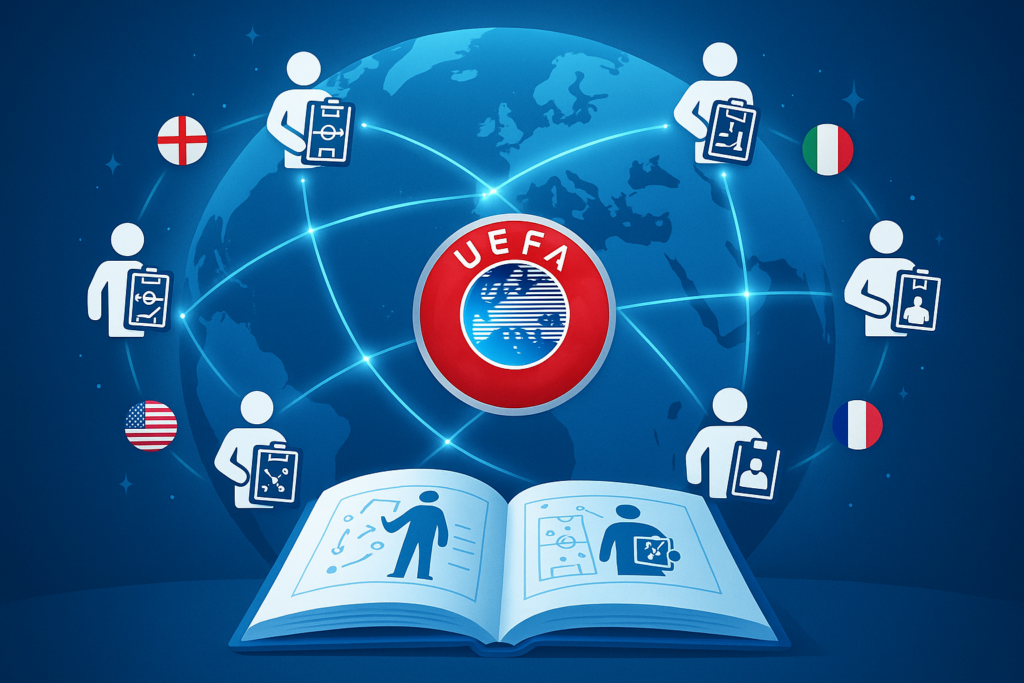
In most countries, football coaching education is structured according to a pyramid model. At the bottom are licences for the amateur sector, while at the top are licences for the professional sector. UEFA, the umbrella organisation of European football, provides the framework with its licence levels (UEFA C, B, A and Pro), which is used in most European countries. However, this structure is often adapted by national associations to meet regional requirements.

1. UEFA C licence - the basis for youth coaches

The UEFA C licence is the entry point to formal coaching education and is aimed at people who want to work at youth and amateur level. Although it is the lowest licence level, the requirements for future coaches are already demanding at this level.

Training content

  • Technical principles: Coaches learn how to teach young players the basics of football such as passing, dribbling, shooting and receiving the ball. The focus is on promoting basic technical skills.
  • Didactics and methodology:: Particularly important in the C licence is the ability to design age-appropriate training. Here, participants learn how to translate complex content into simple and understandable forms of training for children and young people.
  • Understanding the game:: Although tactical training is only deepened in the higher licence levels, a basic understanding of the game is already taught in the C licence. Coaches learn how to teach simple forms of play and movement patterns.

Prerequisites

  • Minimum age:: In many countries, the minimum age for obtaining the UEFA C licence is 16 or 18.
  • Experience: Participants are expected to have basic playing experience, and currently being a part of a football club is often sufficient.

Examinations

At the end of the training programme, an exam is taken which includes both practical and theoretical parts. In the practical part, a training session with a youth team is usually prepared and carried out, which is assessed by the examiners. The theoretical part deals with basic questions on training methodology and the rules of the game.

Career opportunities

With the UEFA C licence, coaches are entitled to work in the youth and lower amateur sector, for example as youth coaches in local clubs. Many coaches use this licence as a stepping stone to gain initial experience and then qualify for the UEFA B licence.

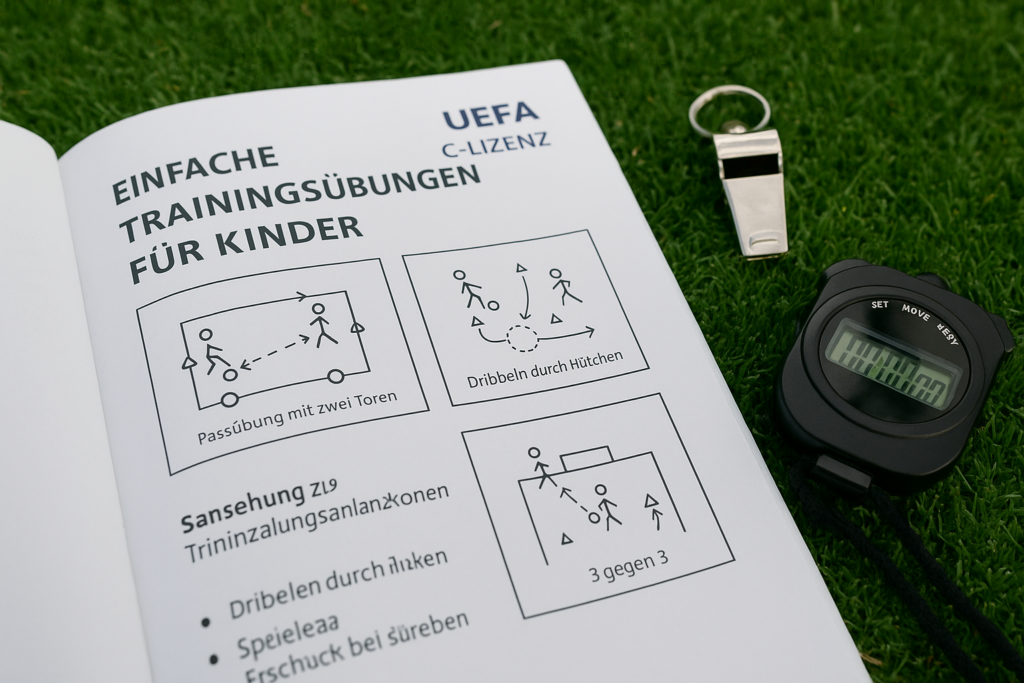
Ein Textblatt der UEFA C-Lizenz

2. UEFA B licence - The entry into high performance football

The UEFA B licence The UEFA B licence is the next level and enables coaches to work in performance-oriented youth teams and in the upper amateur sector. It is crucial for coaches who want to work in football more professionally.

Training content

  • Tactics and systems of play: The main focus of the UEFA B licence is on teaching tactical fundamentals. Coaches learn how to set up teams in different positions and how to implement different systems of play (e.g. 4-4-2, 4-3-3).
  • Match analysis: Coaches are trained to systematically analyse matches and draw conclusions for training. This includes observing and assessing their own team and their opponents.
  • Specific training methodology: The training methods become more complex and the focus is more on individual and group tactics. Training methods are developed that address the specific needs of the players in order to improve their strengths and weaknesses in a targeted manner.
  • Fitness and conditioning training: Coaches acquire fundamental knowledge in the area of training management, particularly in the areas of endurance, strength and speed. Particular emphasis is placed on age- and performance-appropriate training.

Prerequisites

  • C licence: Coaches must be in possession of the UEFA C licence and generally have a certain amount of practical experience as a coach.
  • Minimum age:: As a rule, the minimum age for obtaining the UEFA B licence is 18 years.

Examinations

The examinations for the UEFA B licence are more demanding than those for the C licence. In addition to theoretical examinations, which cover game systems, tactics and training methodology, participants must also plan and carry out complex training sessions. These are not only assessed by the examiners, but often also by the players who complete the training sessions.

Career opportunities

With the UEFA B Licence, coaches can train youth teams at the highest level and take over teams at the higher amateur level. Many ambitious coaches who want to move up to the semi-professional level take this licence.

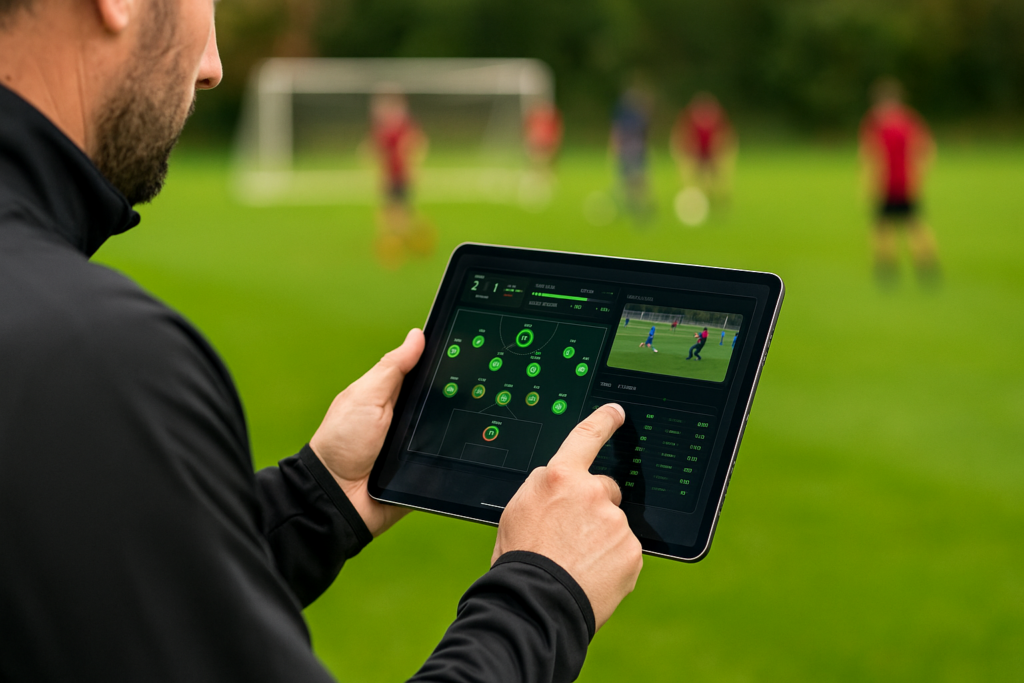
Ein Trainer mit Analysetablet

3. UEFA A licence - For ambitious coaches in the professional sector

The UEFA A licence is one of the highest licence levels and qualifies coaches for roles in semi-professional and professional football. The complex requirements for training and managing a football team are taught here.

Training content

  • Advanced tactics: The course emphasises the development of advanced tactical concepts that are required in the top leagues. Coaches learn how to adjust teams flexibly to different match situations.
  • Match preparation and follow-up: Here, particular emphasis is placed on analysing opponents in order to make specific match preparations. Coaches learn to observe opponents, identify their weaknesses and develop a suitable match strategy.
  • Team management: At this level, not only technical knowledge is required, but also the ability to manage a team. Coaches are trained in psychological aspects, such as motivating players or resolving conflicts within the team.
  • Scouting and talent development: Another important aspect is the ability to recognise talent and develop it in a targeted manner. Coaches learn how to assess player potential and develop it in the long term.

Prerequisites

  • B licence: The prerequisite is possession of the UEFA B licence and several years of practical experience as a coach.
  • Practical experience: In many countries, applicants are expected to have already worked successfully as a coach in the competitive field before being admitted to the UEFA A licence.

Examinations

The UEFA A Licence examinations are extremely demanding and include a detailed analysis and development of match and training concepts. Particular attention is paid to the practical implementation of tactical and methodological content in training sessions and matches. The ability to carry out complex match analyses and draw conclusions for training work is also tested.

Career opportunities

With the UEFA A licence, coaches can manage teams in the second or third division as well as in the higher amateur sector. The UEFA A licence also offers many career opportunities as an assistant coach in the first division and in international football.

4. UEFA Pro licence - The pinnacle of coaching education

The UEFA Pro licence is the highest qualification that a football coach can obtain in Europe. It is mandatory in order to coach teams in the highest national leagues as well as in international professional football (e.g. Champions League, Europa League).

Training content

  • Team management at the highest level: At this level, it is no longer just about tactics and technique, but about the holistic management of a team. The coaches learn how to deal with the high demands of professional football, which range from man-management to media training.
  • Media training: Coaches at this level must be able to deal confidently with the media, as press conferences and public appearances are part of everyday life. Communication strategies and crisis management are key topics.
  • Application of science and technology: The integration of data analysis, sports science and psychological counselling is deepened. Coaches learn how to use modern technology to maximise their team's success.
  • Playing philosophies and leadership styles: A large part of the programme revolves around the development of an individual playing philosophy and leadership style. Coaches are encouraged to find and define their own identity as a coach.

Prerequisites

  • A licence: Coaches must be in possession of the UEFA A-licence.
  • Experience: As a rule, several years of practical experience at a professional level is required.

Examinations

The examinations for the UEFA Pro Licence are intensive and include extensive theoretical and practical tests. Coaches must demonstrate their skills in real match situations and show that they are able to manage a team at the highest level.

Career opportunities

The UEFA Pro Licence is a prerequisite for working as a head coach in the top European leagues or in international competitions. Coaches such as Jürgen Klopp, Pep Guardiola and José Mourinho have obtained this licence before taking their careers to the top of international football.

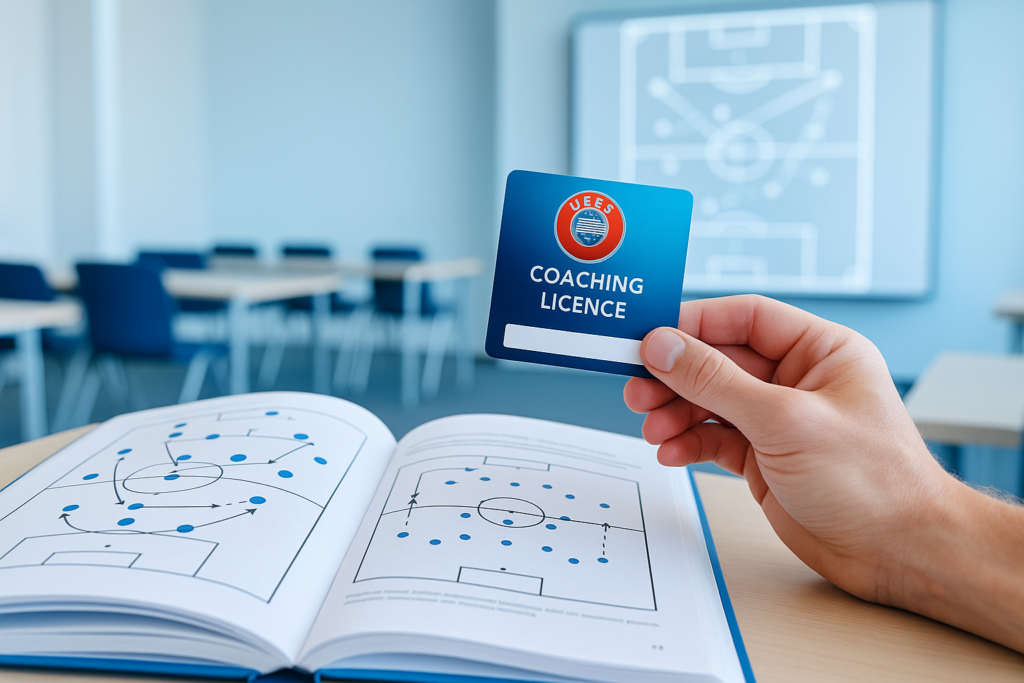
Bild einer Lizenz von UEFA

The cost of the licences

UEFA C licence / youth coach education

The UEFA C licence is the first level for football coaches
and is aimed at people who would like to work in the children's and youth sector. This training programme teaches the basics of coaching, such as training planning, understanding the game and pedagogical work with children. The UEFA C licence costs between €500 and €700 in Austria and usually comprises several modules and a final examination. Depending on the course offered, the training lasts a few weeks and provides a solid foundation for anyone who wants to get into youth football.

UEFA B licence

The UEFA B licence builds on the C licence and entitles the holder to coach youth teams in the upper performance range as well as amateur teams. This licence provides in-depth knowledge of match tactics, training design and sports psychology, which are important for performance-oriented teams. The cost of the UEFA B licence in Austria is between 1,500 and 2,000 euros. The training is more intensive and requires more time, as both theory and practice are covered in depth. This licence is for coaches who want to work ambitiously in the amateur and semi-professional sector.

UEFA A licence

The UEFA A licence is aimed at coaches who want to work in the semi-professional and professional sector. With this licence, coaches can also work in higher leagues and are able to develop comprehensive training plans, implement advanced tactics and shape the individual development of players. The cost of the UEFA A licence in Austria is between 4,000 and 6,000 euros. The course lasts several months and includes extensive theoretical and practical modules such as match analysis, team dynamics and performance-orientated sports psychology. The A licence is a prerequisite for working as a head coach in the professional sector below the top division.

UEFA Pro licence

The UEFA Pro Licence is the highest qualification for football coaches and is required for coaches of professional teams at international level. This licence is a prerequisite for working as a head coach in the top leagues and at international level. The training for the Pro Licence is demanding and requires participants to
have comprehensive knowledge in all areas of coaching, from tactical and technical training to management skills, sports psychology and team leadership. The UEFA Pro Licence costs between €10,000 and €12,000 in Austria and the course often lasts more than a year. It includes internships, examinations and extensive theoretical and practical content.

Challenges in football coach education

Football coaching education is demanding and involves various challenges. Many coaches have to complete their education alongside normal work life, which requires a great deal of time. The higher licences in particular require an intensive examination of tactics, psychology and management.

Time and cost expenditure

The cost of training increases considerably with each licence level. The UEFA Pro licence in particular is associated with high fees, which represents a financial challenge for many coaches. In addition, the time required increases with each licence level, which makes it difficult to balance work and family life.

Practical experience and acceptance

Many national football associations require coaches to spend a certain amount of time working as a coach after each licence level before they are allowed to tackle the next level. This not only provides valuable experience, but also a certain amount of competitive pressure as many coaches compete for limited positions.

Access to training places

The number of training places for the UEFA Pro Licence is very limited. In many countries, only a few coaches are admitted each year. These places are usually highly competitive and many coaches have to wait years to be able to continue their education at this level.

Progress and developments in coach education

Football coach education has developed considerably in recent years. In addition to the traditional content, new topics are also gaining importance, such as the application of data analysis in football, the role of sports psychology and the importance of leadership and communication. Here are some of the most important advances:

Digitalisation and data analysis

More and more associations are integrating digital tools into coach education. Video analysis, tactical software and data-based training management are now an integral part of the higher licence levels. Coaches must learn to interpret large amounts of data and translate this into practical instructions for their team.

Sports psychology and communication

The psychological support of players is becoming increasingly important. Coaches must be able to bring their players not only physically but also mentally to the highest level. This requires skills in communication and conflict resolution, which are increasingly taught in modern training programmes.

Internationalisation of training

As football is becoming increasingly internationalised, many associations attach importance to their coaches being able to compete internationally. Some associations therefore offer transnational training modules or partnerships with foreign football academies.

New Technologies

New technologies are fundamentally changing training and opening up new possibilities for improving performance. Video analysis tools in particular, help to evaluate movement sequences and technique in detail. They enable trainers to provide precise feedback and target weaknesses. In special courses, participants learn how to use these tools effectively, edit recordings and optimise training results. In this way, the combination of technique and knowledge becomes a valuable building block for success in training.

zone14 REPLAY

Football video analysis software for everyone

International comparison of trainer education

Trainer aus aller Welt die sich unter der UEFA ausbilden lassen

While the UEFA licensing structure is largely standardised in Europe, there are differences in coach education around the world.

Austria

In Austria, too, coach education, is organised by the Austrian Football Association (ÖFB), is also closely aligned with the UEFA guidelines. The ÖFB attaches great importance to sound training that takes into account both tactical and pedagogical aspects and enables a permeability from the grassroots to the top level. The training often takes place in the regional association sports schools and increasingly integrates modern approaches such as Video Analysis and sports psychology content in order to prepare the next generation of coaches for the diverse demands of national and international football.

Germany

In Germany, education is organised by the German Football Association (DFB) and is highly structured. The DFB Academy in Frankfurt is regarded as one of the most advanced training centres in the world. Particular emphasis is placed on the training of young coaches, and Germany has developed a strong network for youth football in recent years.

England

In England, the Football Association (FA) is responsible for coach education. There are strict entry requirements, particularly for the UEFA Pro Licence. English coach education has modernised considerably in recent years, particularly in the areas of sports science and data analysis.

USA

In the USA, football coach education is regulated by the US Soccer Federation. The focus here is strongly on the development of youth football, and coach education is closely linked to the university system. The licence structure is based on that of UEFA, although the requirements are more flexible, which makes access easier.

South America

In South America, particularly in Brazil and Argentina, coach education is less structured than in Europe. Many coaches rely on their own experience as players and acquire their licences parallel to an active football career. Even though associations such as CONMEBOL are attempting to formalise education, practice in South America is often strongly influenced by individual experience.

Zwischen Anspruch und Erfolg

Football coach education is a complex and demanding process that ranges from grassroots amateur level to professional football. Education is characterised by high demands in terms of time and costs, but also offers many advances in the areas of tactical knowledge, psychology and technology. An international comparison shows that the UEFA licences are largely regarded as the standard, while other continents go their own way.

The challenges along the way are great, but with the right support and a clear goal in mind, ambitious coaches can advance their careers to the professional level.

Already have a camera but looking for an affordable analysis platform?

zone14 COACH is the solution

Share on Facebook
Share on Twitter
Share on Linkedin
More related content from zone14
Categories
Coaching

Mastering the zone 14: basic training exercises for offense and defense

Contents

Mastering the zone 14: basic training exercises for offense and defense

Football is a game where the outcome can be decided in a matter of moments, and attack training plays a crucial role in preparing players to make those split-second decisions. One of the most important zones on the pitch, often referred to as the Zone 14 , is the place where these drills can have a big impact. This ‘golden zone’, which is located directly in front of the goal, is considered the most dangerous part of the pitch as it has the greatest potential to create goal scoring opportunities.

Understanding the zone 14

Zone 14 is an important area on the football pitch that is located immediately outside the penalty area. From Shots on goal to decisive passes and defensive actions - Many of the game's most important decisions and actions take place in this area. The ability to move in this zone and learn the necessary skills and techniques can have a major impact on the outcome of a game.

Let's take a look at the most important exercises that can be used to maximise the potential of zone 14.

Shooting drills in training: Effective shots from zone 14

Zone 14 offers the optimum angle and distance to the goal to either finish directly or to put the goalkeeper in difficult positions with targeted shots. However, successful shots from this zone not only require technical precision, but also the ability to choose the best shot option under time pressure - be it a well-placed shot into the corner, a hard finish from distance or a skilful lob.

1. Target shooting with pass combination

Objective: Precise and targeted shots after preparation.
Procedure:

  • Mark the zone 14 and set up pylons in the corners of the goal (as targets).
  • The exercise begins with a short passing combination (e.g. double pass or pin pass) in the zone 14.
  • The final player must shoot the ball into the marked corner of the goal.
  • Variations can be introduced by adding a defender or by limiting contact with the ball.

2. Quick conclusion under pressure

Objective: Quick goal finish under time and opponent pressure.
Procedure:

  • The players start in zone 14 with their backs to the goal. A coach or team-mate plays a pass into the area.
  • The player must turn quickly, control the ball and finish before a defender presses him.
  • The defender starts at the same time as the pass and tries to block the finish.

Tip: Encourage quick decisions - shot from the turn, direct shot or body deception before the shot.

3. Situational shooting in outnumbered situations

Objective: Recognising shooting opportunities in realistic game situations.
Procedure:

  • 4 against 3 in zone 14, the ball is thrown in from the outside and the attackers combine to allow either a clear finish or a pass into the penalty area.
  • The coach gives feedback on timing, shooting technique and decision-making after each attempt.

Variations: Additional defenders or ‘no-shoot zones.’

Technical focus in training

  • Body tension: A stable stance enables controlled and powerful shots.
  • Precision over power: Especially in zone 14, placed shots are often more effective than hard shots.
  • Situational shooting: The players should learn to use different shooting techniques such as the instep, full instep or outside instep to suit the situation.
Fußballspieler, der während einer Angriffsübung auf den Torwart schießt.

Training exercises for decision making

Whether it's a deadly pass, a targeted finish or a shift in play, the ability to make decisions quickly and efficiently is crucial in this zone. To hone this ability, there are targeted training exercises that focus specifically on actions in zone 14.

1. Passing and movement dynamics

Objective: Improve your overview of the game and decision-making under pressure.
Procedure:

  • Mark zone 14 on the pitch.
    Line up three attacking players (e.g. one central midfielder and two strikers) and two defensive players.
  • The ball is put into play by a coach or an additional player.
  • The attackers have to create space through short passes and dynamic movements in order to force either a direct finish or a decisive pass into the penalty area.
  • The defenders increase the pressure to make decisions by actively defending.

Variations: Limit to a maximum of two ball contacts to increase the decision-making speed.

2. Decision scenarios in outnumbering situations

Objective: Promoting perception and creativity in decision-making.
Procedure:

  • Simulate a 3 vs. 2 situation in the zone 14.
    The attackers start with the ball and can combine freely to either send a teammate into the penalty area or finish themselves.
  • The defenders try to close down the space and prevent passes into the dangerous areas.
  • After each action, the situation is repeated with new positions to expose the players to different scenarios.

Tip: Encourage players to take risks and try different options, such as chip balls, pin passes or direct finishes.

3. Decision training under time pressure

Objective: Improve reaction speed and prioritize the best play option.
Procedure:

  • A coach signals with a color card (or verbal command) which action should be preferred (e.g. “pass right”, “finish” or “diagonal pass”).
  • The players in zone 14 must execute the respective instruction within a maximum of three seconds and react to the movements of their teammates and opponents.

Addition: After a few rounds, the time pressure is gradually increased to further improve the reaction speed.

A defender one on one with an attacker in football during an attacking drill.

Effective exercises for defense in the zone 14

Zone 14 is not only a key area for the offense, but also for the defense. Teams that defend this area effectively can defuse dangerous actions by the opponent and avoid losing the ball in critical zones. Defensive positioning drills aim to train the behavior of defensive players in zone 14 so that they can condense spaces, intercept passes and block shots.

1. Simulation of the zone defense

Objective: Space-oriented defense in the zone 14.
Procedure:

  • Mark the zone 14 on the pitch.
  • Position 4 defenders in a compact block in the zone.
  • The attackers combine outside and inside the zone to create a finish or a pass into the penalty area.
  • The defenders must not move too far away from their position, but must work together to cover the zone and block passing lanes.

Tip: Pay attention to the spacing between the defenders - compact, but not overlapping.

2. 1-on-1 defense in the zone

Objective: Promotion of individual defense capabilities.
Procedure:

  • An attacker dribbles with the ball into zone 14 and tries to create a shooting or passing opportunity.
  • A defender acts directly to put pressure on the attacker and win the ball.
  • After each action, the situation is repeated with different players.

Tip: Train the timing and angle of the defense to steer the attacker into harmless zones.

3. Outnumbering training for the defense

Objective: Effective spatial defense despite the opponent's superior numbers.
Procedure:

  • 5 against 4 in the zone 14.
  • The attackers can combine the ball freely, while the defenders cover the space and block shots or passes.
  • Vary the number of attackers to confront the defenders with different scenarios.

Tip: Promote communication and clear responsibilities among the defenders.

4. Switching training with a defensive focus.

Objective: Return to defense quickly after losing the ball.
Procedure:

  • The exercise begins with an attacking play in which the ball is lost in zone 14.
  • The defenders must quickly find their position again and defend the zone compactly while the attackers launch a second wave of attacks.
  • After regaining the ball, the defenders immediately switch to attack.

Variations: Limit the time for switching to increase the reaction speed.

Important defense principles in zone 14

  • Space control: The players should learn to hold their positions in such a way that passing routes and shooting opportunities are restricted.
  • Communication: A clear agreement between the defense lawyers is important in order to avoid misunderstandings.
  • Anticipation: Defenders should not only watch the ball, but also recognize their opponent's movements early on.

Improvement of exercises through video analysis

Maximizing the effect of training exercises in zone 14 can be achieved through video analysis, as already explained. This is where the automated AI camera by a company called zone14 comes into play. This technology was developed to analyze and optimize moves across the entire pitch. The camera offers real-time insights and detailed analyses. Coaches can use this technology to optimize their training sessions in zone 14.

Master video analysis in football

Get our free booklet now—with tried-and-tested methods, tactical know-how, and exclusive insights.

Conclusion

Zone 14 is the heart of a soccer game, where both offensive brilliance and defensive solidity are tested. By focusing on the key drills - be it shooting, decision making, passing or defensive positioning - the potential of this important area can be fully exploited. Integrating the zone14 camera into these drills provides invaluable real-time information that allows coaches to refine tactics and improve player performance. By mastering zone 14, teams not only increase their chances of scoring, but also their ability to protect their own goal, which ultimately leads to more success on the pitch.

Start your video analysis.

Sign up now for a completely free demo account.

Share on Facebook
Share on Twitter
Share on Linkedin
More related content from zone14
Already have a camera but looking for an affordable analysis platform?

zone14 COACH is the solution

Categories
Coaching

5 Top-defensive drills in football

Contents

5 Top-defensive drills in football

Defense is the foundation of every successful football team. Although offensive moves and spectacular goals often take centre stage, it is the defense that often makes the difference between winning and losing. Defensive strength is not only shown in the ability to prevent goals, but also in the interaction of the entire team. A strong defense requires not only physical ability, but also mental strength, tactical understanding and teamwork.

Spieler beim Defensivtraining

The basics of defensive work

1. Individual tactics in defense

The one-on-one duel is the ultimate test for every defender. It's not just about stopping the opponent, but also about winning the ball without risking a foul. The key principles of individual defense are:

Anticipate body deceptions: Good defenders recognise the attacker's intentions early on. With the right timing and forward thinking, they can intercept the ball or force the attacker to make mistakes.

The right angle: The defender must always act at an angle that either pushes the attacker out of bounds or forces them to make an imprecise move. The defender should orientate his body in such a way that he remains flexible enough to be able to react quickly.

Active footwork: Constant movement of the feet is crucial in order to be able to follow the opponent's quick changes of direction.

2. Tactical behaviour in the defensive line

Positional play in the defensive line is crucial in order to close down spaces and keep the opponent away from the goal. There are several basic principles in team defense:

Compact formation: The defensive line must remain compact at all times in order to block passing lanes and create superior numbers. The closer the defenders are together, the more difficult it is for the opponent to find gaps.

Shifting in the block: If the ball is played to the side, the entire defensive formation shifts to the ball side together. The opposite side is not neglected, but secured by a wide shift.

Double the opponent: One defender actively attacks the player in possession of the ball, while a second player protects him. This prevents dangerous passes as well as intercepting possible counter-attacks by the opponent.

3. Importance of the transition play

Another important aspect of defensive work is switching from attack to defense and vice versa. Quick switching determines whether the defense is able to prevent counter-attacks or win the ball in dangerous areas.

Reaction time: Defenders must immediately return to their defensive position after losing the ball and close down the pitch to prevent counter-attacks.

Counter-attack protection: Players who are not directly on the ball in attack must always think defensively and position themselves in such a way that they can react quickly if the ball is lost.

Further exercises for defense training

Now that the theoretical foundations have been laid, let's move on to advanced training exercises aimed at improving the principles mentioned above. These exercises are suitable for different defensive situations and can be adapted to individual or collective skills.

1. 1-on-1 tackling in a confined space

Objective: To improve anticipation, positional play and tackling in tight situations.

Set-up:

  • A playing area of 10 x 10 metres is marked out.
  • There is one attacker and one defender on the pitch.
  • The attacker tries to outplay the defender and cross the opposite line.

Procedure:

  • The defender must control the attacker's pace and wait for the right moment to make the tackle.
  • Patience, body language and timing of the tackle are key.
  • Variation: A second line is set up in the centre of the pitch. If the attacker crosses this line, he is awarded a point. This forces the defender to react even faster.
Defensivübungen

2. 2 against 2 on a small pitch

Objective: To improve communication and co-operation in small group situations.

Set-up:

  • A 20 x 20 metre field is marked out.
  • Two defenders and two attackers stand on the field.
  • The attackers must try to score a goal within 10 seconds, either by finishing or by dribbling across the defense line.

Procedure:

  • The defenders work closely together to block passing lanes and force attackers into unfavourable positions.
  • The focus is on protecting the partner, communicating and switching quickly from attack to defense.

3. 4 vs. 4 with neutral players

Aim: To improve defensive teamwork and the ability to close down spaces and practise switching play.

Set-up:

  • Two teams of 4 players face each other on a 30 x 30 metre pitch.
  • There are two neutral players who play in the team in possession of the ball and ensure superior numbers.

Procedure:

  • The team without possession defends compactly, closes passing lanes and tries to win the ball by skilful movement.
  • After winning the ball, the team should switch quickly and use the neutral players to attack.

Focus: This exercise trains defending when outnumbered, the ability to keep the space compact and switching play.

4. Shifting the defensive chain with goal finish

Objective: To improve collective shifting and the positioning and tackling behaviour of the defensive line.

Set-up:

  • A defensive line of 4 players is set up on half a pitch.
  • A coach and three attackers play towards the defensive line from different positions and try to find a finishing opportunity.

Procedure:

  • The defensive line must move together and compactly to stop the attackers.
  • The focus is on keeping the space between the defenders narrow and at the same time forcing the attackers into harmless zones.

Variation: The attackers are allowed to play in superior numbers or with different passing combinations to challenge the defense.

5. Switching when the ball is lost

Objective: Quick switch from attack to defense and immediate protection against counter-attacks.

Set-up:

  • Two teams of 5 players each play on a smaller pitch (approx. 30 x 40 metres) with two small goals.
  • As soon as one team loses the ball, it must immediately switch to a defensive position.

Procedure:

  • As soon as a team loses the ball, the players must immediately reduce the size of the pitch and organise themselves defensively to prevent a quick counter-attack by the opponent.
  • The focus is on reacting quickly and defending together after losing the ball.
1 gegen 1 im Training

Mental training and tactical understanding for defenders

In addition to physical ability, mental strength also plays an important role for defenders. A good understanding of game strategy and the ability to make the right decisions under pressure are essential.

1. Analysing the game

Defenders should regularly analyse games to identify patterns in the opponent's attacks and develop the best defensive strategies.

2. Communication training

Defenders must learn to communicate loudly and clearly to direct their teammates and avoid misunderstandings.

3. Concentration training

Through concentration training, such as visual reaction exercises or quick decision-making tasks, defenders can improve their ability to react and pay attention to the game.

Mentaltraining im Fußball

The role of video analysis in defense training

Video analysis is an indispensable tool for improving defensive work in football. It offers an objective way of analysing the behaviour of individual players and the defense as a whole and identifying weak points.

Start your video analysis.

Sign up now for a completely free demo account.

Individual errors and tactical deficiencies

By analysing match situations , defenders can identify their own mistakes, such as incorrect positioning or poorly timed tackles, and work on them in a targeted manner. At team level, video analyses can reveal tactical gaps in the defensive chain or inadequate shifting and can be specifically corrected in training.

Analysing opponents and preparing for matches

By analysing opponent matches, coaches can identify patterns and weaknesses in the opponent's attack in order to better prepare their own team. In this way, the defense can be specifically adjusted to dangerous attackers or certain attacking moves.

Promoting game intelligence

Video analysis also highlights positive defensive actions, which boosts self-confidence and helps to further develop the right decisions and game intelligence. Players can use the visual feedback to improve their tactical understanding and react more intelligently to match situations.

Videoanalyse beim Defensivtraining

Conclusion

Defensive work is a complex but essential part of football. It requires not only physical skills such as tackling and anticipation, but also a high level of tactical understanding and communication. By regularly practising the exercises presented here - from one-on-one to complex team drills - defenders can take their skills to the next level and give their team the stability it needs.

Effective defensive training should cover all aspects of defensive work: individual skills, interplay in the chain, quick switching and mental strength. This is the only way to make the defense a solid basis for a successful game.

Already have a camera but looking for an affordable analysis platform?

zone14 COACH is the solution

Share on Facebook
Share on Twitter
Share on Linkedin
More related content from zone14
Categories
Coaching

Essential Football Training Gear and Tech Advancements

Contents

Essential Football Training Gear and Tech Advancements

Football is a sport that requires skill and strategy, which are introduced and perfected on the training pitch. An important part of training is the equipment that helps players take their game to the highest level. After all, Cristiano Ronaldo would not have become one of the best players of all time without the right training equipment.

The training equipment used not only simulates real game situations in which you learn to react, perform complicated movements and control your emotions, but also helps to reduce the risk of injury. Safety is paramount when training so that you are fit to rock the pitch in your games. 

Effective training requires modern equipment that encourages and motivates players to go the extra mile and achieve that extra 10% in training sessions.

Let’s take a look at some of the fundamental training equipment used in football.

1. Footballs

Close-up of a football

Without balls, there would be no football, and balls are used in almost all areas of training.

This is obvious, but there is nothing more important. Balls are needed for almost every exercise. Balls come in different sizes, with size 5 being the standard size for adults. These balls are used for passing, dribbling, shooting and heading. The type of ball can have a big impact on the player and their skills. The weight and responsiveness of the ball are crucial for the development of ball feeling and technique. An example of this is the infamous Jabulani ball, which was used at the 2010 World Cup. The Jabulani consists of eight spherical plates designed to improve aerodynamics. Diego Forlan reached his personal peak with this ball. With normal balls in club competitions, he could not achieve the same impact power, which emphasises the importance of the ball in football.

2. Training bibs

Training bibs are used to distinguish different teams during training.

Training bibs are something you remember as a child at school and never forget wearing. However, real football fans remember training vests because Mario Balotelli had trouble putting them on during his time at Manchester City. These colourful waistcoats are worn over normal training gear during warm-ups or general training. Coaches or trainers use them to divide players into teams for small or regular matches.

3. Coordination ladders and hurdles

Coordination ladder

Coordination ladders are used to improve leg speed, coordination and agility. 

Especially at the youth level, coaches emphasise the use of these ladders and hurdles to give players a solid foundation for the future. The ladders can be used for footwork drills, short sprints and general agility drills. The ladders and hurdles are set up on the grass and the players have to perform certain patterns and movements. They help to train fast foot movements and quick changes of direction. To take the use of the ladders to the next level, ball control drills can be added as players make their way through the ladders.

4. Training dummies

Training dummies

Training dummies act as defenders during free-kick and shooting drills .

The best free-kick takers of all time take their cue from the defenders when taking a free-kick. These defenders stand in front of them like a wall to make life difficult for the free-kick taker. These training dummies imitate an opponent's free-kick wall and allow players to practise their shots to be prepared for the big moments. Although these dummies do not jump, they are high enough to represent a defender as if they were jumping during the game.

5. Pop-up and training goals

Small training goal

Training goals are smaller, portable replicas of traditional soccer goals that are used for shooting drills and small-sided games.

Sometimes the usual large goals are too easy to score on during training. To loosen up the game and challenge players to improve their build-up and passing game, it is important that the ball lands in the small goals that can be entered by the players. It looks simple, but it's a big challenge. These pop-up goals are easy to store, especially as they are available in different sizes depending on requirements. Whether they are used to improve a player's shooting ability or a team needs to hit these mini goals during passing drills , they add to a fun but challenging training session.

6. Slalom poles

Yellow slalom poles

Slalom poles are used in drills to improve acceleration, deceleration and change of direction.

They are set up in rows or patterns through which the players move with or without the ball. This not only trains ball control, but also the ability to utilise tight spaces. Slalom poles are particularly suitable for training technique and speed and help to improve reaction time and pace of play, which can be a decisive advantage in match situations. There are also weighted poles for training indoors when the weather is bad or the training pitches need to be protected. The quick and explosive movements needed to outwit the opponent can be developed using these drills. They are ideal for training the mobility of the upper body.

7. Cones and markers

Cones and markers

Cones and markers are useful tools for training sessions to improve dribbling, speed and agility.

This training tool is also reminiscent of childhood. Marker cones come in different shapes, sizes and even colours. Some are shaped like traffic cones, others are more traditional and made of flexible plastic. To set up an obstacle course, trainers place the cones in different patterns, e.g. in the form of grids or zigzag lines. To improve speed and footwork, the players move around the cones. Markers can also be used to demarcate certain areas of the pitch for training and to help players focus on accuracy and spatial awareness. The cones can be used with or without the ball or simply as goalposts.

8. Resistance Bands:

Resistance bands

Resistance bands are a useful tool for improving agility and strength.

When you see an outfield player being outplayed by a stronger defender, or a defender effectively pushing off an attacker in a 1v1 duel or sprint, the use of resistance bands is often mentioned in training. Resistance bands are used to build strength and improve mobility. They are often used during strength training or warming up. To train the lower body, players can perform a range of exercises such as lunges, hip flexion and lateral walking with the band. Resistance bands can be used in training to improve balance, prevent injuries and improve performance on the pitch. Players also train their sprint speed and strength by working against the force of themselves, their coach or a teammate, depending on the type of training session. Resistance is created by holding on to the resistance band while the player is running at full speed. The runner is forced to run harder and faster when they release the resistance.

Using technology to maximise the efficiency of this training equipment

Using training equipment is all well and good. However, modern football requires that little something extra, and that can be the use of technology in football training. Modern technology offers an advantage when it comes to optimising the performance of traditional football training equipment such as coordination ladders, resistance bands and bars. In addition to these options, zone14 AI-powered video analysesthat provide insight into how training affects in-game performance. For example, zone14 can analyse matches after agility and strength training using the automated AI football camera to determine how well these physical improvements translate to real-life match scenarios and help teams refine their tactics and improve overall performance.

Conclusion

Football is a sport that requires a combination of physical skills, mental agility and tactical awareness. The right training equipment is crucial to developing these attributes and allows players to improve their skills, build strength and reduce the risk of injury. Whether it's co-ordination ladders for quick footwork, resistance bands for strength training or free-kick dummies for practice, each piece of equipment plays an important role in preparing players for match day.

But physical training alone is no longer enough. By integrating advanced technologies, such as zone14's AI-based Video Analysis , teams can make the most of their training equipment and gain deeper insights into their performance. By combining traditional tools with cutting-edge technology, players and coaches can refine their strategies and ensure that every drill and practice leads to real success on the pitch.

Football is evolving and those who effectively combine physical training and modern technology will take their game to the highest level.

Start your video analysis.

Sign up now for a completely free demo account.

Share on Facebook
Share on Twitter
Share on Linkedin
More related content from zone14
Already have a camera but looking for an affordable analysis platform?

zone14 COACH is the solution

Categories
Coaching

How do I log in to ‘fussballoesterreich’?

Contents

How do I log in to ‘fussballoesterreich’?

The network „fussballoesterreich“ is an important platform for the administration and organisation of football clubs and associations in Austria. This tutorial explains step by step how to log in to the website, how to obtain access data and how to find your way around the website.

Already have a camera but looking for an affordable analysis platform?

zone14 COACH is the solution

1. Access to the website

Open a web browser of your choice (e.g. Google Chrome, Mozilla Firefox, Microsoft Edge).

Enter the following URL in the address bar: (https://netzwerk.fussballoesterreich.at/fv/) and press the Enter key. You will be redirected to the start page of the network.

2. Receive access data

To be able to log in to the website, you need a valid access pass. These consist of a user name (or your email address) and a password.

Who receives the access data?

Access data is generally issued to official club and association members who are responsible for administrative tasks. These can be, for example, coaches, managers, officials or other persons entrusted with the administration of club activities.

How do I get access data?

Request via the club/association: In most cases, you will receive the access data from the relevant departments within your club or association. Contact the club/association board or the person responsible for IT to request access.

Registration: If you do not have access, your association may have a registration process on the platform. In most cases, the request for access is made via the association's official website and then checked and authorised by the responsible persons.

Direct request: In some cases, it is also possible to request access directly via the network page. There may be a contact form or an email address to which you can send your request.

3. Log in to the website

Step 1: On the homepage of the network, you will find a button or link labelled ‘Login’ or ‘Register’ in the middle area. Click on this to go to the login page.

Step 2: You will now be asked to enter your user details:

Username or email address: Enter the username or email address you used when you registered.

Password: Enter your password. Please note that the password is case-sensitive.

Step 3: Click on the ‘Register’ or ‘Login’ button. If your login details are correct, you will be redirected to the main page of the platform.

Log-in-Screen

Step 4: Forgot your password?

If you have forgotten your password, the platform offers you an easy way to create a new password.

On the login page you will find the link ‘Forgot your password? Click on it.

Enter your registered e-mail address and click on ‘Send’. 

You will receive an email with instructions on how to reset your password. Follow these instructions to create a new password.

5. Navigation on the website

Once you have successfully logged in, you will find yourself on the main page or alternatively a dashboard customised to your role in the club or association. The following overview will help you find your way around the platform:

Dashboard:  The dashboard serves as a central point of contact and provides you with an overview of current tasks, news and notifications. Here you will find important information at a glance.

Tasks: This is where club functionaries get a comprehensive overview of the many tasks involved in working in a club. These include administrative and organisational activities in particular. The organisation and implementation of events as well as the planning and implementation of match operations, including the preparation and follow-up of these events, are also important.

Club administration: You can view and manage your clubs on this platform. Select a specific team to obtain detailed information on various aspects of club life or to make changes. This includes general club information, details of officials, team line-ups, player data and upcoming and past matches. These comprehensive functions enable efficient management and updating of club data.

Team management: You have access to all your teams on this platform. You can view the associated team data and update it if necessary. This includes the team's primary data, information about the players, details about the squad, preliminary line-ups for upcoming matches and the team photo. These functions enable effective management and maintenance of team information.

You can also manage your own fußballösterreich.at club homepage here.

Persons: Here you can find all information about the current members of the club.

Games and locations: All current matches and locations are shown here.

Inbox: Use the internal communication platform to send and receive messages. This area promotes dialogue between members of the association.

Settings: You can edit all settings via your user profile, which you can access via the tools at the top right of the page.

Edit profile: All personal information can be changed by clicking on the little person in the top right-hand corner. 

You can also register for coaching courses and create youth tournaments.

6. Log-out

When you have finished your work on the platform, you should always log out for security purposes.

To do this, click on the switch-off button in the top right-hand corner. This will safely log you out of the platform.

Additional notes:

Access for mobile devices: The platform is generally easy to use on mobile devices, but the user interface can easily be adapted to smaller screens. It is recommended that you first explore the platform on a desktop or laptop to familiarise yourself with all the functions.

Role-based access rights: Please note that your access rights and the available functions may vary depending on your role in the club (e.g. coach, player, official).

Support and help: If you have technical problems or questions about using the platform, a support team is usually available to help you. This can usually be reached via a contact area on the website or directly by email.

With this detailed tutorial, you should now be able to successfully register on the „fussballoesterreich“ website, obtain your login details and find your way around the platform. Good luck with managing your club activities!

Start your video analysis.

Sign up now for a completely free demo account.

Share on Facebook
Share on Twitter
Share on Linkedin
More related content from zone14
Categories
Coaching

Football coach education in Austria

Contents

Football coach education in Austria

Football coaching education in Austria ranges from the basic licence for children and youth coaching to the prestigious UEFA Pro Licence. The Austrian Football Association (ÖFB) has developed a multi-layered programme that aims to provide prospective coaches with a comprehensive understanding of technical skills, game strategy and team management. This education system, which combines both theory and practice, prepares candidates to take on leading and innovative roles at various levels of football, from amateur clubs to professional leagues.

A coach who gives his players instructions

Structure of the coach education

Football coaching education in Austria is strictly structured and goes through several stages, which are regulated by UEFA and the Austrian Football Association (ÖFB). The education pathway begins with the children's and youth coach education and leads to the UEFA-B, UEFA-A and the UEFA-Pro licences. Each of these levels prepares coaches for specific challenges and age groups.

1. Youth coach education

The first level of the coach training programme is aimed at people who want to coach young players. The focus is on the basics of training methodology, how to deal with children and young people and how to make football fun and enjoyable. It is particularly important to teach coaches how to develop the motor skills and tactical understanding of young players without placing too much emphasis on the pressure of competition.

2. UEFA-B-Licence

The UEFA-B-Licence is the first ‘real’ coaching licence and teaches basic skills in the tactical and technical training of adult teams. This licence is a prerequisite for working as a head coach in the amateur sector. The training programme includes theoretical and practical units, which are carried out in cooperation with experienced coaches and instructors from the ÖFB. Among other things, participants learn how to prepare a team for a match, make tactical adjustments and improve the individual skills of the players.

3. UEFA-A-License

The UEFA-A-Licence is the second-highest licence in European football and prepares coaches for professional football. This licence focuses on match analysis, the development of match strategies and the management of a professional team. Coaches with this licence are entitled to train teams in the highest amateur and semi-professional divisions. Here too, the ÖFB favours a combination of theory and practice, with cooperation with professional clubs playing a central role.

4. UEFA-Pro-License

The UEFA-Pro-Licence is the highest coaching licence in Europe and an essential requirement for all coaches who want to work in the top leagues of a country or in international competitions. The training is intensive and covers all aspects of modern football coaching, from match preparation and analysis to team management and crisis management. Coaches with a Pro Licence are highly respected and considered experts in their field. They can work at the highest level, be it in the Bundesliga, in European competitions or as national team coaches.

Various pictures showing a coaches training programme

Requirements and conditions

The path to a UEFA-Pro-Licence is rocky and requires a great deal of commitment and expertise. Applicants must not only have successfully completed the previous licences, but also demonstrate practical experience as a coach. In addition, a deep understanding of the game and a strong leadership mentality are required. The selection of participants for the Pro-Licence is carried out by the ÖFB according to strict criteria, as the number of places is limited.

The role of the ÖFB

The Austrian Football Association plays a central role in coach education. The ÖFB ensures that the training programmes meet the highest standards and are regularly adapted to the latest developments in football. In addition, the ÖFB works closely with international football organisations and renowned coaches to offer participants first-class training.

Start your video analysis.

Sign up now for a completely free demo account.

The path to becoming a football coach

Football coaching education in Austria requires not only specialised knowledge, but also careful planning and preparation. Anyone wishing to embark on the path to becoming a football coach must go through a series of steps, ranging from the initial search for information to continuous further education. This guide outlines the key steps that aspiring coaches should follow in order to successfully embark on their education and establish themselves as qualified coaches in the long term. From gathering information to enrolling and attending courses, each step is crucial to launching a successful career in football coaching.

1. Information and preparation

  • Visit the ÖFB website: The first step is to visit the official website of the Austrian Football Association (ÖFB). There you will find detailed information about the various coaching licences, the requirements and the application process.
  • Check the requirements: There are certain requirements for each licence. For example, the UEFA B licence usually requires a certain number of years of practical coaching experience at amateur level. It is important that you fulfil the requirements.

2. Contact and counselling

  • Contact the regional associations In Austria - the majority of coach training courses are organised by the regional associations. It is advisable to contact the respective regional association to find out about the next course start dates, registration deadlines and specific requirements. The associations can also offer initial advice and help you choose the right course.
  • Consultation: It may be useful to have a personal consultation to clarify individual questions and find out more about the course programme.
Modern image of the diversity of training

3. Application and registration

  • Fill out the registration form: Once you have decided which course you would like to take, fill out the relevant registration form, which can be found on the website of the ÖFB or the respective national association.
  • Submit documents: Together with the application form, certain documents must usually be submitted, such as a CV, proof of previous coaching experience, copies of previously acquired coaching licences and, if applicable, a criminal record certificate.
  • Application fee: A handling fee is usually associated with the application and must be submitted with the documents.

4. Selection procedure

  • Examination of the application: The ÖFB or the respective national association examines the applications received. For more advanced licences, in particular the UEFA Pro Licence, there is often a selection process in which applicants are assessed for their suitability.
  • Admission decision: If the application is successful, the applicant receives a confirmation of admission and information on how to proceed, such as the exact start date of the course, the course content and the conditions of participation.

5. Participation in the courses

  • Course start: The courses usually take place on fixed dates and over a specific period of time. Attendance to all sessions is compulsory and the course includes both theoretical and practical units.
  • Final examination: At the end of each course there is a final examination, which depending on the licence may consist of a written, oral and practical tests. Passing this exam is a requirement for obtaining the respective licence.

6. Further training

After acquiring a licence, the ÖFB regularly offers further training events and workshops to keep coaches up to date. Continuous further training is often necessary for maintaining the validity of the licences acquired.

A seminar about training

Getting started with video analysis

As an aspiring football coach, learning and understanding video analysis is very important to deepen your tactical knowledge and understanding of the game. It's best to start with the basics: learn how to record games and use the videos correctly. There is special software that allows you to edit games, highlight certain scenes and analyse data. It is also recommended to take part in workshops or courses offered by experienced coaches or sports analysts. There you will get practical tips and learn more complex techniques, for example how to recognise your opponent's patterns of play or refine your own tactics. Practice makes perfect: start by analysing individual game sequences and then work your way up to more comprehensive analysis. It is also very helpful to get feedback from experienced colleagues to continuously improve your skills and gain a deeper insight into the strategic aspects of football.

zone14 as your assistant coach

At zone14, we offer an ideal tool for aspiring football coaches who want to enter the world of video analysis. The software features a user-friendly interface that makes it easy even for beginners to record matches and carry out detailed analyses. REPLAY can be used to highlight key match moments, track player movements and effectively recognise tactical patterns. In addition, the platform offers advanced analysis functions such as Heatmaps and pass networks, which provide a deeper insight into the game. By integrating statistical data , zone14 not only helps you to better understand your own team, but also to see through the strategies of your opponents. With regular updates and dedicated support, zone14 is always on hand to help you hone your coaching skills and lead your team to success.

Conclusion

Football coach education in Austria has the aim of training highly qualified coaches from grassroots to the top. The focus on practical relevance, cooperation with professional clubs and strict selection criteria ensure that the best coaches make the leap into professional football. The quality of the education is reflected in the international success of Austrian teams and coaches and shows that the ÖFB is making great progress in effective coach education.

For prospective coaches, however, this also means that the path to the top requires discipline, patience and a great passion for the game. Those who take on this challenge can be sure that they will receive an education that prepares them for the highest level of football.

Already have a camera but looking for an affordable analysis platform?

zone14 COACH is the solution

Share on Facebook
Share on Twitter
Share on Linkedin
More related content from zone14
Categories
Coaching

Coaching like Ralf Rangnick: "The Professor" of the Austrian national team

Contents

Coaching like Ralf Rangnick: "The Professor" of the Austrian national team

Ralf Rangnick, often referred to as “The Professor", has impressed the football world with his innovative training methods and tactical finesse. With his appointment as coach of the Austrian national team, the Austrian Football Association has big plans to raise the team to a new level of performance. This article looks at Rangnick's training and playing style, his successful time at Red Bull and how he integrates modern data and video analysis into his work.

The next match against Poland

Current European Championship situation

The Austrian national team is facing a decisive phase in the group stage of the European Championship qualifiers. After an intense and hard-fought match against France, which unfortunately ended in a narrow 1-0 defeat, Ralf Rangnick's team is facing more challenges than ever. Despite the defeat, the Austrians put in a courageous performance that gives hope for the matches ahead. Their defensive work was solid, but they still need to make more of an impact in attack. The focus is now on the decisive game against Poland on Friday. This game is seen as a key match to keep their chances of reaching the round of 16 alive. It will be crucial to be successful against the strong Poles, especially in attacking play and in capitalising on chances. Expectations are high and the Austrian team is ready to prove its class.

An Austrian coach

Ralf Rangnick's style of play

Ralf Rangnick is known for his intense and dynamic style of play, which is strongly characterised by so-called "counter-pressing". This style aims to put the opponent under pressure as soon as the ball is lost in order to win it back quickly and put them in an attacking position. "The Professor" firmly believes that the best opportunities arise when the opponent is unprepared and is just switching over.

- Counter-pressing: This style of play requires a high level of physical fitness and discipline from the players. The team must act as a cohesive and synchronised unit in order to put the opponent under pressure effectively.

- Quick transitions: After winning the ball, the team plays quickly and purposefully forwards. These transitional plays are key to Rangnick's philosophy of taking the opposition by surprise.

- Spatial distribution and positioning: Rangnick attaches great importance to the correct spatial distribution and positioning of players. Each player must know exactly where to stand and when in order to make the most of pressing and switching moments.

Training methods

Ralf Rangnick's training methods are as modern as his tactical approaches. He favours intensive and well-structured training that promotes both the physical fitness and tactical training of the players.

- Intensity and endurance: Rangnick demands a high level of physical fitness from his players. His training sessions are intensive and demand both stamina and speed.

- Tactical training: Rangnick uses special exercises and match situations to convey his tactical ideas. These include pressing and fast transition play.

- Individual development: In addition to team training, Rangnick attaches great importance to the individual development of the players. This involves developing both technical skills and tactical understanding.

Training der österreichischen Mannschaft vor dem Match gegen Polen

Successes at the Red Bull Group Clubs

An important part of Rangnick's career was his time at Red Bull clubs, in particular RB Leipzig and Red Bull Salzburg. It was here that he developed and refined many of his methods that are so successful today.

- RB Leipzig: Rangnick joined RB Leipzig as sporting director in 2012 and led the club from the fourth division to the Bundesliga. His strategy was based on a clear philosophy: to sign young, talented players who fit into his pressing and transitional game. Under his leadership, RB Leipzig not only achieved promotion to the Bundesliga, but also finished second in the 2016/17 season.

- Red Bull Salzburg: In parallel to his work at RB Leipzig, Rangnick played a key role in the development of Red Bull Salzburg. The club dominated the Austrian Bundesliga and also played an increasingly important role at European level. Rangnick's influence was clearly evident in the team's style of play - aggressive, dynamic and always focussed on ball possession.

The past relationship between Red Bull and Ralf Rangnick

The "assistant professor": Lars Kornetka

Lars Kornetka is a renowned football coach and video analyst who has made a name for himself in professional sport with his expertise in detailed match analysis. He began his career as an analyst and over the years has developed into one of the leading minds in this field. Kornetka is best known for visualising complex match situations and providing tactical insights that help teams to significantly improve their performance.

Together, they have perfected their way of playing football. This has also been evident in the Austrian national team for around two years. The two have known each other for a long time. During their collaboration, particularly at Schalke 04 and later at RB Leipzig, they jointly promoted the use of detailed video analysis in football. Kornetka, who specialises in the visual breakdown of match scenes, ideally complements Rangnick's tactical skills by deciphering complicated patterns of play and opponent strategies to help optimise team performance. Their partnership emphasises the importance of technological support in modern football and makes them pioneers in the use of data-based training methods.

Integration of data and video analysis

Ralf Rangnick has shown in his previous positions, including at Manchester United, how valuable the consistent use of video analysis is in modern football. At all of his clubs, video analysis was an integral part of daily training and match preparation. Rangnick used the technology to analyse both the individual performance of players and tactical aspects of team play in detail. By analysing the match recordings of each training session, he can precisely identify the weaknesses and strengths of his players and develop targeted training measures.

- Data analysis: With the help of data analysis, Rangnick can collect precise statistics on running routes, passing accuracy, pressing efficiency and many other aspects of his players' play. This data helps to recognise weaknesses and work on them in a targeted manner.

- Video analysis: With the help of video analysis, Rangnick can analyse match scenes in detail and visually show the players where there is room for improvement. This allows his tactical concepts to be communicated more precisely and clearly.

- Feedback and adjustments: The collected data and videos are not only used for analysis, but also for continuous improvement. Rangnick uses this information to continuously adapt his training and prepare optimally for the upcoming matches.

Do you want to lead your team to success like Ralf Rangnick? Find out how advanced video analytics technologies like zone14 can help your team too. Get a free zone14 REPLAY demo account and try out all our features. 

A coach using video analysis

Impact on the Austrian national team

The introduction of Ralf Rangnick as coach of the Austrian national team has already borne its first fruits. The team is showing greater intensity in the game and appears to be better trained tactically. The use of data and video analysis has helped to improve the players' individual performances and make the team stronger as a whole.

Rangnick has succeeded in bringing a new dynamic and a higher level of professionalism to the team. His focus on discipline, fitness and tactical finesse has modernised the Austrian national team's style of play and significantly increased its potential.

- New playing culture: Under Rangnick, a new playing culture has developed that emphasises intensity and winning the ball quickly. This culture has not only motivated the players, but also increased the interest of the fans.

- Talent development: Rangnick attaches great importance to the development of young talent. Thanks to his contacts and experience at the Red Bull clubs, he has access to a network of young, talented players who have the potential to strengthen the national team.

Training session of the Austrian national team

Conclusion

Ralf Rangnick has taken an important step in the development of Austrian football with his commitment as coach of the Austrian national team. His innovative training and playing style, coupled with the integration of state-of-the-art data and video analyses, has raised the team to a new level. The experience and success he has gained at the Red Bull clubs is now being channelled into his work with the national team and promises a promising future. It will be interesting to see how these developments will affect the future success of the national team. The "Professor" certainly has the potential to usher in a successful era in Austrian football.

Share on Facebook
Share on Twitter
Share on Linkedin
More related content from zone14
Categories
Coaching

What the important zone 14 in football is all about

Contents

What the important zone 14 in football is all about

Football is a game of tactics and strategy, where every square metre of the pitch has a special significance. One particularly important region that can often make the difference between winning and losing is the so-called zone 14. This area has proven to be particularly valuable for creating scoring opportunities and is a key element in modern football analysis, especially through the use of video analysis.

A pitch that highlights the Zone14

What exactly are zones in football?

In football, the pitch is often divided into zones to enable detailed tactical analysis and strategy development. A common division consists of 18 zones, which divide the pitch into rectangular areas.

Zones 1 to 6: Defence

Zone1: The left wing in your own half of the defence. This is where the defence concentrates on attacks coming down the opponent's right wing.

Zone 2: Centre of your own penalty area. Main area of the goalkeeper and the centre-backs against the ball.

Zone 3: Right wing area in your own half of the defence. Defence against attacks down the opponent's left wing.

Zone 4: Left midfield in your own half. Supporting the defence and initiating the build-up play.

Zone 5: Central midfield in your own half of defence. Important zone for switching from defence to attack.

Zone 6: Right midfield in own half of defence. Serves to support the defence and the transition to attack.

Zones 7 to 12: Midfield

Zone 7: Left wing area in midfield. Used for offensive runs and crosses.

Zone 8: Central defensive midfield. Link between defence and midfield, ball control and distribution.

Zone 9: Right wing area in midfield. Offensive runs and crosses.

Zone: 10 Left centre midfield. Creative build-up play and switching to attack.

Zone 11: Centre attacking midfield. Decisive zone for creative passing and game control.

Zone 12: Centre right midfield. Similar to zone 10, important for building up play and switching to attack.

Zones 13 to 18: Attack

Zone 13: Left attacking third in the opponent's half. The focus is on creating scoring opportunities and passing into the penalty area.

Zone 14: Central attacking third in front of the opponent's penalty area. Decisive zone for shots on goal and dangerous passes.

Zone 15: Right attacking third in front of the opponent's penalty area. Similar to zone 14, important for the preparation and execution of attacks.

Zone 16: Left wing area in and around the opponent's penalty area. Used to create scoring opportunities and crosses.

Zone 17: Centre of the opponent's penalty area. Key zone for scoring goals and putting maximum pressure on the opponent's defence.

Zone 18: Right wing area of the opponent's penalty area. Used to create scoring opportunities and crosses.

These zones help coaches and analysts to systematically analyse the pitch and develop targeted strategies for different phases and situations of the game. They enable a detailed analysis of the strengths and weaknesses of both the team and the opponent.

Ein Spielfeld unterteilt in 18 Zonen. Die wichtigste davon ist markiert.

Was ist die Zone 14 im Fußball?

Zone 14 in football, also known as the ‘golden zone’, is strategically an extremely important area of the pitch. It is located centrally in front of the opponent's penalty area, about 10 to 20 metres from the goal. Why is zone 14 so important? Quite simply, it offers players an excellent position to play dangerous passes into the penalty area or to shoot directly at goal. If a team manages to control the ball in this zone, the chances of scoring a goal increase considerably. The importance of this zone can be explained by several factors:

High success rate for shots on goal: Statistics show that shots on goal from zone 14 have a higher success rate. This is because the players in this zone have a better view of the goal and there are fewer opposing defenders between themselves and the goal.

Key position for build-up play and converting chances: Zone 14 is often the place where the decisive passes that lead to goals are played. Players who are in this zone have the opportunity to play dangerous passes into the penalty area or to score themselves.

High level of control and overview: Players in zone 14 have a central position on the pitch and therefore a good overview of the action. They are able to direct attacks and maintain possession of the ball, allowing the team to put pressure on the opposing defence.

Psychological effect on the opponent: The presence of one or more players in zone 14 can put the opponent's defence under pressure and provoke mistakes. Defenders must be constantly alert and risk opening up spaces that can be exploited by other attackers.

Tactical flexibility: Teams that utilise zone 14 effectively can play more variably. They can attack both through the centre and down the wings, as defenders are often forced to focus their attention on this central zone.

Teams that manage to control this zone and utilise it effectively often have a big advantage in the game.

Anweisungen beim Training machen Meister im Spiel

The role of video analysis in zone 14

Modern video analysis has revolutionised the way coaches and analysts understand football and develop strategies. In particular, video analysis also offers invaluable advantages in relation to Zone 14:

Identification of key players

Player movements and positioning: Video analysis allows coaches to study the movements and positioning of key players in zone 14. Players who are often in this zone are often creative midfielders or forwards who can play dangerous passes or finish themselves.

Player profiles: Analysis can show which players are particularly effective in zone 14 and which actions they prefer in this zone (for example: shooting, passing, dribbling).

Tactical patterns and moves

Attacking patterns: The analysis can provide information on how a team builds attacks that involve zone 14. This can improve the understanding of certain attacking patterns and favoured moves.

Defensive behaviour of the opponent: It is also possible to analyse how the opponent defends zone 14. Which players are there? What pressure is exerted?

Shooting and passing patterns

Shooting positions and success rate: By analysing the shooting positions and the success rate of shots from zone 14, coaches and analysts can find out which shots are most effective.

Pass routes and directions: Analysing passing routes in and out of zone 14 shows how a team creates chances. It becomes visible which passing combinations are successful and which are not.

Space control and possession

Use of space: Video analyses can help to understand how well a team controls zone 14. Is the space being utilised effectively or is it often left unoccupied?

Possession patterns: Analysing possession in zone 14 can show how long a team can keep the ball in this crucial zone and how they defend the ball there.

Dynamics and movement patterns

Movements without the ball: Analysing the movements of players without the ball in zone 14 is crucial to understanding how space is created or defended.

Winger involvement: How are the wingers involved in attacks that affect zone 14? Wingers' runs into zone 14 can create dangerous chances.

Set piece scenarios:

Free kicks and corners: Analysing set-piece situations that are played into the penalty area can reveal how effectively a team uses these opportunities.

Weaknesses of the opponent in set pieces: By analysing the opponent's defence of set-pieces in zone 14, weaknesses can be identified and exploited.

Reaction patterns and adjustments

Game reactions: How does the team react when the ball is lost in zone 14? The ability to quickly switch to defence can be crucial.

In-game adjustments: The analysis can help to make adjustments during the game. If a tactic is not working, the video analysis can show alternative approaches.

We chose our name for a reason. If you want to know how your team can make better use of Zone 14, we'll help you understand exactly what happens in this important area of the pitch. zone14 Replay can help you to provide your team with all the necessary information directly and without much effort. Visit our website now for more information or sign up directly for a no-obligation demo.

Fußballanalyse bei einer Trainingseinheit

How teams use zone14

Coaches and teams have developed different strategies to use the 14 zone effectively and maximise its advantages:

Ball possession and game control: A key element is precise passing and skillful positional play to get the ball into the 14 zone. This requires not only technical but also tactical skill.

Get playmakers into position: A particularly creative player is often deployed as a playmaker in the zone 14. These players have the ability to play decisive passes or make dangerous finishes themselves.

Create overloads: Some teams try to create more space and time for attacks by overloading certain zones in order to penetrate zone 14 more effectively.

Use counter-pressing: Quick counter-pressing after losing the ball near zone 14 can be used to initiate surprise attacks. This requires intensive pressing and quick switching.

Examples from practice

Some of the most successful football teams in the world have shown how important the zone 14 can be. Here are two of the most outstanding examples:

FC Barcelona under Pep Guardiola and Luis Enrique:

Lionel Messi, Xavi and Andrés Iniesta: Under Pep Guardiola, FC Barcelona were known for holding the ball patiently and playing precise passes into the 14 zone. Xavi and Iniesta were masters at playing dangerous passes in this area or creating scoring chances themselves. Lionel Messi used this zone to set up his unrivalled dribbles and finishes. FC Barcelona under Luis Enrique also successfully relied on controlling the 14 zone, with players such as Neymar and Luis Suárez also playing an important role.

Manchester City under coach Pep Guardiola:

Kevin De Bruyne: Manchester City have perfected the zone 14 concept under Pep Guardiola. Kevin De Bruyne is an outstanding example of a player who utilises this zone masterfully. Guardiola has structured the team in such a way that they regularly control the 14 zone through skilful changes of position and quick passing.

A combination of the FC Barcelona and Manchester City logos

Conclusion

Zone 14 is more than just an area of the pitch, it is a strategic key to success in modern football. Teams that can control this zone and utilise it effectively have a significant advantage over their opponents. The integration of video analysis into tactical development makes it possible to further increase efficiency in zone 14 and make well-founded decisions. It is therefore particularly exciting for football fans to observe the action in this zone in order to better understand the subtleties and tactical masterpieces of the game. Through detailed analysis and targeted use of this crucial zone, teams can maximise their chances of scoring and ultimately winning.

Share on Facebook
Share on Twitter
Share on Linkedin
More related content from zone14
Categories
Coaching

The importance of technical drills and dribbling in football

Contents

The importance of technical drills and dribbling in football

Technique in football is an art that goes far beyond the purely athletic. It is a demonstration of a player's agility, creativity and ability to control the ball with precision. It's not just about running with the ball, but controlling it and using it as an extension of your own abilities. In this article, we dive deep into the intricacies of technique and dribbling, discovering the importance of the different aspects and offering effective drills to perfect these skills.

Technical principles

  • Ball control: Ball control is at the heart of good technique. The ability to receive and handle the ball is fundamental to moving through a variety of defences. Techniques such as the use of the instep and outside of the foot are crucial for ball control and allow the player to determine the flow of the game.
  • Change of pace The dribbling and the ability to change pace at the right moment is evidence of high quality. With a sudden run, you can leave defenders behind and utilise open spaces. The ability to switch quickly can make all the difference in an attack.
  • Skill-Moves: The appeal of dribbling lies in its unpredictability. Various technical manoeuvres - crossing, feints and quick changes of direction - add flair to dribbling. These movements are not just for show, but are a strategic means of creating goal-scoring opportunities. You just shouldn't overdo it.
Technikübungen visualisiert

Areas of application for technical exercises

  • Confined space Football is often played in confined spaces, especially in midfield. A player with good ball control and the ability to make quick decisions is an important linchpin for navigating these tight spaces.
  • Eins-gegen-Eins-Situationen: A one-on-one duel between an attacker and defender can be decisive for the game. The ability to overcome a defender with a well-timed move or a change of pace opens up scoring opportunities or the chance to get the ball into the attacking third.
  • Counter-Attack: Football is a dynamic game and counter-attacks are often lightning-fast. Dribbling plays a central role in counter-attacks. A player who is able to move the ball quickly and make smart decisions at the same time can exploit weaknesses in the defence and initiate a devastating counter-attack.
  • Posession: Possession-orientated styles of play have become more important and dribbling is crucial to maintaining possession. Players with good technical skills are able to outplay opposing players, maintain possession and dictate the tempo of the game.
Technikübungen visualisiert

Examples of technical exercises in football

  • 1v1-scenarios: In training, create one-on-one situations in which the players alternate between acting as attackers and defenders. This exercise emphasises the importance of overcoming a defender in one-on-one situations and encourages creativity and confidence in your own dribbling skills.
  • Reaction exercises: Improve reaction time through drills that require quick changes of direction in response to a signal from the coach. This improves the player's ability to adapt to rapidly changing situations on the pitch - a crucial skill in the unpredictable nature of a football match.
  • Endurance dribbling: Dribbling stamina and endurance are developed through a longer course. Players navigate the course while maintaining control of the ball, which improves their ability to dribble effectively even when fatigued.

Technique for passing and scoring

Dribbling is a skill in football that has a decisive influence on passing and shots on goal. A good dribbling technique enables players to manoeuvre successfully through tight defensive lines and thus create space for precise passes or shots on goal. Dribbling not only strengthens individual ball control, but also promotes tactical understanding of game situations.

A player who is technically strong can draw defenders towards him and thus open up spaces for his team-mates. Skilful dribbling allows players to get into optimal positions to play precise passes. The combination of dribbling and passing makes it possible to move the ball safely through your own ranks while maintaining the initiative in attack. For additional inspiration, you can read our article on 3 top passing drills as well.

Dribbling is also of central importance when shooting at goal. A player who dribbles skilfully through the opposition's defence can not only create his own goal-scoring opportunities, but also serve teammates in promising positions. Dribbling makes it possible to penetrate the penalty area and create effective shots on goal in dangerous areas. Training drills to improve shooting in footballWe have already clarified this in a previous article.

The importance of dribbling for passing and scoring lies in the ability to create space, overcome defenders and create dynamic attacking opportunities. Players who perfect their dribbling technique not only become an individual threat to the opposing defence, but also key players in creating scoring opportunities for their team. Targeted technique training is therefore an important component for success in modern football.

Verschiedene Varianten von Technikübungen

5 top technique exercises

1. Dribbling through slalom poles:

    - Place several slalom poles in a row with sufficient space between them.

    - The player dribbles the ball through the slalom poles by making tight turns and changing direction.

    - Concentrate on ball control and the ability to dribble the ball under pressure.

2. Short pass triangular game:

    - Mark a triangle on the playing field with cones.

    - Three players are located at the corners of the triangle.

    - The players pass the ball quickly and precisely between themselves by moving and changing positions.

    - The aim is to play the ball quickly and improve ball control.

3. One-on-one dribbling:

    - Divide the players into pairs and mark out a limited area.

    - Each pair tries to dribble the ball away from each other while remaining in a confined space.

    - The focus is on protecting the ball, keeping it under control and at the same time trying to overcome the opponent.

4. Technical course:

    - Set up various stations on the course, e.g. cones, tyres or slalom poles.

    - The player runs through the course and performs a specific technique at each station, e.g. dribbling, passing, receiving the ball or shooting.

    - The focus is on executing the techniques with accuracy and speed.

5. Pass-and-sprint exercise:

    - Mark two targets on the course, one as a starting point and the other about 20-30 metres away.

    - The player passes the ball to his partner and then sprints quickly to the goal to get the ball back.

    - This exercise aims to improve the accuracy of passes and develop the player's ability to move quickly from passing to sprinting.

Verschiedene Varianten von Techniktraining

Video analysis as an aid for technical exercises

Die Videoanalyse spielt eine entscheidende Rolle bei der Verbesserung von Technikübungen im Fußball, um die Fähigkeiten der Spieler zu verfeinern. Durch die Aufzeichnung und Analyse von Sequenzen können Trainer und Spieler wertvolle Einblicke in ihre Leistung gewinnen und gezielt an Schwächen arbeiten. Hier sind einige Gründe, warum die Videoanalyse für Technikübungen von großer Bedeutung ist:

  • Individual error detection: Video analysis makes it possible to scrutinise every detail of dribbling and identify individual errors or potential for improvement. Players can check their movements, ball control and decisions in detail, which leads to more targeted error correction.
  • Tactical Insights: Video analysis not only makes it possible to assess the technical aspects of dribbling, but also to analyse tactical elements. Players can understand how they can open up spaces through dribbling decisions, play off defenders and thus positively influence the game.
  • Comparison with role models: By analysing successful dribbling sequences from professionals, players can gain inspiration and learn from their technique. Video analysis makes it possible to break down successful dribbling sequences and understand the principles that lead to successful ball control.
  • Motivation and self-confidence: Watching successful dribbles on video can increase players' motivation and boost their self-confidence. It helps them to recognise positive examples and focus on improving their own skills.
  • Long-term development: The video analysis makes it possible to track progress over time. Players and coaches can regularly compare recorded scenes to see how technical skills improve in training and during matches.

By integrating video analysis into technique training, coaches and players can work more specifically on the further development of technique and create a sound basis for individual improvements. The visual feedback from videos helps to deepen the understanding of one's own game and thus maximise the effectiveness of dribbling drills in football. We at zone14 have set ourselves the goal of making video analysis possible for every club, and it doesn't matter whether you train an U-8 or the club team.

Futuristische Videoanalyse

Conclusion

In football, the path to mastering technique and dribbling is a continuous process of refinement and development. The combination of ball control, ball proximity, change of pace and strategic moves results in a dynamic player who is able to influence the game in different situations. Through dedicated training and targeted drills, players can improve their dribbling skills and unlock new dimensions to their overall performance on the pitch. The football world awaits your skills on the pitch.

Share on Facebook
Share on Twitter
Share on Linkedin
More related content from zone14
Categories
Coaching

Training drills to improve shooting in football

Table of contents

Training drills to improve shooting in football


A good shot on goal is essential for a successful finish. It's not all just about power and accuracy, but also the ability to recognise the right moment and act quickly. Effective shooting football drills should therefore cover various aspects such as technique, decisions, and accuracy. It is also important to work on shooting power in order to get the ball into the net with more force. Placing the ball in the goal accurately should also be practised, and precision drills are a good way of doing this. Another important aspect of shooting training is interaction with other players: team goal-shooting exercises can help you to adapt to each other and score more successfully. Variations in goal shooting technique should also be practised in order to be able to react flexibly in different game situations. Our article with 3 top passing drills .


Basic techniques and exercises to improve your shooting

Good shooting technique is essential for a successful football match. But what are the basic techniques and exercises to improve your shooting? One important technique is correct posture when taking a shot. The player should stand to the side of the goal. You need to look towards the goal to place the ball accurately. Overall, fundamentals such as posture, ball control and strength development should be practised regularly in order to continually improve your shooting and ultimately be successful in football.

Specific shooting drills to improve your shot

There are many basic techniques and exercises that can help a footballer improve their shooting technique. However, when it comes to increasing your shooting power, specific shooting drills should be performed. One example is training with weights or resistance bands on the legs while shooting. Another option is to work the thigh and hip muscles by doing specific exercises such as squats or lunges.

Precision training: shooting drills to place the ball more accurately in the goal

The perfect finish is the goal of every footballer. To achieve this, good goal-kicking training is essential. Because only those who continuously improve their technique and shooting power will also be successful in the game. In addition to increasing shooting power, precision when shooting at goal also plays a decisive role. Every player can improve the placement of the ball in the goal through special exercises. For example, shooting at specific corners of the goal. Training with cones or markers on the training pitch also helps to increase accuracy.

Combining speed and accuracy: effective drills for quick results

To be a successful goalscorer, you need not only shooting power and accuracy, but also speed and reactivity. The combination of the two can make the difference between a goal and a miss. Effective drills that focus on speed can help improve these skills. These include exercises with a partner or at the end of a sprint. Practising different goal-scoring techniques in a short space of time can also help improve your ability to react and make quick decisions when shooting. A good combination of speed and accuracy can make the difference between victory and defeat, so be sure to include this in every training session.


Practice interacting with other players: team goal-scoring drills

Team goal-scoring drills are a great way to improve teamwork and adapt to different playing positions. An effective exercise is the "triangle game", where three players stand in a triangle and pass the ball to each other. The third player then takes a shot at goal. It is all about quick communication and coordination. "Two against one or three against two are also great ways to practise shooting teamwork. However, it is important that the drills are repeated regularly and that all players take an active part in order to improve teamwork.


Practising goal-scoring scenarios: tips and tricks for different match situations

To be successful in different situations, you need to practise variations of the goal-scoring technique. A few tips and tricks can help. For example, practising shots from different angles and distances can help the player to react more flexibly to different match situations. Practising shots with the weaker foot or practising volleys can also help the player to use an effective shooting technique in any situation. It is important that the player not only focuses on his strengths, but also works on his weaknesses to improve his skills.

Heatmaps by zone14 (Zoomed)

How video analysis can help with shooting training

Incorporating video analysis into football training is very useful for shooting drills. The ability to record and review one's own shooting technique on video gives players valuable insight into their movement patterns. Foot position, posture and ball contact can be analysed in detail. Video analysis with coaches or teammates can provide concrete suggestions for improvement and identify individual weaknesses. Regular repetition of this video analysis during training not only allows visual progress to be monitored, but also provides a motivational basis for targeted goal-scoring exercises. This data-driven approach not only makes training more effective, but also promotes targeted player development.

Conclusion

In conclusion, the most effective shooting drills for a perfect finish are a combination of different techniques and exercises. A good goal-scoring drill is essential for a successful game. Basic techniques such as instep kicking and instep shooting should be mastered in order to be able to target the goal. Special shooting drills to increase shooting power are also important for getting the ball into the goal quickly and hard. Precision training helps to place the ball accurately, while drills that combine speed and accuracy practice quick finishing. Team goal-scoring drills develop teamwork and variations of shooting techniques help to achieve successful results in different situations. As a complement to physical training, mental training should not be neglected. Visualisation techniques can help to improve concentration in the final third of the game, thus increasing the chances of scoring. Overall, when choosing the right shooting drill, it is important to ensure that it is adapted to the individual's level of ability and that it is practised regularly. This is the only way to ensure successful completion of the game!

Share on Facebook
Share on Twitter
Share on Linkedin
Categories
Coaching

Perfect your passing: 3 top passing drills in football

Contents

Perfect your passing: 3 top passing drills in football

The importance of passing drills in football should not be underestimated. Good passing accuracy and quick change of directions are crucial to a team's success. In this blog article, we present the three best drills you can use to get your team in top form. From basic techniques to tactical advice, you'll find everything you need for an effective passing game. These drills are suitable for everyone and will take your team to the next level, whether you're a beginner or a pro.

The Art and Importance of Passing

In football, passing is much more than a simple transfer of the ball. It's a complex art form that combines precision, situational awareness, and creativity. The ability to pass effectively sets the rhythm and flow of the game, determines how well a team can control the match, and opens up scoring opportunities. Legendary midfielders such as Xavi, who epitomised Barcelona's famous tiki-taka style, exemplify how strategic, well-timed passes can maintain possession and control the game's pace, illustrating that good passing is about quality over power.

Additionally, strong passers also have the ability to read the game and manipulate the opposing team's positioning to create advantageous situations. This involves not only technical skills but also an intelligent understanding of the game’s dynamics - knowing where teammates are at any given moment and selecting the optimal type of pass for the situation. This level of awareness can transform skilled passers into pivotal playmakers who can dictate their team's attacking strategy.

Exercise 1: Power Play

Goal of the exercise

The exercise promotes fast passing, decision-making under pressure and team coordination. The outnumbered players learn to keep the ball moving and find gaps, while the outnumbered team develops defence strategies to win the ball.

Set-up: Number of players: 5-7 players (Example: 4 against 3)

Materials:

  • 4 cones to mark out a square playing field of approx. 20 x 20 m
  • 1 football
Darstellung des Überzahlspiels

Course of the game

  • Team in superior numbers: The team in superior numbers passes the ball to itself and tries to play a predetermined number of passes (e.g. 6 or 10 passes in a row) without losing the ball to the defending team.
  • Outnumbered team: The outnumbered team tries to win the ball by blocking the passing lanes and putting pressure on the player with the ball.
  • As soon as the outnumbered team has played the specified number of passes, it receives a point.
  • If the outnumbered team wins the ball, the point goes to the defending team and the roles are reversed (the inferior team becomes the superior team and vice versa).

Role change

After each point (either by reaching the number of passes or by losing the ball), the roles are swapped between the outnumbered and outnumbered team so that each player has to both attack and defend.

Variations

  • Increasing the difficulty: The number of passes that the outnumbered team has to play can be increased (e.g. 12 passes) or the playing field can be reduced to make the exercise more intensive and difficult.
  • Increasing the dynamic: A time limit can be introduced (e.g. the overtime team must complete the passes within 30 seconds) to create additional pressure and encourage fast play.
  • Limit contacts with the ball: Limit ball contacts per player to one or two in order to train speed and passing accuracy.

Coaching points

  • Movement without the ball: Players in superior numbers must constantly move into the open space to support the player with the ball and to be able to pass to him.
  • Passing accuracy: Passes must be sharp and precise in order to put the defending team under pressure.
  • Quick decisions: Outnumbered players must be able to decide quickly under pressure whether to pass, dribble or play the ball into an open space.
  • Defensive tactics: The defending team should press intelligently by blocking passing lanes and putting pressure on the ball carrier instead of blindly running towards the ball.

Extending the exercise

  • Increase the team strength: The exercise can be carried out with more players (e.g. 5 against 4 or 6 against 5) in order to train teamwork and overview.
  • Two-ball mode: As an additional challenge, two balls can be in play at the same time. This promotes coordination and communication within the team.

Benefits of the exercise

  • Decision-making: Players learn to make quick decisions under pressure.
  • Condition and endurance: The exercise is intensive and requires a lot of movement, which improves the players' general fitness.
  • Defence strategies: The defending team practises pressing and passing.
  • Teamwork: This exercise emphasises the importance of teamwork, communication and coordination.

Exercise 2: Pass rondo

Goal of the exercise

This exercise promotes precise passing, ball control under pressure and decision-making. The players learn to play the ball in tight spaces and to withstand defensive pressure at the same time.

Set-up: Number of players: 8 (6 forwards, 2 defenders).

Line-up:

6 players (A, B, C, D, E, F) line up evenly distributed outside the circle.

2 players (G and H) position themselves in the centre of the circle as defenders.

Materials:

  • 4 cones or markers for a square of approx. 10-15 metres.
  • 1 football
Rondo as a representation

Procedure of the exercise

Player A starts with the ball and passes to one of the other attackers (e.g. player B).

The offences try to pass the ball between each other for as long as possible, while the two defenders in the middle try to intercept the ball or block the passing lane.

The forwards may have a maximum of two contacts with the ball: one for receiving the ball and one for passing it on. Advanced players can switch to direct play.

If a defender wins the ball, he becomes an attacker and the player who caused the ball to be lost moves to the centre as a defender.

Variants

Variant 1:

Increasing the difficulty: The playing field can be reduced in size to shorten the passing distances and increase the pressure on the passer.

Variant 2:

Limitation of ball contacts: Instead of two ball contacts per player, the offense players are only allowed one ball contact, which further trains the speed and precision of the passes.

Coaching points

  • Quick play: Players must act quickly and make the right decision to keep the ball. Playing the ball quickly should be encouraged.
  • Movement without the ball: Even if the players are on the outside, they should always move minimally into the open space in order to remain playable.
  • Body deception: The outfield players should deceive their movements and passes in order to confuse the defenders and gain time.
  • Defensive behaviour: The two defenders must work together as a team to win the ball. They must block the passing lanes intelligently and exert pressure on the player with the ball.

Extension of the exercise:

  • Larger groups: The rondo can also be played with more players, e.g. 7 against 3 or 8 against 4, to further increase the pressure.
  • More ball contacts: For less experienced players, two or more ball contacts can be allowed to make it easier to start the exercise.

Benefits of the exercise

  • Passing accuracy: Players must play accurate and precise passes to protect the ball from defenders.
  • Flow of the game: Players learn to pass the ball quickly and cleanly through the group without interrupting the flow of the game.
  • Dealing with pressure: The exercise simulates real pressure in the game, which teaches players to make the right decisions in tight spaces and under time pressure.
  • Defensive teamwork: The exercise also trains the defenders to act as a team and press tactically.

Exercise 3: The cross game

Preparation for the actual training session is essential in order to prevent injuries and get the players in the right frame of mind for the exercises ahead. In this context, the three-person triangle drill is particularly suitable as an effective warm-up exercise. Three players form a triangle and pass the ball to each other in a specific order. The challenge is that each player is only allowed to pass to one other player and the positions are constantly changed. This not only trains passing and ball control, but also improves the tactical thinking of the players. This exercise not only serves as a warm-up, but also prepares the players for the subsequent passing drills.

Exercise 4: The square game

One of the most important skills in football is passing accuracy. You can use the square game to improve your players' short passing accuracy and understanding of the game. The exercise consists of a square pitch with four players on each side of the pitch. The aim is to pass the ball quickly and accurately from one side to the other without an opposing player intercepting the ball. This exercise not only develops the players' technical skills, but also their ability to read the pitch and make smart tactical decisions.

Exercise 5: The zone game

The zonal drill is one of the best passing drills in football to train tactical thinking, use of space and passing accuracy in different game situations. In this exercise, two teams are formed and the pitch is divided into different zones. Each player is assigned a specific zone within which they must move in order to receive or pass the ball. This restriction means that the players have to know their positions precisely and learn to make quick decisions. The zonal drill is particularly suitable for training wingers and midfielders as it allows them to improve their ability to utilise space. This exercise can also help to improve passing accuracy and strengthen communication within the team.

People watching a live stream of a football match.

Types of Passes in Football

Short Passes: These are crucial for keeping possession of the ball and are typically used to maintain control and set up more aggressive moves. They are like the careful moves in a chess game, gradually breaking down the opponent's defence.

Long Passes: Long passes can quickly change the game by moving the ball over large distances, often bypassing midfield congestion. This type of pass can give forwards a direct chance to face the defence and create scoring opportunities.

Through Balls: These passes are designed to cut through the defence, setting up a teammate to run onto the ball in a prime scoring position. They require precise timing and a good understanding of teammates' movements and runs.

Switching Play: This pass involves transferring the direction of play from one side of the field to the other. It's used to exploit space on the opposite flank and can unsettle a well-organised defence by creating new angles and running routes for attack.

Counter-Attacking Passes: In moments when the opposition is unbalanced, such as during a transition from defence to offence, these quick, accurate passes can initiate a swift attack, catching the opposition off guard.

In the spotlight of success: video analysis for training

The integration of video analysis into training offers numerous advantages, as it enables a precise and objective assessment of athletic performance. By recording movement patterns, zone14 can recognise the finest details that may be overlooked during training. This enables targeted correction of mistakes and fine-tuning of movement patterns. In addition, zone14's video analysis enables the critical review of tactical decisions, game strategies and competition performances with the help of artificial intelligence. Recorded videos can be easily shared and discussed with other coaches or team members thanks to modern technologies, which significantly improves communication and collaboration in the training process. Overall, video analysis makes a decisive contribution to increasing the efficiency of training and optimising the performance of athletes in the long term.

Conclusion

Targeted training with the best passing drills in football can get your team into top form! As already mentioned, passing drills in football are of great importance for the system of play and team performance. With the exercises presented here, you can work specifically on the technique and precision of your players to bring them to a higher level. It is particularly important that you adapt and vary each exercise individually for your team to ensure optimal development. Through regular training, players not only improve their style of play, but also their tactical behaviour and understanding of the game. In this way, you can ensure that your team performs consistently well and plays successfully - whether at amateur or professional level. Take the opportunity to improve your team and lead it to success!

Share on Facebook
Share on Twitter
Share on Linkedin