← Back to the blogWomen’s football
Women in Football: Interview with Anna Ressmann
Anna Ressmann on the joy of playing and training together, the growth of women's football in Vienna and her dream that every girl can play.
Contents14 sections
- Can you briefly introduce yourself and how you got into football?
- How many all-female teams are there in Vienna?
- How has this developed in recent years?
- How has women’s football changed in recent years?
- How important is good youth work to spark a passion for football in more girls?
- Is there a general tendency for girls to start playing football later than boys?
- Are there reasons why this is still the case?
- What role do sponsors and partners play in building and supporting women’s teams, and how can these relationships be strengthened?
- Perhaps it is also an opportunity for companies to set trends?
- What other problems are there at the moment apart from financial resources?
- What about roles for women off the pitch?
- What can or must the regional associations do to raise the standing of women’s football?
- What influence do professional female footballers have on change in women’s football?
- Why should girls start playing football?
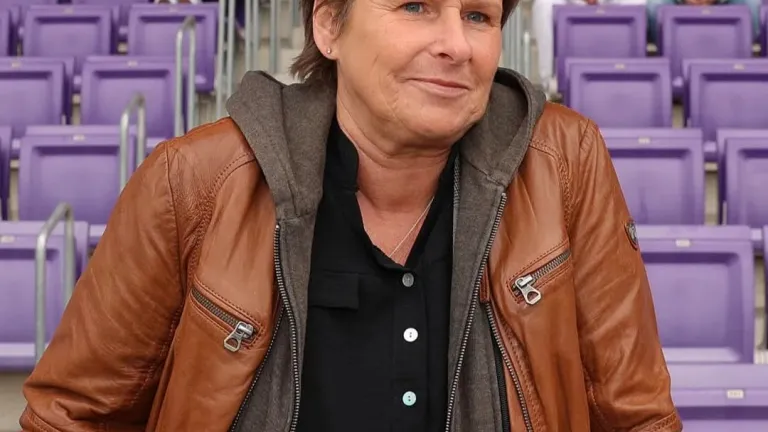
As part of our Focus: Women in Football campaign, we recently spoke to Anna Ressmann. Besides her role as head of women’s football at FC Mariahilf, she currently sits on the board of the women’s committee of the Vienna Football Association (WFV).
Can you briefly introduce yourself and how you got into football?
My name is Anna Ressmann. I actually got into football through my godfather Rudolf Czech. At the time, he was at St. Rochus, a football club that played in the DSG and also had a league team (youth team). My sister and I played with the boys there a few times. Then at some point Rochus had a women’s team. We were about 17 years old then. We played there for two or three seasons and then I moved to Mariahilf. That was in 2006, and in 2008 I joined the board. I’ve been head of women’s football at Mariahilf since 2011. In 2017, I also joined the women’s committee of the WFV. At the moment I’m responsible for the Landesliga there, so I’m deputy chair of the WFV women’s committee for the Landesliga and responsible for the girls’ leagues.
How many all-female teams are there in Vienna?
Basically, we have three big 11-a-side leagues in Vienna. Unfortunately, the Landesliga, the strongest of the three, only has eight teams this year. The first division has eleven teams and the second division has six. In total there are around 25 11-a-side teams. And then we also have the small-sided teams. That’s another eight, plus a few in the DSG league.
How has this developed in recent years?
There has been little development in the women’s leagues, if anything almost a step backwards. The fact is that we keep losing teams, so the number of teams is stagnating or growing far too slowly. Sometimes there are fewer, sometimes more. The positive thing is that in Vienna we now have three leagues again; until recently there were only two. We hope that more 11-a-side teams will grow out of the Newcomer League and increase the number of teams. But in November I did at least get the latest figures on girls’ and women’s football. And the number of new registrations is rising. Of course there was a clear slump during the coronavirus period. After that, though, you see an increase again. There are now also girls’ leagues: in the spring at least, 30 girls’ teams play in them. These teams didn’t even exist a year and a half ago, and they are the basis for more women’s teams. So there has already been some development. Because I believe that although the general trend is for clubs to lose members in football, the number of female players in Vienna is rising. But we still make up a very small part. Girls and women account for 7% of footballers.
How has women’s football changed in recent years?
I think it has generally improved. More clubs now offer girls’ and women’s football. So something has happened. In terms of spectator numbers, I don’t think much has changed. I don’t know how we compare with the men’s Landesliga, but we’re far below it, and in terms of money too. In the men’s Landesliga the players already get decent pay, while in the women’s Landesliga the players pay a membership fee. Financially, of course, we are far below. Structural problems are still a big difficulty. That’s what we want to tackle now. If you look at how pitches are allocated, so many clubs have no space for girls’ and women’s football. They have ten youth teams, so ten boys’ teams, and two men’s first teams. But then there’s no space for the one girls’ or women’s team? That’s exactly where we want to point out these problems. We want to highlight them together and make them transparent, so that we can then work together on funding that rewards the clubs that do offer the space. Unfortunately, many clubs still prefer to take on a subtenant, because that brings in money directly, or they simply aren’t interested enough.
How important is good youth work to spark a passion for football in more girls?
Yes, that’s important, and it’s something that has clearly improved in recent years. Girls used to play in mixed programmes with the boys. Later, some clubs offered girls-only training. But it was hard for them to keep the girls interested. It was hard to organise friendly matches. And joining the boys’ leagues was really only an option for the better players. And not every club can have the best 10 or 20 per cent of the girls. That’s simply not possible.
Then we sat down with the clubs and looked at which age groups needed it. So last spring we set up the girls’ league. You can already see a strong increase. We started with 17 teams in the girls’ leagues. Those were 17 new teams that didn’t exist before. And now, in the spring, we have 30. Unfortunately, we also found that some teams had to give up. So it isn’t easy there either. But there is a positive development. And the young girls are what matters, they are really the foundation.
You need young talent to produce good players later on. And they have to start as early as possible.
Is there a general tendency for girls to start playing football later than boys?
Yes, definitely. That was also one of the reasons why we set up the girls’ leagues, because on average girls simply start much later. And then you have the problem that when they play against boys, there are a few years of difference in sporting experience. The girls only start at 13, 14 or even 15 and older. You can’t make up the years against boys who started at five, six or seven.
Are there reasons why this is still the case?
There are several reasons. It’s still partly anchored in society that football is a men’s sport, and often people don’t even know which clubs offer football for girls. And also that some clubs simply don’t want girls. Unfortunately, that’s still the case, even though there is an upturn in general.
What role do sponsors and partners play in building and supporting women’s teams, and how can these relationships be strengthened?
Well, in general terms, the Women’s Bundesliga got a sponsor this year. Apart from the Bundesliga, though, there is no women’s league in our regional association that has a sponsor. In the men’s game, for example, the regional cup is supported by a sponsor; the women’s cup isn’t. I don’t know how the individual clubs are doing, whether they already have major sponsors on board or not. But it’s more likely that, if there are any, they are at the Bundesliga clubs. So there is definitely room for sponsors in our leagues.
Perhaps it is also an opportunity for companies to set trends?
Yes, definitely. Take the new London Underground line as an example: it was named after the Lionesses. Internationally, there are some really good examples being set. So if anyone would like to sponsor the girls’ league or the Viennese women’s leagues, companies are very welcome to get in touch.
What other problems are there at the moment apart from financial resources?
Besides the structural problems I mentioned, it’s hard to find volunteer officials. Some girls’ teams can’t find enough players. We have also tried to network with Sara Telek and Kickmit, for example, because they work directly in schools. Clubs can write to Sara, and she comes to training so that they have direct contact with the players. But it all takes a lot of time. Nowadays, of course, you get a lot of new players through social media. But you also need resources and a bit of expertise to look after them. I don’t think you can reduce it to one factor.
What about roles for women off the pitch?
The world of officials is very male-dominated, which is understandable because there are simply so many more male footballers. And in the end, some of those footballers become officials at some point. It’s the same with female footballers, and their number is slowly rising. Hopefully that will also raise the number of female football officials at some point. But as a woman, you do have to ask yourself whether you are really welcome in such a male-dominated field, that’s one thing. As a club, you always have to ask yourself whether you welcome women on the board – unfortunately that’s sometimes not yet the case. Then we also have to look at whether and how we can make women feel comfortable and want to work with us. On the other hand, there are generally just too few footballers who can or want to put in the time to make a difference. I think if a few people say, okay, we want to make a difference now, then it works. But you need a few motivated people. That’s not so easy to find.
What can or must the regional associations do to raise the standing of women’s football?
Well, most of the work in the Vienna Football Association is done by volunteers. What I would actually recommend is many more young people on the board. I’d like to see the structures rejuvenated: most of the players are of an age that isn’t represented on the board at all. I think I’m the youngest member of the board. I’m already in my late 30s, so I’m a long way from my early 20s. There are also only two women on the entire board. We are currently working on a five-year plan for girls’ and women’s football in Vienna. And there will be a joint meeting to work out common goals. There we want to prepare everything we want to achieve in girls’ and women’s football, and also map out a path and develop concepts for how to get there.
What influence do professional female footballers have on change in women’s football?
It has got much better, because when I was young there was simply no one I could identify with. There was nothing on TV or anything like that I could have looked up to as a role model. Things are much better today. If you ask young players, they give different answers about who their role models are, sometimes male, sometimes female, but they are there, and they know the national team players. You saw it in Vienna recently at the friendly against France. The stadium was full, so the potential for enough people to come and watch is definitely there.
Why should girls start playing football?
I still play football myself and have just started again after a break. It’s a team sport that is a lot of fun and gives you a lot back. Playing and training together is something very special and brings joy. The joy you see on a pitch is just incredibly fun. My dream is that every girl and every woman in Vienna can play football. Unfortunately, there aren’t enough clubs for that yet. I’d like everyone to have the chance to play football.